



Klepp, Norway-based aquaculture technology provider AKVA Group saw its revenues for the second quarter of 2024 rise 8 percent year over year to just over NOK 1 billion (USD 93.1 million, EUR 84.7 million), with CEO Knut Nesse confirming the company's best-ever Q2 revenues were largely driven by its Sea Based Technology (SBT) business.
However, delivering AKVA’s Q2 2024 results on 16 August 2024, Nesse said there’s been a lack of growth in the production and supply of Atlantic salmon in recent years that continued in Q2. This indicates traditional farming areas and technologies are “out of capacity” and that an annual supply increase of just 1.5 percent is likely through 2040, according to Nesse.
In addition to slow supply growth, the company has determined through 10 years of data that long production times in the sea are driving higher mortality rates and production costs, making the need for companies to innovate through other strategies a priority.
“If we are to grow more than 1.5 percent, we need to do something on top of [traditional coastal production],” he said. “We still believe that post-smolt is the most likely growth opportunity. If we are to drive growth in the next five to 10 years, we believe that post-smolt is the best investment and ticket to provide some growth.”
Benefits of such strategies, according to Nesse, include fewer sea lice treatments and improved fish health, as well as better utilization of farming licenses, which in turn leads to improved volumes, he said.
“We have delivered many large post-smolt facilities which are working fine, with very good biological performances,” Nesse said, “The way I see it, if you consider the price paid in the last [new volume license] auction – NOK 3,500 [USD 326, EUR 297] per ton – it’s pretty much on par with [post-smolt capex].”
Nesse also shared other strategies AKVA is seeing in the industry, including closed containment production, which is taking time to establish, with long lead times for scaling significant volumes.
Semi-offshore production, meanwhile, will require a new licensing system to generate some momentum, while offshore is also “in limbo” because of the threat of a future resource tax, he said. These issues point back to an effective post-smolt strategy becoming more and more of a priority, Nesse said.
“Our view is that a viable production strategy to reduce the production time in open-sea cage farming will be to apply a post-smolt strategy. That’s the best tool we have today to get down to around nine months in the sea,” Nesse said. “The other production strategy is, of course, to get away from the sea lice, and there, we believe the best available commercial technology is deep farming.”
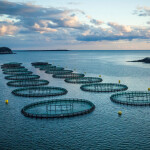
AKVA has delivered more than 100 of its Nautilus deep-farming concept cages to three different salmon-farming companies, which have been organized into 17 sites. AKVA sold most of these cages in the second half of 2024, with a lesser number sold in H1 2024.
“Overall, this is working well. It’s not that you don’t see sea lice, but you see a lot less compared to conventional farming,” Nesse said.
According to AKVA’s Q2 report, the company posted an EBIT of NOK 63 million (USD 5.9 million, EUR 5.3 million)
The group received orders totaling NOK 888 million (USD 82.7 million, EUR 75.2 million) in the period, representing a year-over-year decrease of NOK 952 million (USD 88.7 million, EUR 80.6 million). This was aided by what Nesse called “an acceptable order intake” of NOK 713 million (USD 66.4 million, EUR 60.4 million) in its SBT segment. At the end of the quarter, the company had an order backlog of NOK 2.4 billion (USD 223.5 million, EUR 203.3 million).
AKVA Group's EBITDA increased by NOK 24 million (USD 2.2 million, EUR 2 million) to NOK 110 million (USD 10.2 million, EUR 9.3 million) in H1 2024.
Revenue earned by its SBT segment in Q2 2024 totaled NOK 842 million (USD 78.4 million, EUR 71.3 million), up from NOK 733 million (USD 68.3 million, EUR 62.1 million) a year previously. The segment’s EBITDA and EBIT ended at NOK 106 million (USD 9.9 million, EUR 9 million) and NOK 68 million (USD 6.3 million, EUR 5.8 million), respectively, up from NOK 82 million (USD 7.6 million, EUR 6.9 million) and NOK 46 million (USD 4.3 million, EUR 3.9 million). Its order intake total represented a NOK 23 million (USD 2.1 million, EUR 1.9 million) increase year over year.
SBT’s order backlog at the end of the quarter was NOK 816 million (USD 76 million, EUR 69.1 million), down NOK 1 million (USD 93,144, EUR 84,708) on the same period a year prior.
AKVA's Land Based Technology (LBT) segment's revenues for the quarter were NOK 137 million (USD 12.8 million, EUR 11.6 million), down NOK 37 million (USD 3.4 million, EUR 3.1 million) year over year. Its EBITDA and EBIT ended the period at NOK -1 million (USD -93,144, EUR -84,708) and NOK -4 million (USD -372,440, EUR -338,799), respectively, which were improvements on NOK -4 million and NOK -6 million (USD -558,660, EUR -508,168) in Q2 2023.
The segment’s order intake fell to NOK 149 million (USD 13.9 million, EUR 12.6 million) from almost NOK 1.1 billion (USD 102.4 million, EUR 93.2 million) previously, while its order backlog was reduced to NOK 150 million (USD 14 million, EUR 12.7 million) compared to NOK 162 million (USD 15.1 million, EUR 13.7 million) last year.
The high order intake in Q2 2023 was related to AKVA securing a post-smolt contract with Cermaq Norway.
While the market for land-based is still slow and AKVA has not been awarded any new significant contracts so far in 2024, Nesse said the expectation is that LBT’s margins will gradually improve throughout the rest of the year and into 2025. He previously told SeafoodSource land-based fish farming is at an inflection point, on the verge of market acceptance and growth.
Revenues for AKVA’s Digital (DI) segment amounted to NOK 35 million (USD 3.3 million, EUR 3 million) in Q2, which was NOK 2 million (USD 186,111, EUR 169,313) more than in Q2 2023. Its EBITDA and EBIT were NOK 5 million (USD 465,162, EUR 423,193) and NOK -2 million (USD -186,111, EUR -169,313), respectively, while its order intake fell NOK 63 million (USD 5.9 million, EUR 5.3 million) to NOK 26 million (USD 2.4 million, EUR 2.2 million).
Nesse said he expects salmon prices to remain strong this year, driven by reduced supply, and that there will be a normalization of the post-smolt market in Norway in the second half of the year. As such, the company is aiming for a minimum revenue for the year of NOK 3.6 billion (USD 334.9 million, EUR 304.7 million), which would represent 5 percent growth on last year and a profitable EBIT of 4 percent to 5 percent year over year.
Nesse said that going into 2025, the company expects a minimum 10 percent year-over-year revenue growth, with 5 percent growth for SBT, some 30 percent for LBT as more companies explore land-based options, and 10 percent to 20 percent for DI. This should bring a minimum EBIT of 6 percent, he added.
“We have been through quite [a lot of] changes – I call it a real turnaround situation – over the last couple of years. We have been focusing a lot on operational excellence within different parts of the business. We have installed pretty solid cost reduction programs, and we are now planning for scaling the digital and land-based businesses,” Nesse said. “We’re now seeing the first signs that it’s coming together. It’s too early to claim victory, but we think we’re on a good [path] with good momentum and are happy to see progress.”
