



Plans for the development of an NAD 2.5 billion (USD 152.9 million, EUR 131.5 million) Atlantic salmon farm in Namibia have inched closer to reality, as partners of the consortium behind the undertaking recently signed a share underwriting agreement.
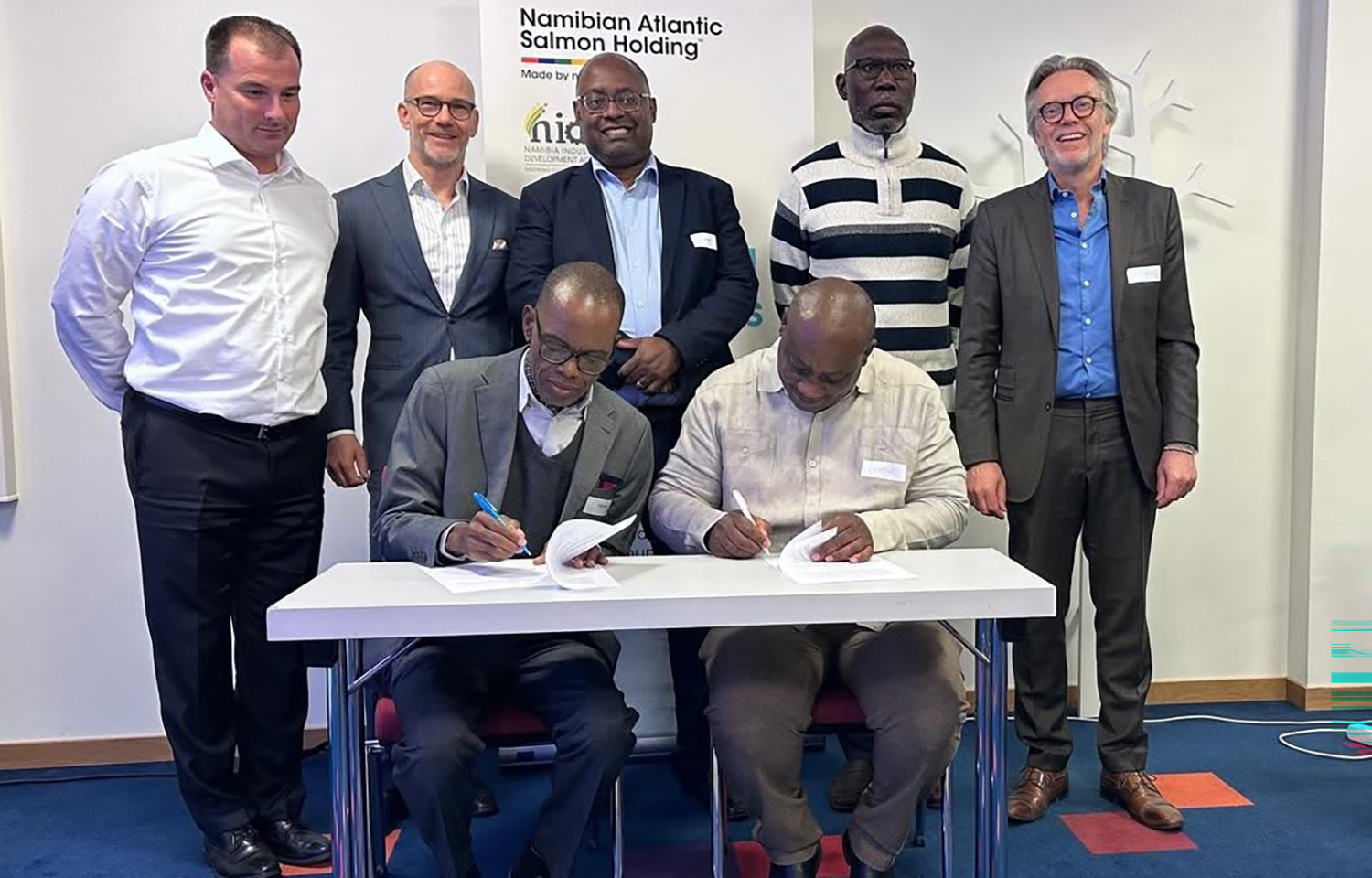
At the end of a seminar on Namibia's burgeoning salmon industry held in Bergen, Norway, representatives from Namibia Atlantic Salmon Holding (NASH), the project's holding company; the African Aquaculture Company (AAC), the operational entity behind the project; and the Namibia Industrial Development Agency (NIDA), a state agency that would hold around 60 percent equity in the project; signed the agreement, progressing upon talks that were held in Windhoek, Namibia, in February.
Additional funding for the venture is expected in the form of loans underwritten with Norwegian export guarantees. Additionally, Namibian financial stakeholders, Norwegian aquaculture specialists, and Nordic investment bank ABG Sundal Collier have also expressed interest in backing the project.
The project, which has been billed as Africa's first commercial sea-based salmon-farming venture, includes three offshore sites off the coast of Lüderitz, a location AAC said takes advantage of “the Lüderitz upwelling cell of the Benguela Current upwelling system."
AAC CEO Helge Krøgenes explained at the recent Blue Food Innovation Summit that these oceanographic conditions closely resemble those found in established salmon-producing regions.
"The temperature profile is 10 degrees Celsius during the summer and about 15 to 16 degrees during the winter – very similar to Chile," he said.
In this location, the project will roll out in phases. An offshore pilot phase with a capacity of 1,000 metric tons (MT) will kick off the project at one of the offshore sites. Then, the project will expand production in 5,000-MT phases, eventually reaching around 51,000 MT, comprising around 17,000 MT from each site.
This phased approach aims to incrementally measure and mitigate environmental impacts, as well as optimize infrastructure and production techniques as it moves along.
AAC is expected to start with five floating pens supplied by Norwegian aquaculture technology firm AKVA group, including mooring, feeding systems, and digital monitoring solutions.
AAC said in one of its project briefs that the Atlantic salmon it intends to raise will be farmed “in a process that mimics their natural life cycle, beginning in freshwater hatcheries and then moving to large sea cages in coastal waters where they are grown to harvest size.”
According to AAC, salmon ova secured from Europe will be reared “to approximately 100-gram smolts at a freshwater facility in South Africa.”
“After undergoing smoltification, the smolts will be transported by truck to Namibia, and at Lüderitz Port, the smolts will be loaded onto boats and moved to net pens at AAC sites,” the firm said.
The salmon, AAC said, will be grown to a harvest weight of 3 to 5 kilograms before being processed in Lüderitz for subsequent supply to the domestic market, as well as the rest of Southern Africa, Europe, and Asia.
The project is projected to generate revenue of EUR 400 million to EUR 450 million (USD 465.2 million to USD 523.3 million) annually, with Namibian government officials touting the project’s anticipated contributions to job creation and making the Southwest African country’s economy more diversified and resilient.
"This initiative is expected to create jobs, strengthen food security, and open new export markets as Namibia moves toward a more diversified and resilient economy," Namibia Deputy Minister for Agriculture, Fisheries, Water, and Land Reform Ruth Masake said.
“As a nation that is committed to economic diversification and industrial growth, we must move beyond traditional harvest-based fishing toward … high-value aquaculture and processing.”
