




The U.S. fishery and aquaculture industries are leaving money on the table, but a collection of investment groups and scientific institutions are working to change that via the recently launched North Atlantic Blue BioTech Summit.
Begun by the Bigelow Laboratory of Ocean Sciences in East Boothbay, Maine, U.S.A., as well as aquaculture investment firm Hatch Blue, the inaugural summit took place on 19 March and brought investors, startups, educators, academics, and more to Portland, Maine, to discuss how biotech solutions can unlock value for the seafood industry.
“This is the first step, for me, of taking this blue biotech opportunity to the next level,” Hatch Blue Co-Founder and Partner Wayne Murphy said.
Murphy said the summit marked one year since he and Hatch Blue Managing Director Tanja Hoel traveled to Maine and went through a “marathon of meetings” as part of Hatch Blue’s mission to find aquaculture investment opportunities in the U.S.
“By the fourth meeting … we really got the sense that blue biotechnology and the amazing resources here in Maine ... could be created into something very valuable,” Murphy said.
Alongside the summit, Hatch Blue and Bigelow Laboratory organized a first-of-its-kind Blue BioTech Studio at Bigelow’s East Boothbay headquarters. Featuring 10 global teams, the studio gave emerging projects from around the world the ability to engage with mentors and potential investors.
“We got applications from Norway, Germany, the U.S., and Canada, and these companies were selected to come here to what I’d like to term the ‘Boothbay boot camp’ where our teams have been locked away for the last two weeks,” Murphy said.
That work culminated in five companies giving a brief investor pitch to the assembled audience, which included major aquaculture investment groups like Hatch Blue, S2G Ventures, Norfolk Green Ventures, and more.
Murphy said the inaugural summit and the studio were both means of answering increased global demand for marine-derived solutions, which is becoming a valuable part of the blue economy.
“There’s an increase in global demand for natural marine-derived solutions in health, food, agriculture, and biomaterials,” Murphy said. “By 2030, it’s projected this whole sector is going to be worth at least USD 15 billion [EUR 12.9 billion] and beyond.”
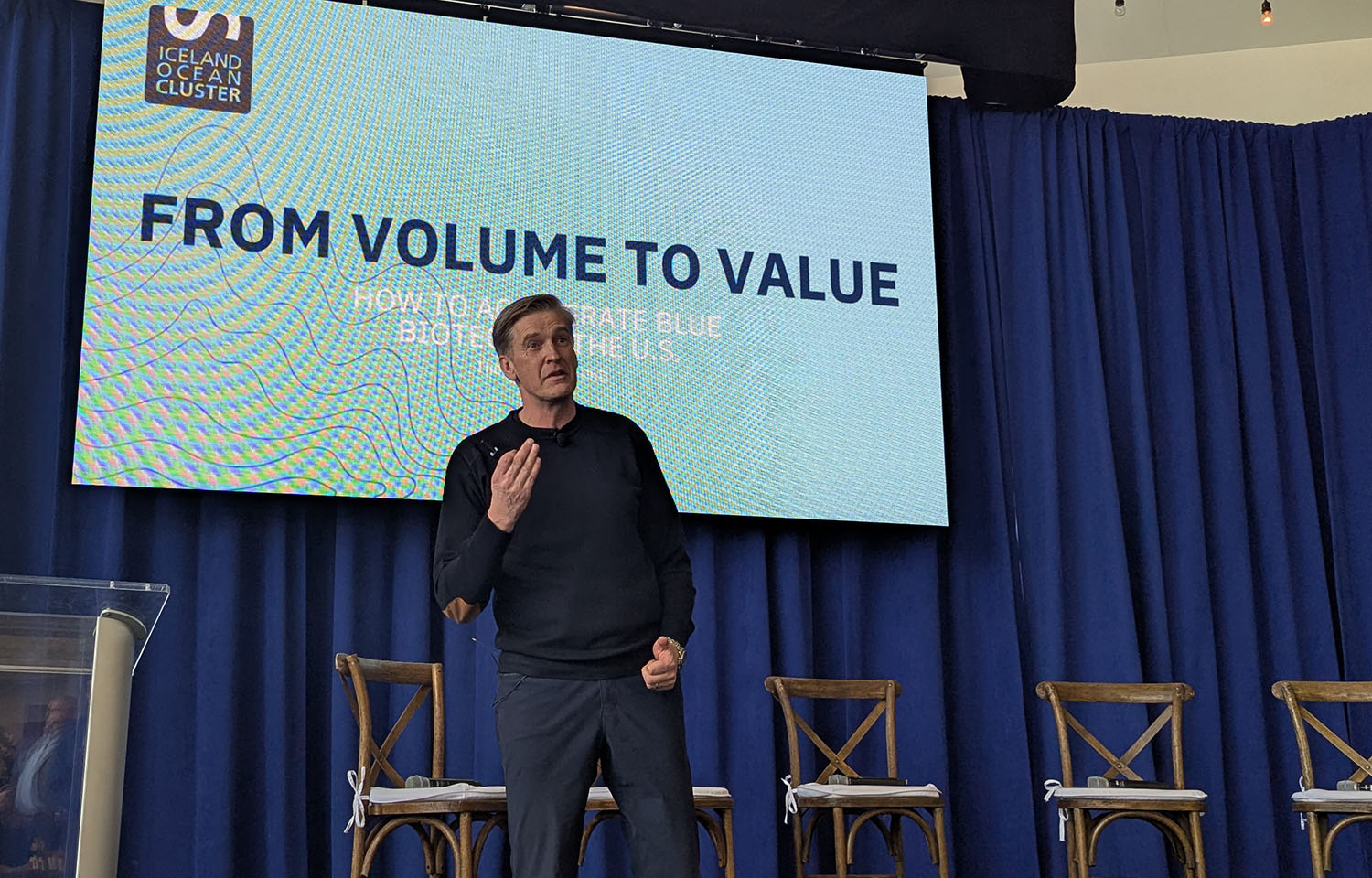
Pharmaceuticals, nutrition, feed supplements, pet food, and more are all a part of that value, but innovation is needed to unlock that growth, according to such speakers as
Sigfusson said the cluster’s efforts have unlocked tremendous value for the country’s cod fishery, improving the value of each singular cod to the nation’s economy from USD 50 (EUR 43) per cod to as much as USD 5,000 (EUR 4,300) per cod.
“This is not a utopian thing; this is happening right now,” he said.
Some of that unlocked value is taking what were once byproducts of the cod industry and turning them into valuable products – and that many of those now-valuable products are the creation of companies that were once small startups.
“We should never underestimate those that are starting at the early stages,” Sigfusson said.
One company, partially started in the Iceland Ocean Cluster, was working on how to turn omega-3 fish oils into a product that could be used for eye health.
That company, called Oculis, is now worth USD 1.4 billion (EUR 1.2 billion) on the Nasdaq stock exchange.
Sigfusson said another newer example was a fish oil plant that was sold for nearly USD 250 million (EUR 215 million) to a fishing company that has begun to move into pharmaceutical-level production of the products.
Yet another example of a successful company is Kerecis, which uses cod skin in biomedical applications for wound treatment. That company was worth USD 5 million (EUR 4.3 million) in 2014 but, by 2023, was already worth USD 1.3 billion (EUR 1.12 billion).
Murphy said opportunities like that are available in the U.S., and Maine in particular is currently the host to the highest concentration of players in the blue biotech sector in the U.S.
“This is why this blue biotechnology that we’ve taken to develop and grow here in Maine is really key in terms of building fertile ground to find innovation,” he said.
Murphy said Hatch Blue has done more than just talk about building the fertile ground, it has also “put its money where our mouth is.” Hatch Blue has 14 blue biotech companies in its portfolio, spanning multiple countries including Singapore and Argentina.
“We see this as an interesting sector married with some innovations and talent and opportunities coming in,” Murphy said. “We want to continue to take that strategy of supporting this sector going forward.”
