




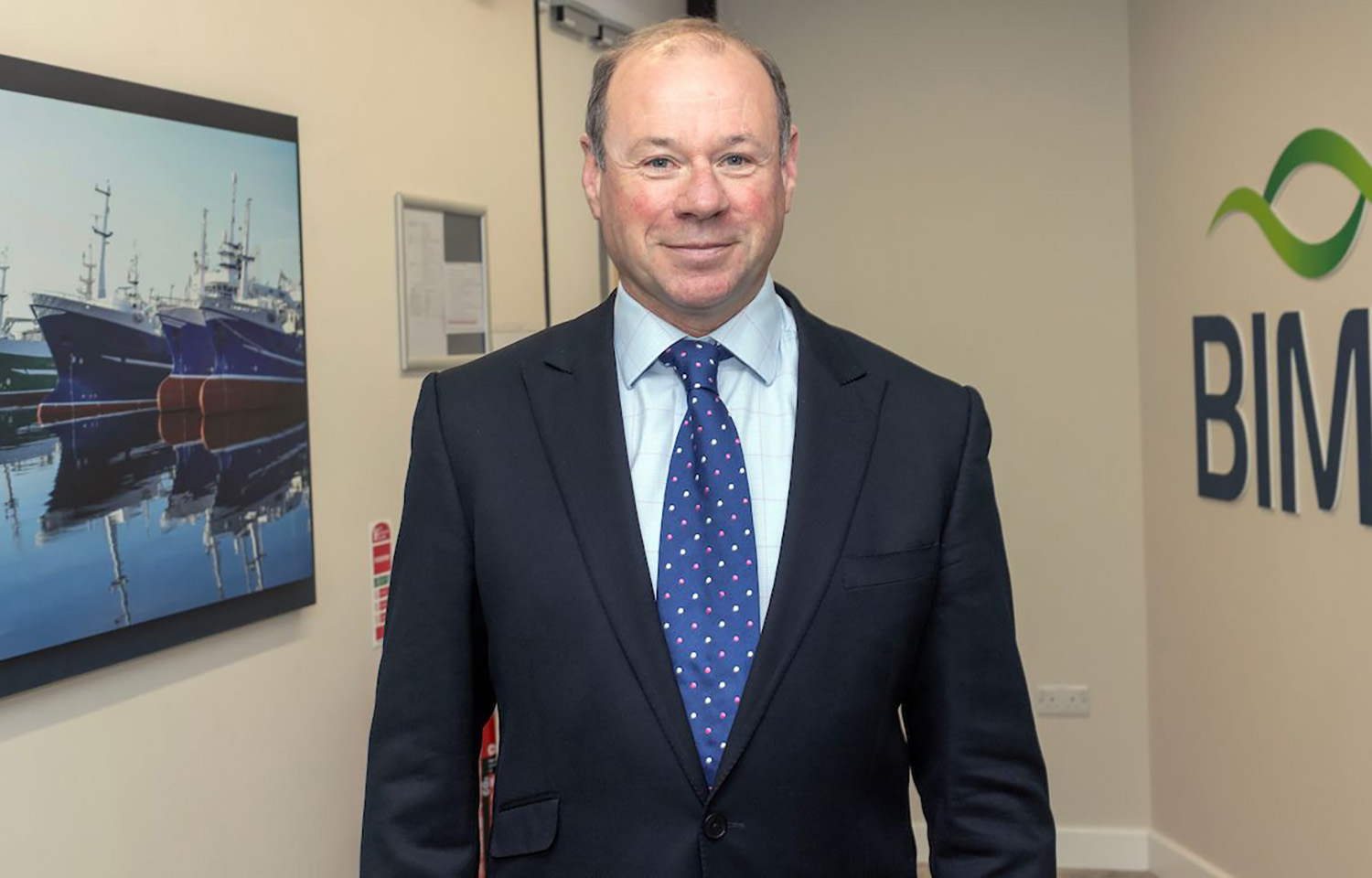
Bord Iascaigh Mhara (BIM), Ireland’s seafood development agency, has appointed Richard Donnelly as its interim CEO.
Donnelly currently serves as the development and innovation services director at the agency and will take on the CEO role starting 10 November, when BIM’s current CEO, Caroline Bocquel, will move on to a new position as CEO at Fáilte Ireland, a national tourism promotion agency.
According to BIM, a competitive process to appoint a permanent CEO is already underway.
“Donnelly has worked closely with a broad range of stakeholders, including industry representatives, government bodies, and research institutions, to drive BIM’s mission of enabling an innovative, competitive, and resilient seafood sector that contributes to Ireland’s coastal communities and national economy,” BIM Chair Aidan Cotter said.
Donnelly steps into the role at a time when the nation’s fishing industry has expressed criticism of BIM and its practices.
The Irish Fish Processors and Exporters Association (IFPEA) has particularly criticized what it says is an overly rosy view of the industry consistently presented by BIM.
“Every report I see from BIM gives the impression the industry is booming and profitability is up,” IFPEA General Secretary Brendan Byrne said, explaining that the industry has, in fact, been struggling due to ongoing impacts of Brexit, which saw Ireland cede quota to the U.K., as well as overfishing of shared stocks by non-E.U. nations.
Byrne said his members now face “unprecedented” challenges as the new year approaches due to potential cuts to mackerel quota in the Northeast Atlantic Ocean recommended by the International Council for the Exploration of the Seas.
“This will lead to factory closures and the loss of 2,000 jobs,” Byrne told SeafoodSource.
He added that as these issues pile up, he sees a “massive disconnect between [BIM] and those of us working in the industry.”
Though Byrne and others have levied criticism against BIM for not highlighting the industry’s struggles, the agency has acknowledged some difficulties, including heavy raw material shortages with which the nation’s processing sector is struggling.
However, BIM stopped short of blaming burdensome E.U. regulations for the shortage like many in the fishing industry have.
“Globally, competition for raw material has increased, pushing up landing prices and eroding processor margins. As a result, landings into Killybegs have become less frequent, while processing costs have risen in parallel with transport, packaging, fuel, and labor costs,” the agency said.
The Irish Sea Fisheries Protection Authority (SFPA) also disputed fishing industry claims that new E.U. requirements for weighing catch and tracing vessels is creating a shortage of raw materials for processors.
Looking forward, the IFPEA has called on BIM to explain how it intends to spend the EUR 7.4 million (USD 8.5 million) increase in its 2026 budget announced recently by Ireland’s government.
BIM told SeafoodSource “it is not in a position to comment” on what it will spend the extra funds on as it is “awaiting official budget allocation for the delivery of its 2026 work program from the Department of Agriculture, Food, and the Marine.”
