



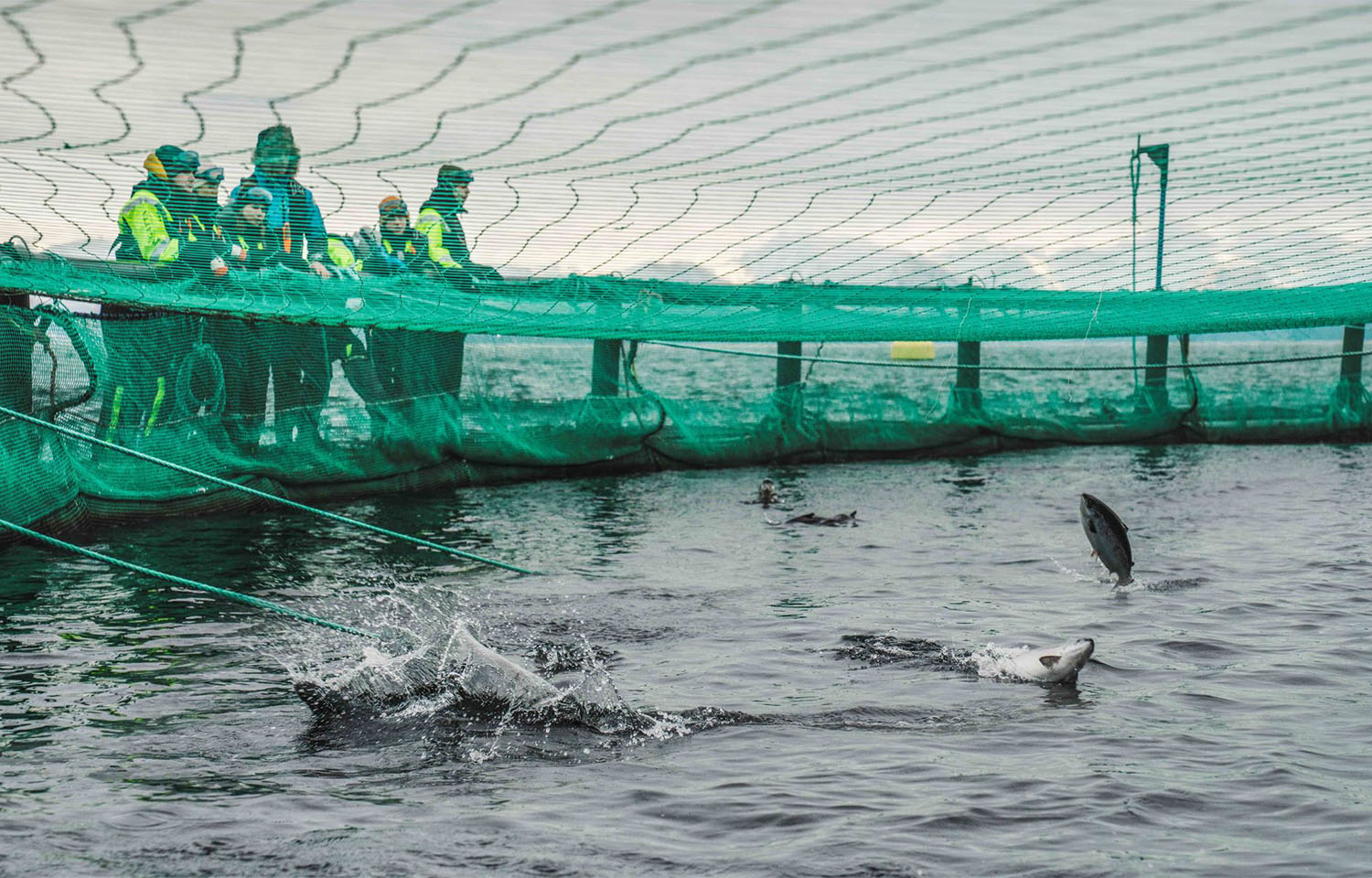
Frøya, Norway-headquartered salmon-farming firm SalMar posted large decreases in operational EBIT in the second quarter of 2025, largely due to the downgraded quality of harvested fish in Central Norway and lower market prices that companies across the sector faced in the period, according to CEO Frode Arntsen.
SalMar Group posted operational Q2 2025 EBIT of NOK 524 million (USD 51.5 million, EUR 44.2 million), down compared to the NOK 1.38 billion (USD 135 million, EUR 117 million) the company recorded in Q2 2024.
Despite the “unsatisfactory” numbers, Arntsen said the quarter also came with “several good signals” that have continued into the third quarter.
“We had a record high number of fish and biomass in the sea at the end of Q2, which will give increased volume in the second half of the year. Also, the superior share is back to normal levels from the third quarter. At the same time, we also see that the cost level is decreasing, which will become apparent later in the second half of the year,” he said.
In total, SalMar Group harvested 64,500 gutted weight tons (GWT) of salmon in the three-month period – up from 44,800 GWT in Q2 2024. However, that came with an operational EBIT per kilogram of just NOK 8.10 (USD 0.80, EUR 0.68) – down from NOK 30.70 (USD 3.02, EUR 2.59) previously.
By farming location, SalMar’s Fish Farming Central Norway operations harvested 33,900 GWT of salmon in the quarter, compared to 27,100 GWT in Q2 2024. The segment generated operating revenues of NOK 2.12 billion (USD 208.4 million, EUR 178.8 million), which was down from NOK 2.66 billion (USD 261.5 million, EUR 224.4 million) previously. The segment recorded operational EBIT of just NOK 7 million (USD 687,000, EUR 592,000), marking a huge drop from the NOK 1.1 billion (USD 108 million, EUR 93 million) recorded in Q2 2024.
Arntsen remarked that it was a “weak result” solely driven by the high proportion of downgraded fish during the period. He added, however, that the biological situation has turned around in the area, and the superior share has increased significantly since July. So far in August, it has stood around 94 percent, he said.
Meanwhile, Fish Farming Northern Norway harvested 20,600 GWT in Q2, compared to 17,000 GWT in the corresponding period of last year. Its operating income totaled NOK 1.33 billion (USD 130.8 million, EUR 112.2 million), which was down from NOK 1.45 billion (USD 142.6 million, EUR 122.3 million) previously.
The group’s Icelandic Salmon segment harvested 4,000 GWT in Q2, which was up from 700 GWT last year. As a result, the segment generated operating revenues of NOK 291 million (USD 28.6 million, EUR 24.5 million), compared to NOK 113 million (USD 11.1 million, EUR 9.5 million) previously.
Arntsen said the Q2 harvest volume in Iceland increased at the end of the period in order to mitigate effects from bacterial kidney disease (BKD) and that this harvest came when market prices were at their lowest – again affecting results.
SalMar Ocean, of which SalMar purchased Aker Capital’s 15 percent ownership stake and became the company’s sole owner in March, recorded Q2 operating revenues of NOK 427 million (USD 42 million, EUR 36 million), compared to no revenues in Q2 2024. However, it posted operational EBIT losses of NOK 75 million (USD 7.4 million, EUR 6.3 million), compared to losses of NOK 30 million (USD 2.9 million, EUR 2.5 million) in Q2 2024, partially due to low average harvest weights and prices.
Its joint venture Scottish Sea Farms, which SalMar co-owns with fellow salmon-farming firm Lerøy, harvested 11,600 GWT in Q2, compared to 12,200 GWT harvested in the same period last year. The Scottish operations reported good biological status in seawater in all regions in Q2, but low market prices, as with other segments, also affected its profitability in the quarter.
Elsewhere in the company, SalMar’s Sales and Industry segment, which sells all the fish the group harvests in Norway, generated operating revenues of almost NOK 6.1 billion (USD 599.8 million, EUR 514.4 million), which was up from NOK 5.9 billion (USD 579.9 million, EUR 475.6 million) previously, while its operational EBIT increased by NOK 538 million (USD 52.9 million, EUR 45.4 million) to NOK 448 million (USD 44 million, EUR 37.8 million).
“The flexible setup in Sales and Industry means that we can effectively handle variations in quantity, size, and quality or what biological [challenges] bring. The [value-added processing] means we can handle much of the downgraded fish ourselves,” Arntsen said. “But, even though we had a high utilization during the period, we were also forced to sell downgraded fish to other processors, which affected our price achievement.”
Meanwhile, in Q2, SalMar announced intentions to acquire the remaining stake in salmon-farming company Wilsgård, which has now been completed as of August, strengthening the firm’s presence in Northern Norway.
Despite the Q2 difficulties, the Wilsgård deal, together with improved biology and increased biomass, has led SalMar to increase its total 2025 harvest guidance by 4,000 GWT to 298,000 GWT. It is now projecting its Norwegian operations to produce 262,000 GWT, Scottish Sea Farms to harvest 32,000 GWT, of which SalMar will receive half, Icelandic Salmon to harvest 13,000 GWT, and SalMar Ocean to contribute 7,200 GWT.
