



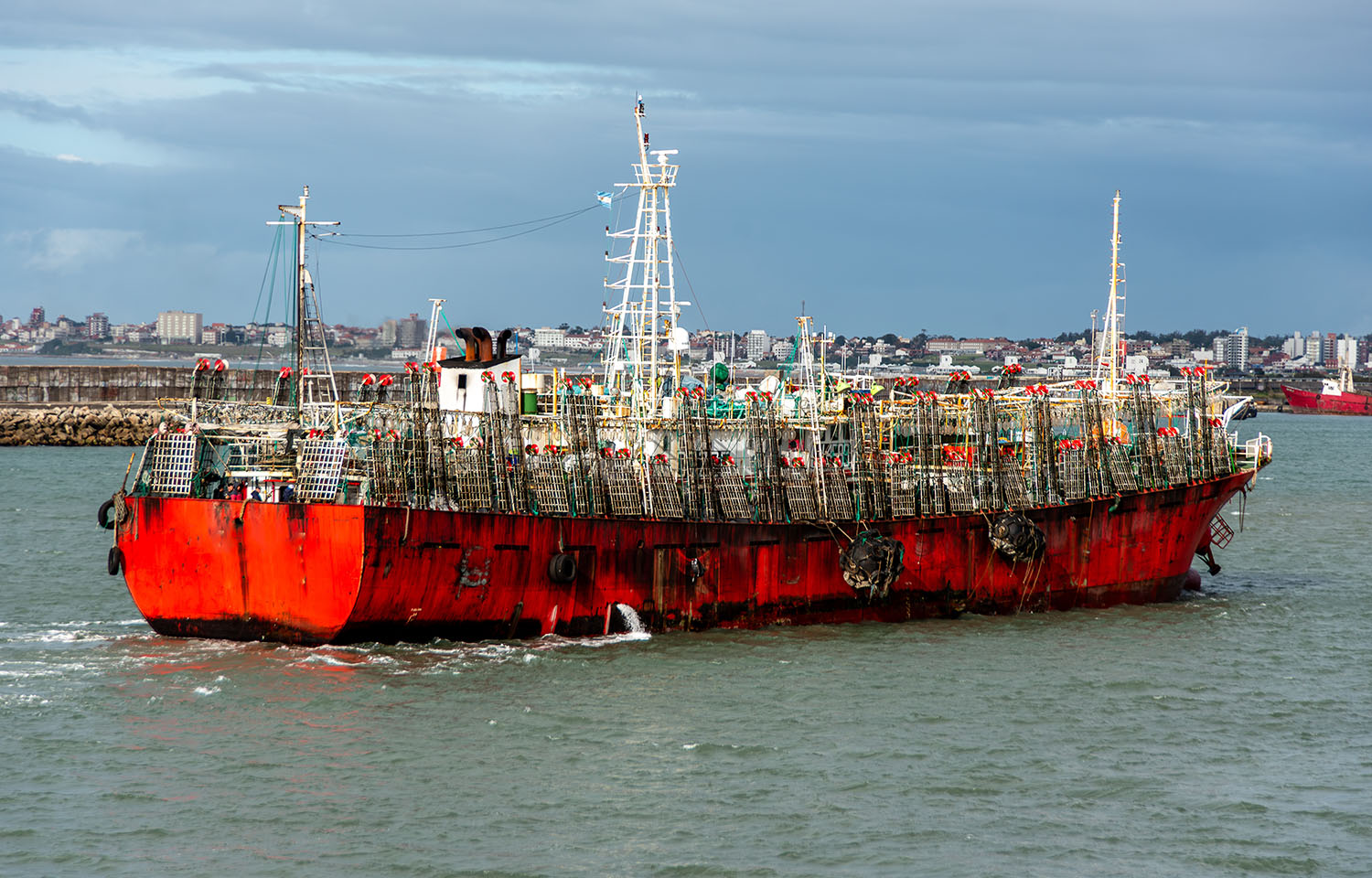
The Environmental Justice Foundation (EJF) said its recently released study on foreign fleets targeting squid near Argentina has reaffirmed a link between illegal, unreported, and unregulated (IUU) fishing and human rights abuses.
The study focused on an area known as Mile 201, just outside Argentina’s Exclusive Economic Zone (EEZ) – and thus just outside regulatory oversight. As squid migrate outside of the Argentine EEZ squid jiggers assemble in the area in huge volumes.
EJF CEO Steve Trent told SeafoodSource that Mile 201 is a generally lawless space, where a lack of regulatory transparency means vessels can stay at sea for months at a time. These conditions exacerbate the vulnerability of crew members to labor rights violations and human rights abuses – and continue to cement the link between IUU and human rights issues.
“The illegal fishing, the unsustainable fishing, the targeting of protected species, that’s happening. Wherever that happens, you tend to have the human rights abuses, and vice versa,” Trent said.
EJF’s research, which drew on satellite data, field research conducted in Mile 201, passport and contract information, and nearly two hundred crew member interviews, suggested that there was a strong likelihood that the unregulated nature of Mile 201 enabled other serious crimes – especially within the Chinese squid jigging fleet, which has increased its fishing effort in the area dramatically in recent years.
“There’s a lot of data there, and more coming all the time,” Trent said. “And the one thing I can say is these aren’t isolated events. In every geography, in every jurisdiction, across every company, and almost every vessel that we’ve identified to investigate, we are seeing the same crimes.”
The EJF has performed a number of studies on distant-water fleets similar to the Argentine squid fleet. A report in 2024 identified human rights issues connected to IUU in China’s distant-water fishing fleet in the Southwest Indian Ocean, and past studies by the EJF found declining stocks contributing to IUU are also a warning sign for human rights issues.
Trent said in the Argentine squid fishery has continued that pattern and crew members, especially in the Chinese fleet, described being regularly physically abused by their vessel leadership. Others experienced serious labor rights violations such as being forced to work until they could no longer stand, and being routinely underfed. One man spoke of working in his vessel’s freezer for 18 hours straight as his hands ached, and said when he took off his gloves, he had severe frostbite, which ultimately resulted in the loss of half his fingers.
The EJF report also documented numerous instances of animal abuse and illegal hunting of protected species.
Trent said that it was no surprise – given the unregulated nature of the area and the harsh nature of the work onboard – that both vessel leadership and crew members were engaging in “opportunistic” attacks on wildlife such as seabirds, seals, sharks, and turtles.
It wasn’t clear yet, he said, how these animals were being used. Some animal products, like shark fins, were likely being sold on the black market by captains or other vessel leadership. Other objects, like seal teeth, might be sold by crew members to supplement their incomes.
“It’s very often specifically directed by the captain. He wants that product, it’s a side income for him. Sometimes you will have protected species and non-target species who are targeted by crew. And that can be [for] anything from feed through to their own cultural interest. So it’s not like it’s always the captain” Trent said. “You can make the case that the captain is facilitating and allowing it. “
Trent said it’s also possible crew members are hunting wildlife and threatened species to supplement their diets given the nature of labor abuse on board.
“It’s absolutely the question we’ve been asking. And again I think there probably is [some hunting happening], but we need to go deeper, we need to get the data sets, we need to get the proof,” he said.
Relatedly, Trent said that there is “a growing data set that I really want us to investigate closer, that is about illnesses that are driven as a result of malnutrition.”
While identifying medical histories can be challenging, since crew members often use different colloquialisms than their interviewers, Trent said that the EJF had developed a data set on malnutrition through secondary investigations of claims made in crew member interviews.
He said that many crew members spoke of an illness they called ”Beriberi.”
“It’s more likely Scurvy,” Trent said, adding that a next question for EJF researchers is how many crew member deaths are enabled by such malnutrition.
“My brief to the [EJF research] team is ‘don’t smooth this over’,” Trent said.
He said the investigation into the Argentine squid fishery is critical due to the massive uptick in its size and effort in recent years – which presents both environmental and labor rights concerns.
“Squid is a highly vulnerable species, [which can] be overfished easily. In one season, you can see it collapse,” he said. “So what we’re trying to do is get the data set on that … across the fishery [to show] that it’s structural, that you have the human rights abuses, and the illegal, unsustainable, unregulated fishing.”
For these reasons, EJF is pushing for more transparency and regulation in the Argentine squid fishery, as well as urging squid-consuming nations to boycott products from national fleets – like that of China – that are highly correlated with abuse.
“It’s the reason we got involved in this quite arcane fishery. [Squid] isn’t a charismatic mega fauna that everyone loves. [We got involved with squid] because we see it as something that really is undermining the architecture of marine system sustainability. If you care about sharks and … dolphins and tuna, it’s a problem,” Trent said. “If you care about the people who are in this industry who are supporting it and working in it, it’s a problem. [Squid] ticks all the boxes.”
