






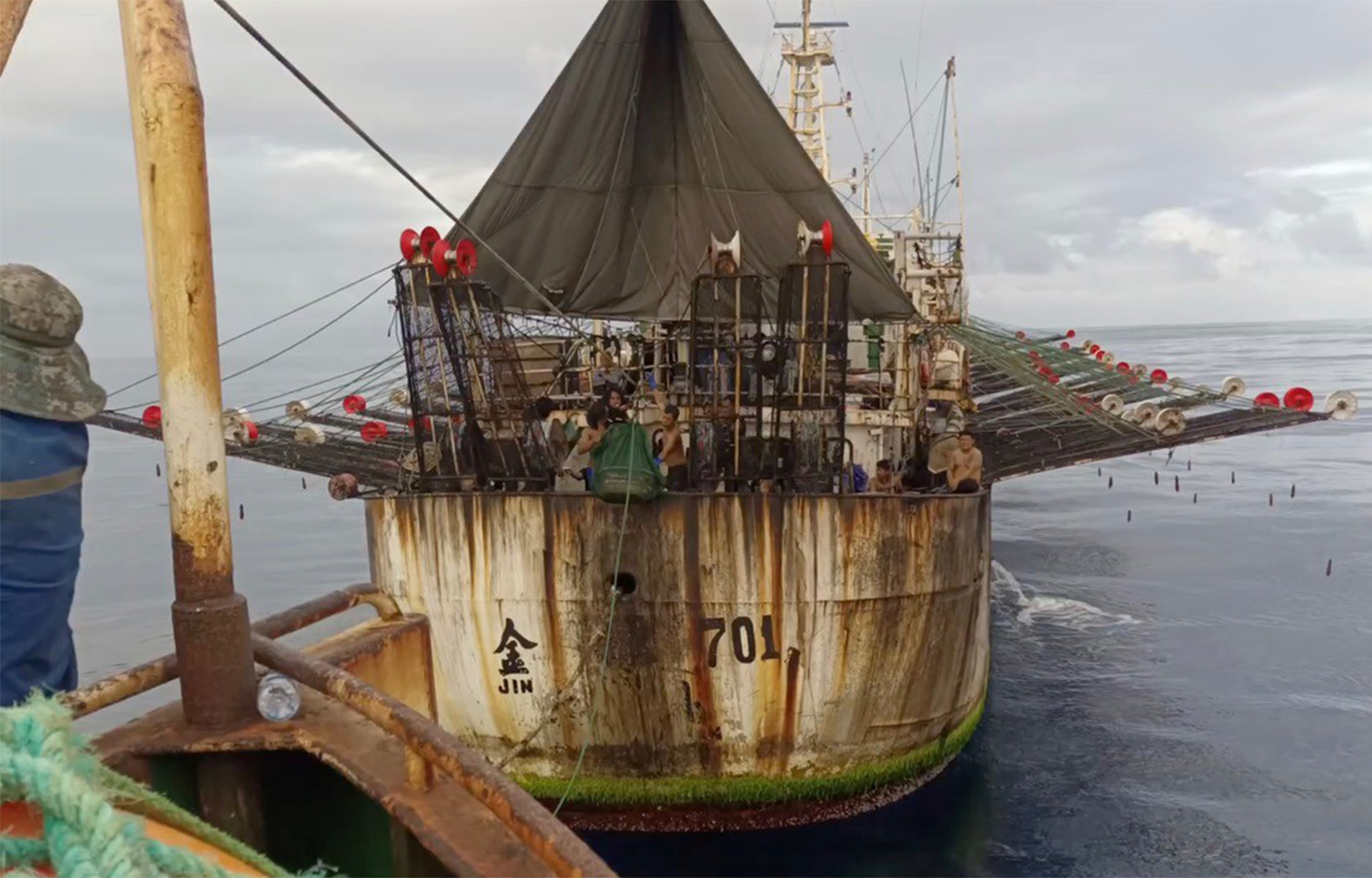
One of the world’s most important squid fisheries is approaching a critical tipping point, according to an investigation by the Environmental Justice Foundation (EJF), with the NGO warning that weak governance, opaque supply chains, and an expanding distant-water fleet are pushing the Southeast Pacific jumbo flying squid fishery toward ecological and social crisis.
The report, “Unseen and unaccountable: The growing threat of China’s squid fleet in the South Pacific,” argues that inadequate regulation by the South Pacific Regional Fisheries Management Organization (SPRFMO) has allowed industrial fishing pressure to escalate in the Southeast Pacific – raising risks not only for marine ecosystems but also for global seafood supply chains. The report came as recent meetings of the SPRFMO brought heavy criticism from member states after weeks of negotiations resulted in only slight reductions in the number of vessels authorized to participate in the fishery and little additional oversight.
EJF Director of Squid Fisheries Dominic Thompson said that fishing pressure on jumbo flying squid has been steadily increasing in recent years and may have already peaked, leading to an increased likelihood of ecological collapse without improved governance.
“This is also the world’s largest squid fishery, accounting for 42 percent of global squid landings in 2023. While landings have increased year over year, evidence suggests biomass may have peaked around 2010. Reports submitted to SPRFMO show significant declines in catch rates; Chile reported a 52 percent decline in 2025 alone,” Thompson said.
At the center of the report is China’s distant-water squid fleet, which dominates fishing activity across the Southeast Pacific high seas.
“China’s squid fleet in the Southeast Pacific is vast and highly industrialized. Over 500 squid jiggers operate across the region, responsible for 99 percent of squid jigging activity there,” Thompson said.
In 2023 alone, the fleet caught nearly 500,000 metric tons (MT) of jumbo squid.
The investigation describes a tightly integrated supply chain built around at-sea transshipment and large-scale processing hubs in China.
“Operations are highly consolidated,” Thompson said. “Catch is transshipped at sea to refrigerated cargo vessels, transported to China – primarily Zhoushan – and aggregated, processed, and exported globally. This consolidation severely undermines traceability.”
Despite the fishery’s global importance, the report argues that governance remains dangerously underdeveloped.
“The regulatory environment is deeply inadequate,” Thompson said. “There are no catch limits, no effective bycatch regulations, and no protections for marine mammals. SPRFMO lags behind other RFMOs in adopting even basic conservation and management measures.”
He explained that “a core enabling factor” is the lack of transparency, particularly through the fleet’s use of at-sea transshipment, opaque ownership structures, and weak port controls.
EJF’s investigation also found that regulatory tightening in one country simply pushes risky vessels to neighboring ports.
“As Peru strengthened port monitoring requirements, high-risk vessels shifted operations to Chile,” Thompson said. “Our investigation documented nine vessels with abuse allegations using Chilean ports in 2025.”
EJF also found that vessels frequently operate across multiple oceans, further complicating oversight. Thompson said the EJF investigation found that 126 Chinese-flagged squid jiggers operating in the Southwest Atlantic are also registered on the SPRFMO vessel list.
On top of the questionable sustainability and traceability of the massive squid fleet, the EJF investigation also found evidence of labor rights issues and illegal fishing during its analysis, which gathered testimonies from crews working aboard squid vessels.
EJF interviewed 81 fishers from 60 Chinese-flagged vessels and found widespread reports of abuse and illegal fishing practices. More than half of respondents reported physical violence on board, while six indicators of forced labor were recorded at prevalence rates exceeding 90 percent. Fishers also described widespread shark finning and the deliberate killing of marine mammals.
The working conditions for fishers are compounded by the structure of squid fishing operations, which often involve long deployments far from port. Thanks to the ability to transship catch many vessels remain at sea for up to two years at a time, leaving crews effectively isolated and unable to report labor abuses.
That prevalence of abuse coupled with a lack of sustainability raises concerns for seafood buyers in major importing regions, including the United States, the European Union, and the United Kingdom, Thompson said.
“The opacity of China’s fishing operations in the South Pacific, coupled with the extensive use of at-sea transshipment and an extremely efficient processing industry which incentives aggregation of squid supply, make it almost impossible for seafood buyers to say for certain their product is not tainted by abuse,” Thompson told SeafoodSource. “Tainted squid from vessels engaging in either fisheries or labor abuse can easily be mixed with legitimately caught squid throughout the supply chain, compromising the entire supply. Seafood buyers from the E.U., U.S., and U.K. should demand that Chinese squid suppliers work to disaggregate squid supply chains as much as possible to ensure more robust supply chain scrutiny and traceability.”
Trade transparency is further complicated by how squid products are classified in international trade statistics.
“The lack of species-specific HS [Harmonized System] codes means that trade analysis for squid is extremely inaccurate,” Thompson said. “This is because all squid species are aggregated together and combined with cuttlefish too. The only differentiation comes from whether the product is fresh or frozen.”
The problems aren’t without solutions, according to the EJF. Governments can call on the World Customs Organization and its Harmonized System Committee to disaggregate squid species and give them their own HS codes.
At the same time, seafood companies can take proactive steps to identify and scrutinize risks in their supply chain and limit their exposure to fisheries and labor abuses, Thompson said.
“These include demanding supply chain traceability down to the individual catching vessel, demanding that vessel owners/fleet operators install CCTV on catching vessels, demanding that catching vessels do not stay at sea for more than one year at a time, demanding that vessels have WIFI installed and a grievance mechanism put in place so that crew can alert the authorities if they are being abused, demanding that all transshipments have full human observer coverage alongside electronic systems such as cameras,” he said.
Of all changes, potential measures simply restricting transshipment at sea could be one of the most effective ways to improve oversight, Thompson said.
“This would go a long way to reducing the risks. This is because at-sea transshipment serves as such a powerful enabler of opaque fishing practices,” he said. “At-sea transshipment really does facilitate the abuses because vessel captains know that no one is going to scrutinize what they do onboard their vessel for up to two years at a time.”
Meanwhile, from a trade perspective, stricter import controls would likely send shockwaves through China’s squid supply chains and demonstrate that efforts to consolidate and aggregate squid supply chains are not proving as cost effective or strategic as intended, Thompson said.
“It would quickly disincentivize the current detached beneficial ownership models and, instead, spur the individuals reaping the profits from these vessel operations to take the compliance of their vessels much more seriously. Fleet operators would also be incentivized to disassociate from vessels with a known track record of engaging in fisheries or labor abuses, further incentivizing compliance and acting as a powerful deterrent against further infractions at sea,” he said.
Despite the severity of the situation, EJF maintains the fishery can still be stabilized if governments act quickly.
“Transparency in fisheries is achievable, can be implemented at little to no cost, and can have almost immediate results. Peru’s new regulation has proven itself as an effective tool to screen out high-risk foreign vessels and prevent them from encroaching into Peruvian waters,” Thompson said. “This crisis is solvable. The tools exist. What is missing is political will.”
