





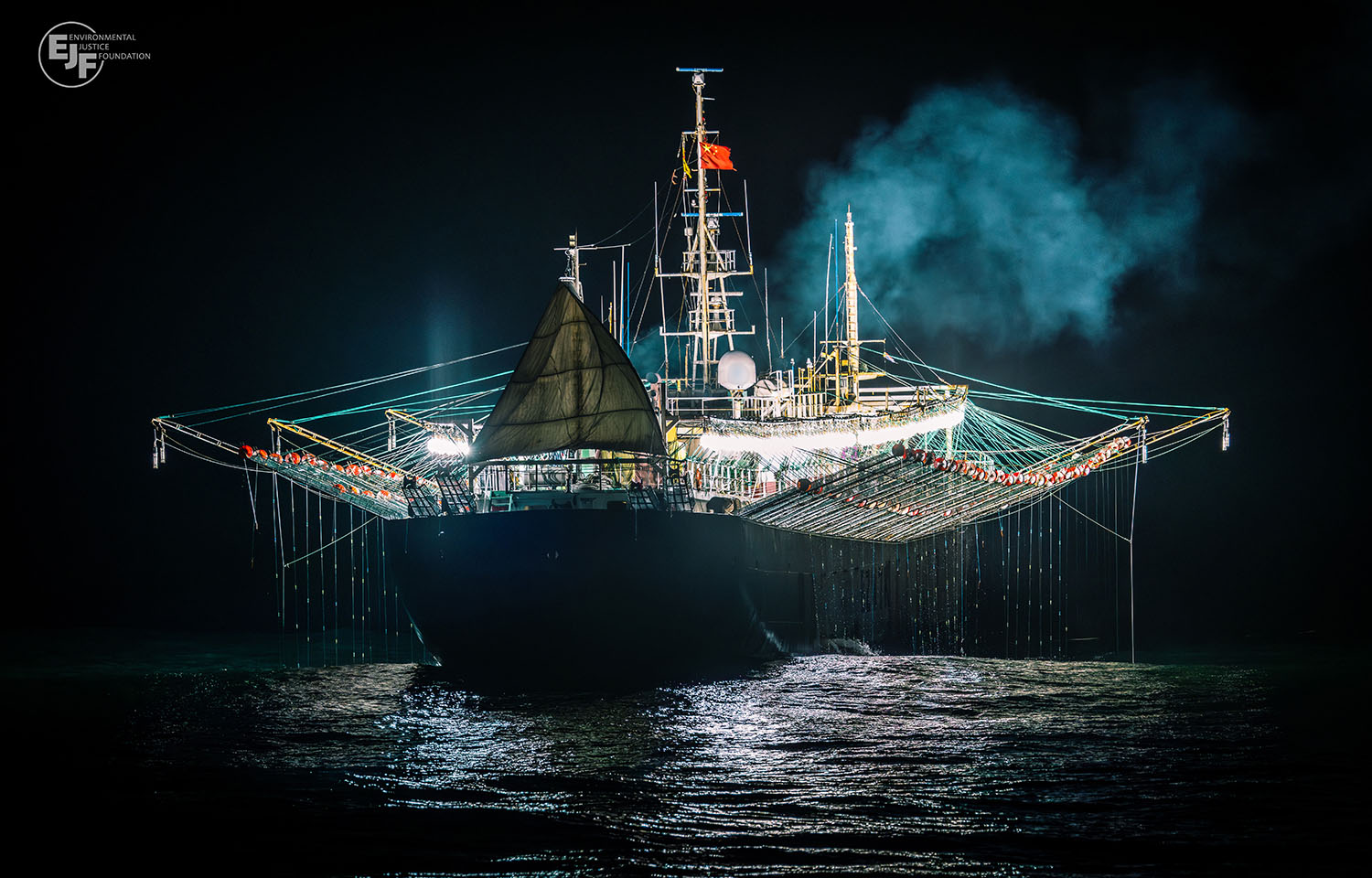
A new report from the Environmental Justice Foundation (EJF) alleges the Southwest Atlantic Argentine shortfin squid fishery is being threatened by lax regulations that enable overfishing, human rights abuses, and marine wildlife abuse.
The EJF report, the result of a five-year investigation conducted between 2019 and 2024 into conditions in the fishery places the blame for many of the issues it identified with the Chinese squid jigging fleet. According to the report, the fleet has increased its fishing efforts in an area known as ”Mile 201,“ where squid from the fishery can be accessed just outside Argentina’s Exclusive Economic Zone (EEZ), by 85 percent over the period studied.
The report said each year Mile 201 sees the convergence of hundreds of vessels targeting squid migrating from Argentina’s coastal waters into the high seas.
EJF said squid fisheries worldwide are currently under pressure thanks to growing demand for new seafood species, in part caused by the overfishing and depletion of popular finfish species. According to the study fishing efforts targeting squid increased by “nearly 70 percent” between 2017 and 2020. Unlike other fisheries such as tuna, which have long-established regional fishery management organizations (RFMOs,) squid often lacks any regional management or regulatory oversight.
The Southwest Atlantic squid fishery currently has no science-based catch quotas or harvest limits in place. Such unregulated fisheries, outside of the EEZs of various nations, make up about 86 percent of the global squid fishing effort, the report said.
Due to the lack of regulations, fishing pressure on the stock is high. EJF said fishing pressure outside the well-managed fishery in the Argentine EEZ is four times higher than within it, and overfishing is causing problems. That has implications for Argentina’s economy, as squid is central to both the regional ecosystem and the Argentine economy.
“Without urgent action, we are heading for disaster,” EJF CEO and Founder Steve Trent said.
Squid occupy intermediate positions in ecosystem food chains, serving as both predator and prey for other species. In the case of the Argentine shortfin squid this means that the animal “sustains dolphins, seals, whales, seabirds and commercially valuable fish such as hake and tuna.”
“At the same time, squid underpin food security and economic resilience in many coastal communities and national economies, as a target catch for small-scale and local industrial fisheries and source of fishing license revenue for coastal state governments,” the report said.
EJF said the lack of management causes more than just sustainability concerns. Because there is no set quota, vessels stay at sea and fish for very long periods of time without ever going to port where they would come into contact with authorities. They do this by delivering their catch to reefer vessels and being serviced by at-sea refueling ships.
“All kinds of controls – navigation security checks, health controls, working conditions, catch, etc. – are being avoided by staying at sea for [so] long,” Argentine Coast Guard Captain Sergio Almada said.
The lack of transparency means that squid vessels, in general, are associated with a high risk of forced labor. Through its research and interviewing, crews detailed “extensive human rights abuses” on board vessels, including violence, intimidation, excessive working hours, and wage deductions.
EJF said it has presented its report as a warning to leading squid-consuming nations, noting that given the fact that Argentine shortfin squid provides a sizeable share of the global squid catch (12.2 percent in 2023), there is a high risk that squid from the fishery, “associated with the use of forced labor and/or illegal or cruel fishing practices” are ending up in U.S., E.U., and U.K. markets.
Along with threats of forced labor, the lack of transparency also results in the threat of illegal, unreported, and unregulated (IUU) fishing, along with the abuse of often protected wildlife – such as the mass killing of seals and shark finning.
The EJF confirmed via both interviews and photography the potential for harm to marine wildlife from squid jiggers. A number of interviews with fishers drew reports of fur seal harpooning and shark finning, as well as other harmful practices that affected marine life, particularly on Chinese vessels.
Workers reported that seabirds, including giant petrels, albatrosses and Megellanic penguins were sometimes caught after being entangled in lures. They said that while attempts were usually made to throw the birds back, they were sometimes seriously injured.
The report said it used AIS location data provided by Global Fishing Watch, as well as extensive field research during squid migration periods comprising numerous interviews with scientists and fishers working in the fishery – including 165 Indonesian squid jiggers and 4 Filipino squid jiggers who had previously worked on board Chinese, South Korean and Taiwanese vessels.
EJF said that the AIS location data provided key insights but was limited by the fact that not all vessels are tracked via AIS data, nor are all AIS messages recorded in the database for various reasons, including lack of connectivity. EJF said that this meant that while some apparent increases in fishing effort might be due to greater data connectivity, it was likely that AIS data underreported rather than overreported fishing efforts in the Southwest Atlantic shortfin squid fishery.
It also drew on data from the Outlaw Ocean Project’s Bait-to-Plate database, various lists of national fleets, scientific stock assessments of the Argentine shortfin squid, reports of Fishery Improvement Projects (FIPs), Sea-web maritime ships database, trade data from UN Comtrade, Eurostat and TradeDataPro, and scholarly studies pertaining to the fishery.
