






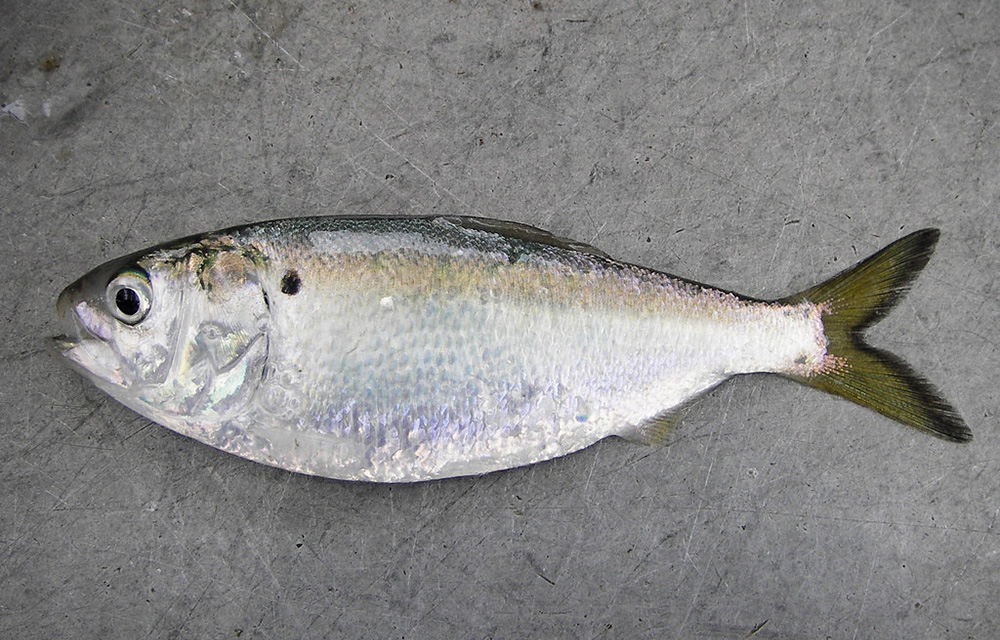
The Atlantic States Marine Fisheries Commission (ASMFC) decided not to take any immediate action on the Chesapeake Bay menhaden fishery at its summer meeting, instead moving to take up the issue at their Winter 2026 meeting.
Conservation NGOs have long criticized management of the Chesapeake Bay menhaden fishery, arguing that removing baitfish like menhaden from the ocean hurts other fish like striped bass and deprives prey from area ospreys – claims which have been disputed by commercial fishing interests. CBF has argued that regulators need more data in order to properly manage the species and ensure commercial fishing isn’t negatively impacting other species, but efforts to fund studies within the Virginia state legislature failed due to disagreements over methodology.
“There are clear signs of peril in the Chesapeake, and menhaden are one of the connecting threads. It’s been a year since the Commission first took notice of these concerns, yet any potential for further action has been delayed again,” Chesapeake Bay Foundation (CBF) Virginia Executive Director Chris Moore said in a statement on the vote.
On the other side of the issue, the Menhaden Fisheries Coalition has accused the CBF of spreading misinformation and urged regulators to maintain allowable catch levels and base their management on “sound scientific principles.”
“Too often during public meetings on fisheries management, the voices of those of us who work directly in the menhaden fishery – and whose livelihoods depend on it – are dismissed as self-serving and frequently perceived as the ‘bad guys,’” UFCW Local 400 members wrote to ASMFC earlier this year. “We are vilified by special interest groups and verbally threatened at-sea and online.”
The commercial menhaden fishery is largely harvested by Ocean Harvesters, which provides its catch to Reedville, Virginia, U.S.A.-headquartered Omega Protein – which is owned by Canada-based seafood giant Cooke since its acquisition by the company in 2017. Some opponents of the menhaden fishery have seized on foreign ownership of Omega Protein as a main point of criticism; in July, a mysterious campaign calling itself “Make America Fish Again” popped up with a petition calling for an end to “industrial fishing for forage fish in the Gulf of America and Atlantic Ocean” and “foreign exploitation.” The campaign website includes no information about its organizers and, as of publication, the petition had 39 signatures.
The ownership of Ocean Harvesters was also the subject of a lawsuit claiming the company was in violation U.S. foreign ownership laws due to its connections to Cooke.
As part of its efforts to get a handle on the debate over menhaden, ASFMC established a working group in August 2024 to evaluate actions, meeting nine times over several months to develop a report for the regulatory body.
“Moving forward with such actions without investigating whether there are, in fact, fewer menhaden in the Bay or whether the fishery has any impact on osprey, risks gravely impacting a more than a 150-year-old industry and hundreds of jobs while doing nothing to improve the osprey situation,” Omega Protein Senior Scientific Advisor Peter Himchack wrote to the board. “The menhaden fishery is managed in the most conservative manner in its 150 year or so history, and the reduction fishery is operating at its lowest sustained levels – in the Bay and overall – for as long as we have reliable records (i.e., since the 1950s). Precaution is already the policy.”
Despite growing demand from conservation NGOs and others for action on the issue, the Atlantic Menhaden Management Board voted 7 August to push back any decisions until its Winter 2026 meeting in February. In the intervening weeks, the Plan Development Team will further develop options for distributing reduction fishing effort throughout the season, potentially relieving fishing pressure concentrated on the summer months.
“The Chesapeake’s fisheries and predators can’t wait. Menhaden are key to a thriving Chesapeake Bay, and a healthy, productive Chesapeake is vital to the entire Atlantic coast. We appreciate the efforts of those on the ASMFC menhaden management board who have worked to keep this important issue at the forefront,” Moore said in a statement. “One foreign-owned company consistently prevents progress in Virginia, and now coastwide at the ASMFC. While it’s encouraging that the ASMFC will continue working on this important issue over the coming months, the Chesapeake Bay is running out of time.”
The continued opposition to menhaden fishing in the Chesapeake comes as a study of predator-prey dynamics by the University of Southern Mississippi found oceanic predators tend to have a widely varied diet and no single species – like menhaden – is the dominant part of their diets.
