




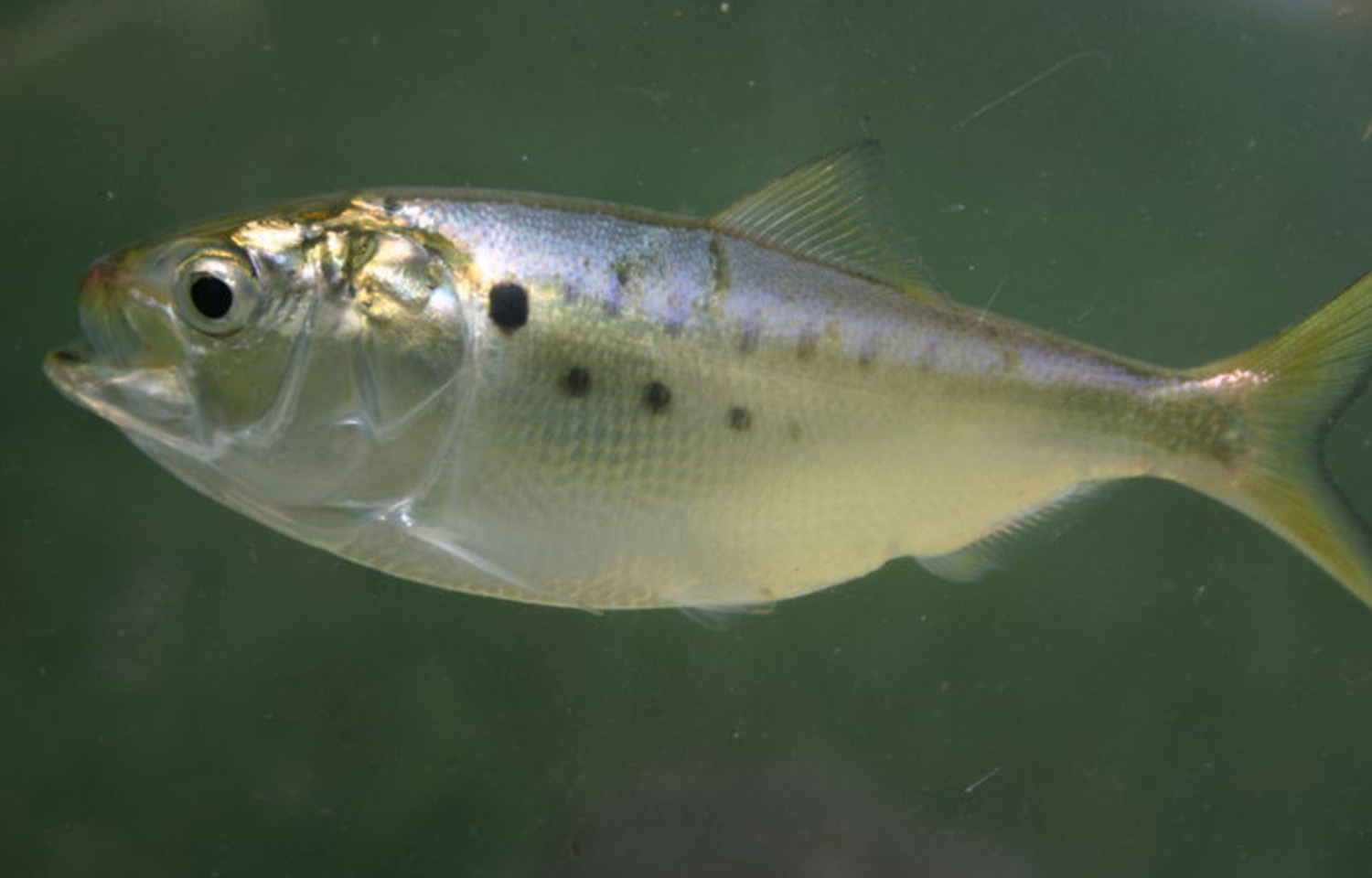
As debate over the sustainability of the menhaden fishery in the Chesapeake Bay continues between the fishing industry and environmental groups, the Science Center for Marine Fisheries (SCEMFIS) has funded a new project that will create a detailed roadmap for managing reduction fishery more effectively.
SCEMFIS said in a release the new project will feature scientists from Chesapeake Biological Laboratory, the University of Maryland Center for Environmental Science, Virginia Institute of Marine Science, and NOAA and aims to establish meaningful harvest caps for Atlantic menhaden in the bay. The project will review existing menhaden science – including estimated biomass, migration patterns, and the consumption of menhaden by other species – and find gaps in information that can be filled via more research.
SCEMFIS said the goal is to establish a fishing quota that is tailored to the Chesapeake Bay. Currently, the area is subject to a 51,000-metric-ton (MT) harvest cap, which is based on average landings of menhaden from 2012 to 2016, but that total “is not a biological reference point and, thus cannot, by itself, inform managers about the status of the portion of the stock within the bay or the potential ecological impacts of harvest on other species.”
The current cap is intended to be a precautionary interim limit, and the new project will identify what new research is needed to determine a maximum sustainable yield taking the environment of the Chesapeake Bay into account.
“The roadmap is intended to be practical and actionable, leveraging tools and data already in use and identifying where new information, such as novel tagging, hydroacoustics, and spatial modeling, would add significant value,” SCEMFIS said in a release.
The menhaden fishery in the Chesapeake Bay is managed as its own independent quota and has been the subject of intense debate for years. The Atlantic States Marine Fisheries Commission (ASMFC) recently decided to not take any action on the Chesapeake Bay fishery amid calls from environmental groups like the Chesapeake Bay Foundation (CBF) to curtail the amount of catch in a bid to protect other species.
The CBF has long argued that menhaden are a foundational species in the bay and that recent declines in other predatory species like striped bass and birds of prey like osprey provide evidence for possible drops in menhaden population.
“There are clear signs of peril in the Chesapeake, and menhaden are one of the connecting threads,” CBF Virginia Executive Director Chris Moore said after the ASMFC declined to take any action on the fishery.
Major menhaden harvesters like Ocean Harvesters and the Menhaden Fisheries Coalition have argued the current catch levels of menhaden in the Chesapeake Bay are already precautionary, and there’s no scientific evidence or justification for cutting quotas. The coalition said it welcomes SCEMFIS’ new study on menhaden in the Chesapeake Bay as a means of developing scientifically defensible quotas for menhaden.
“For nearly 20 years, the Chesapeake Bay menhaden harvest cap, a harvest limit that applies only to the reduction fishery, has been managed without biological justification,” the coalition said in a release responding to SCEMFIS’ new study.
The Menhaden Fisheries Coalition said that when the Chesapeake Bay harvest cap was first established in 2006, it was a compromise between the states of Virginia, Maryland, and environmental groups, not a scientific limit.
“As the ASMFC's own executive director at the time, Vince O'Shea, testified before Congress in 2008, the Bay Cap was established ‘in response to a political problem’ and ‘there was not a science basis for the Cap,’” the coalition said.
The Menhaden Fisheries Coalition said other menhaden quotas, including those in other bays, have all increased in recent years in response to large biomass, while the Chesapeake Bay fishery has remained capped at 51,000 MT.
“The Chesapeake Bay menhaden harvest cap has become a symbol of how fisheries policy can drift away from science with outside influence from special interest groups dictating management strategies,” the coalition said. “The ASMFC's own scientists have said for over a decade that there is no biological justification for this cap.”
