






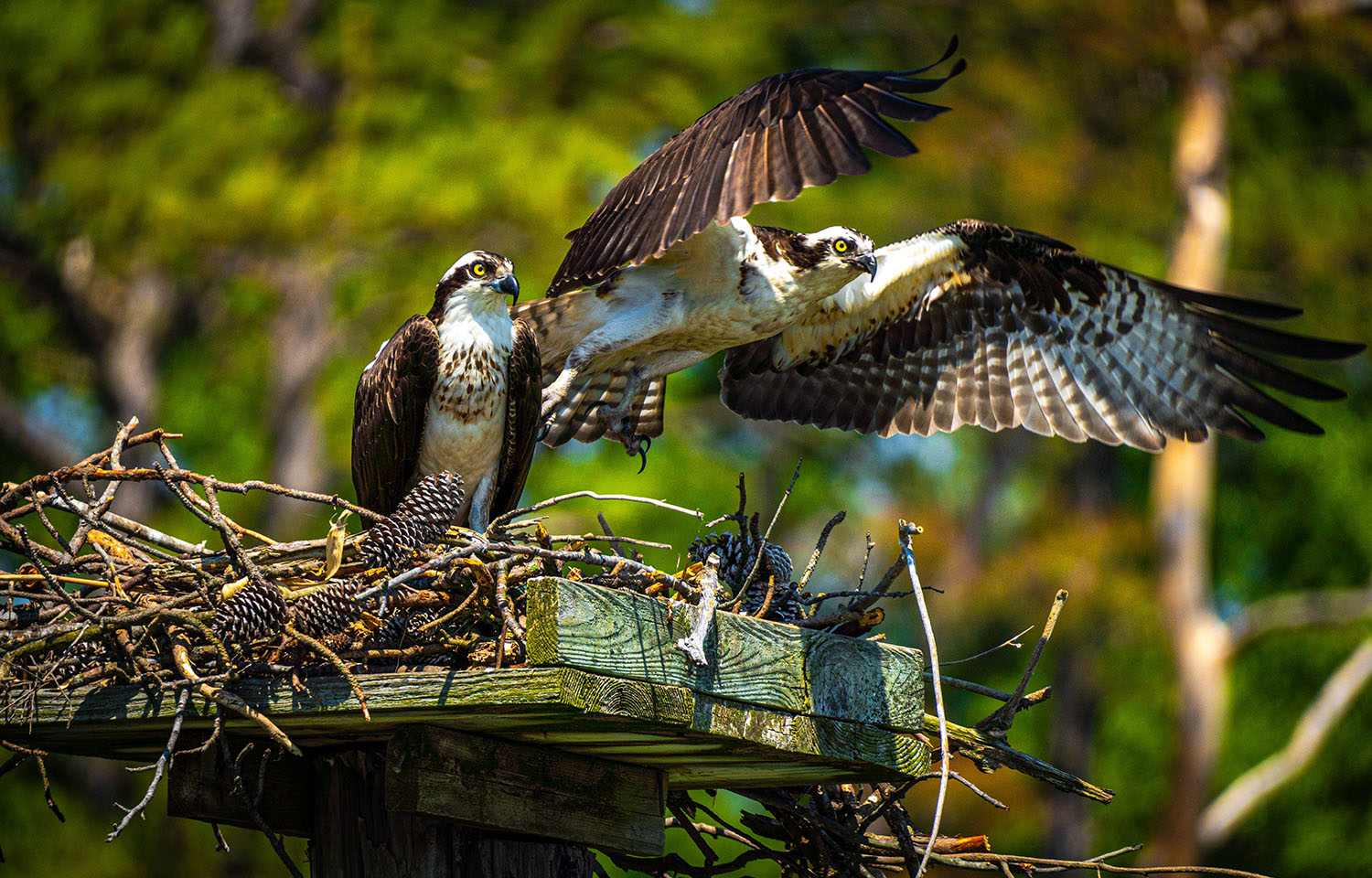
A new research paper published in Frontiers in Marine Science has linked the decline in osprey breeding populations in the Chesapeake Bay to a decline in menhaden.
The paper, “Widespread reproductive deficits in Chesapeake Bay ospreys,” links a reduction in breeding pairs of osprey in the bay with a lack of access to menhaden in the region. The study found that in the 2024 breeding season, osprey productivity in areas with high salinity were below the levels required to maintain the population inside the bay.
“Although several factors are operating within this ecosystem that may affect productivity, we suggest that Atlantic menhaden availability is the primary driver of low reproduction,” the paper states.
That paper has led to renewed calls from environmental groups to reduce the fishing pressure for menhaden within the Chesapeake Bay, the latest in a long-running dispute between the fishing industry and environmentalists. Environmental groups have criticized management of the menhaden fishery, arguing that removing the practice has been hurting the populations of other species including osprey and striped bass.
“Ospreys continue to tell us something is wrong. The science clearly demonstrates that declining menhaden numbers are driving this crisis. Virginia needs to listen,” Chesapeake Bay Foundation (CBF) Forage Campaign Manager Will Poston said in a press release.
Poston and the CBF argue the new paper has demonstrated a lack of menhaden is becoming an issue and urged regulators to reduce fishing pressure to prevent further issues.
“Ultimately, decision-makers must pause reduction fishing inside the Bay until menhaden research is completed,” Poston said. “Pausing reduction fishing in the Bay is the safest option to protect current and future jobs, promote healthy and productive Bay wildlife and fisheries, allow more menhaden to mature, and safeguard this struggling estuary.”
The Science Center for Marine Fisheries (SCEMFIS) funded a study of the menhaden stock inside Chesapeake Bay featuring scientists from Chesapeake Biological Laboratory, the University of Maryland Center for Environmental Science, Virginia Institute of Marine Science, and NOAA. That study is intended to provide a detailed roadmap for managing the menhaden fishery inside the bay, allowing regulators to manage it more effectively.
NGOs have pushed the Atlantic States Marine Fisheries Commission (ASMFC) to cut fishing quotas inside the bay, and in October 2025, the commission chose to cut the 2026 quota by 20 percent in 2026. That decision drew criticism from the fishing industry, which pointed to the low risk of overfishing of the stock.
It also drew criticism from environmentalists, as the fishery cap for the Chesapeake Bay remained 51,000 metric tons (MT), in line with the previous year. However, ASMFC also initiated an addendum to Amendment 3 – which set the 51,000 MT cap – that could reduce that total by as much as 50 percent.
Amid those threatened cuts, companies targeting menhaden inside the Chesapeake Bay have continued to advocate for the industry due to a lack of direct evidence the fishery is responsible for declines in osprey and other species. Ocean Harvesters – the company targeting the majority of the menhaden quota in the Chesapeake Bay – said the newest study has again not directly linked declines to the fishery.
“The study documents osprey concerns, but it does not prove that our fishery caused it,” Ocean Harvesters CEO Monty Deihl said. “Many of the study areas discussed are not places where our vessels fish, and the paper appears to accuse commercial harvest without showing a clear connection between actual fishing activity and the nesting problems it describes. Before this paper is used to call for new restrictions, the public deserves a careful look at timing, geography, local environmental conditions, and what the data actually prove.”
The company said the paper relies on multiple assumptions: poor osprey reproduction may be an indication of food stress, that food stress may be a reflection of reduced menhaden availability, that the reduced availability may be a sign of broader scarcity, and that broader scarcity is the fault of commercial fishing.
“This paper is likely to draw attention because it reads, at least up front, like an indictment of menhaden availability in the Chesapeake Bay,” Omega Protein Senior Fisheries Scientist Peter Himchak said. “But, the paper also details numerous other possible mechanisms that may affect osprey productivity, and those caveats are critical considerations in evaluating this issue.”
The company said the paper should not be taken as a study of the status of the menhaden stock and continued surveys and science by fisheries managers have proven the stock continues to not be overfished, with no overfishing occurring.
“Ospreys matter and so does scientific accuracy. Any fair assessment has to account for where the fleet actually fishes and whether other prey and local environmental conditions are being considered,” Deihl said. “The Bay needs good science, not an oversimplified and irresponsible blame campaign. The people who work in this fishery deserve a fair assessment of what the paper actually proves.”
