




The World Wildlife Fund (WWF) has been researching and exploring how utilizing invasive species in products can help lessen environmental disruption, particularly in instances where eradication is not possible.
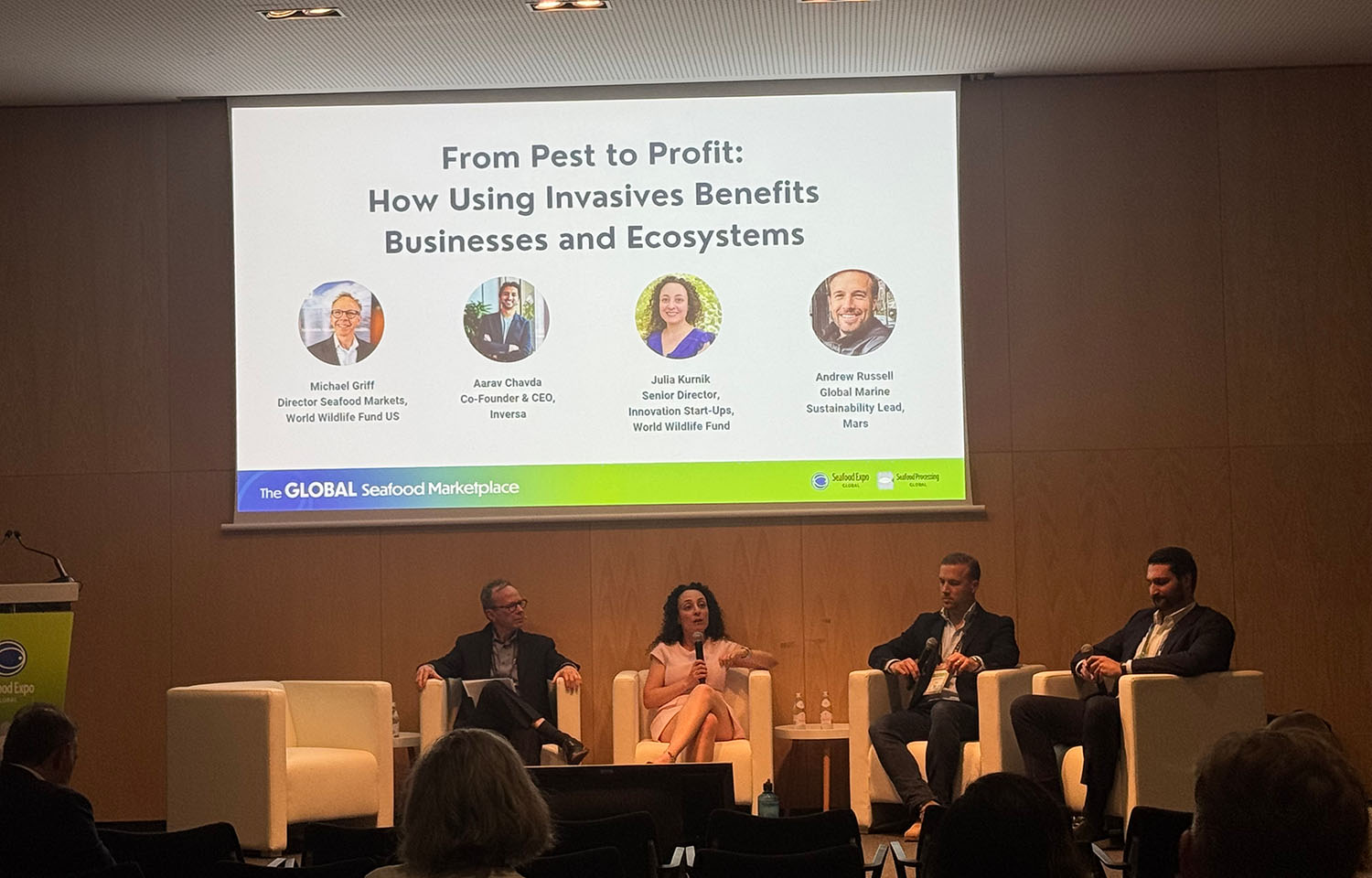
At Seafood Expo Global, taking place 21 to 23 April in Barcelona, Spain, panelists from the U.S. division of WWF, Berkshire, United Kingdom-based pet food producer Mars, and Tampa, Florida, U.S.A.-based leather product creator Inversa spoke about the ways invasive species such as Florida pythons and carp have been turned into pet foods and apparel, with the common goal of promoting biodiversity in mind.
“Today, many invasive species have become so widespread that true eradication is no longer feasible and requires us to think about different strategies and expectations, so we’re exploring market driven solutions and working with companies and developing supply chains,” WWF U.S. Director of Seafood Markets Michael Griff said.
WWF Senior Director of Innovation Start Ups Julia Kurnik said her work has been researching and creating databases for the utilization of invasive species, as many natural resource and state departments neglect to provide up-to-date information on invasive species counts. From there, her work is able to inform people like Mars’ Global Marine Sustainability Lead Andrew Russell and Inversa Head of Development Henri Ferre.
“Historically, it’s been about eradication and if that’s possible, that’s wonderful,” Kurnik said. “But where it’s not possible, we’re hoping that creating goods and services to make use of those invasives can be a way to really bring environmental benefits and get [invasive species] to a steady level.”
At Mars, Russell said the company has taken a particular interest in carp, which is considered invasive in the U.S. Additionally, Mars has a 15-year partnership with the WWF to research the promotion of biodiversity.
“Inversa really started as an observation, an idea in response to what invasive species are doing to the planet,” Ferre said. “Second, your base driver of biodiversity loss causes our climate roughly USD 423 billion (EUR 360,861,300) a year and we don’t really have anything to say to driving that number down. Typically, the model is you have a beach cleanup, or fish cleanup and a non-product process, but what if we were to grade something commercially valuable.”
Kurnik added that businesses are tasked with building a supply chain around a product that could disappear in three to five years, but will provide a framework that can be swapped based on the invasive species that’s most prevalent.
“With carp, when we looked at invasive carp in the United States and the pet food market, we found that with a fairly low entry point into the pet food market, you could source enough carp that you can limit spread, that you can begin to decrease the density so that biodiversity and naive fish can come back into those riverways,” Kurnik said.
Russell added that it’s been a dual benefit, using innovation and traceability systems to support local fisheries and bring ecosystems to a healthy level. But, Kurnik said, marketing can be tough when it comes to navigating the “ick factor” around a poorly perceived species in a product.
“Carp is seen as an ick fish; it does have a negative connotation and when you’re asking people to feed it to their pets, perhaps that then brings up another question,” Kurnik said. “I’m a terrible example of this because I feed everything to my pets.”
For pet food companies like Mars, in a market where nutritional regulations are highly enforced and important to navigate, leaning on messaging about the protein content in carp has proven beneficial.
