



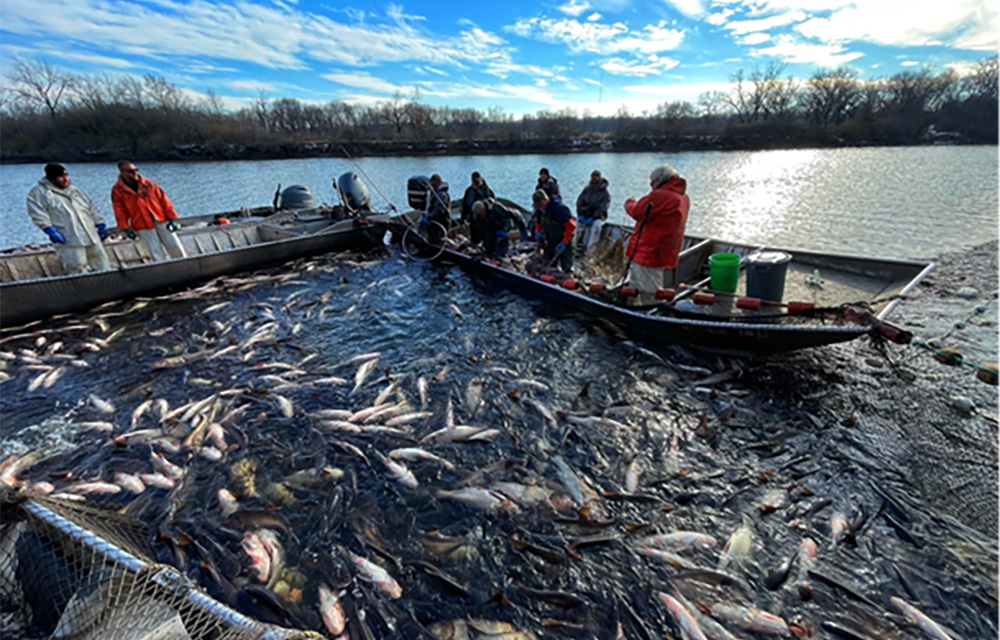
The U.S. Fish and Wildlife Service (USFWS) has announced USD 19 million (EUR 16.3 million) in funding for projects aimed at managing invasive carp and stopping their advance along the Mississippi River basin and into the Great Lakes.
“We’re committed to supporting interagency invasive carp management partnerships that span both the Mississippi River and Great Lakes basins – some of the largest coordinated conservation efforts in North America,” Aaron Woldt, assistant Midwest regional director for the USFWS Fish and Aquatic Conservation program, said in a release. “We can only manage a challenge of this magnitude by working together. These valuable investments build our collective capacity to reduce the destructiveness of invasive carp and work to restore aquatic environments for the American people.”
Since first being introduced to help with pest control at aquaculture facilities in the U.S., invasive carp species have wrecked ecological havoc in the country. The fish outcompete local species and have no substantial predators, allowing them to spread quickly throughout the country.
USFWS has provided grant funding for the last 10 years to curb the spread of Asian carp. On 14 August, USFWS announced its latest round of funding, with USD 19 million for 33 projects aimed at controlling the carp across 18 states. Roughly USD 10 million (EUR 8.6 million) of the funding will be used for targeted mass removal, while USD 6.6 million (EUR 5.7 million) will be used for monitoring and USD 388,000 (EUR 333,000) will be used for deterrence projects.
In addition to the grant funding, USFWS said it would dedicate USD 12 million (EUR 10.3 million) in support of field operations and interagency coordination to manage invasive carp.
The grant announcements come shortly after U.S. President Donald Trump directed the federal government to prioritize efforts to stop invasive Asian carp from reaching the Great Lakes.
“My administration is committed to protecting the Great Lakes – the world’s largest surface freshwater system and a highly valued shipping avenue, resource for fishing and recreation, and source of high-quality drinking water – from the economic and ecological threat of invasive carp,” Trump said in May. “This threat affects every state that borders the Great Lakes: Illinois, Indiana, Michigan, Minnesota, New York, Ohio, Pennsylvania, and Wisconsin. Curbing this threat requires immediate and effective deployment of resources, infrastructure, and expertise.“
U.S. lawmakers are considering approving fiscal year 2026 funding for invasive carp mitigation as well.
