






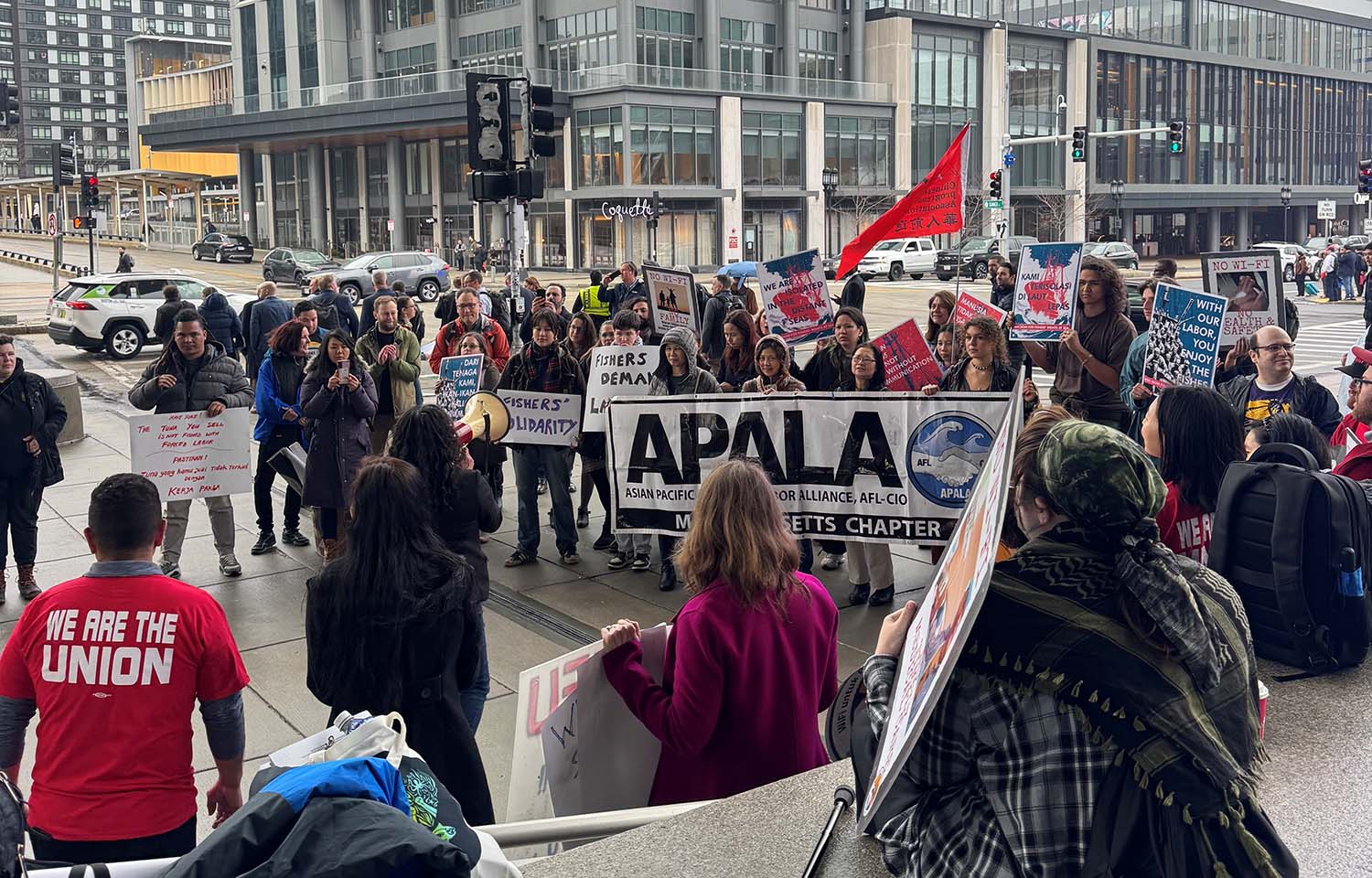
Members of the Global Labor Justice (GLJ) organization spoke to a crowd during a panel and a vigil outside the Thomas M. Menino exposition building at the 2026 Seafood Expo North America (SENA) on 16 March to advocate for enforceable brand agreements with fishing vessels in Taiwan.
GLJ also hosted a panel session on 16 March, at which speakers discussed instances of alleged forced labor, lack of access to Wi-Fi, withheld paychecks, and abuse that took place on a Marine Stewardship Council (MSC)-certified vessel in Taiwan: You Fu.
Onboard, Indonesian migrant fisher Masduki Priyono claimed to have experienced multiple instances of abuse by his superiors. Examples included working with crewmates for over a year without pay, instances of food and water being withheld, at times a lack of access to medical care, no ability to communicate with family due to a lack of Wi-Fi onboard, and an additional nine months of work with no additional pay.
“Wi-Fi access for crew needs to be mandatory on Taiwanese vessels,” Priyono said. “With Wi-Fi, we would have been able to communicate with our union and our families and check in real time to see if we were being paid.”
GLJ has reported that 60 percent of vessels in the Taiwanese fleet claim to have installed Wi-Fi, but only 2 percent of fishers have access to it. Therefore, the GLJ strongly suggests the usage of enforceable brand agreements (EBAs) for enabling Wi-Fi services onboard vessels.
“An enforceable brand agreement is a model that links the bottom of the supply chain to the top,” GLJ Legal Director Allison Gill told SeafoodSource. “It uses the leverage of the buying of the brand at the top to make sure that the commitments are implemented at the bottom. I think we’ve seen very good uptake of that demand generally, with various efforts by governments, by companies even, by the ecosystem of organizations that work around companies to implement various non-binding Wi-Fi programs.”
Also speaking on the panel was Tufts University Professor Jess Sparks, who detailed her research in the power of an EBA for mitigating forced labor and why certifications like MSC only protect products, not workers.
“This week, we will be releasing a report in collaboration with the International Transport Breakers Federation, which details numerous cases of labor abuses and forced labor in a range of MSC-certified fisheries,” Sparks said during the panel. “In this analysis, we have found that there are actually cases of repeated offenses; some of these offenses occurred while audits for recertification were happening. Only about half of the fisheries had vessel lists available. We were looking for cases, and there were cases where we have the worker testimony, we have the name of the vessel, and found many times that the lists were not available or if there was a list available, sometimes they would be changed very rapidly, with no archiving a previous list.”
Sparks added that even with documented reports of labor abuse, traceability was not enforced on a certified vessel 100 percent of the time, meaning there is no paper trail for the workers onboard the vessel or the consumers buying products on store shelves that may have been created via forced, unpaid labor.
“If you’re a buyer, there’s no way of you tracing what was happening when you were buying that product,” Sparks said. “We know that product, particularly canned tuna, can stay on shelves in a supermarket for a very long time without any type of archival information. As a buyer, you’re still at risk that the product on your shelf has been caught by forced labor and that certification has done nothing to reduce risk of forced labor in your supply chain.”
GLJ has long documented the need for Wi-Fi onboard vessels at multiple SENA events but took it one step further this year calling for tangible action through EBAs. GJL said that EBAs bring brands into binding agreements with supplies to secure labor such as enforceable Wi-Fi access, a grievance procedure, and protections against retaliation as a condition of sourcing. If brands tie purchasing power to guaranteed connectivity and labor rights protections, vessel owners will have a financial incentive to comply. Without binding commitments, Wi-Fi remains discretionary and can be restricted or revoked, undermining freedom of association at sea.
“Our presence at the expo this year is really about making clear that the access to the technology is not enough and that the success we’ve had in bringing attention to and socializing the need for Wi-Fi technology on vessels is really important,” GLJ Strategic Research Director Mandi Jackson told SeafoodSource. “If [fishers] can’t access the Wi-Fi, they don’t have power in the supply chain unless they have fundamental labor rights.”
Through an interpreter, Priyono detailed the multitude of grievances he and his crewmates endured two years ago, calling for better transparency and action to be taken to support workers with the same urgency that large seafood corporations take to protect product quality.
“We usually only got a total of five hours of rest a day and sometimes as little as two to four hours a day,” Priyono said. “Our captain had a terrible temper and often yelled and swore at us if we made any mistakes. Food was also inadequate for one to two months; we had to survive on the fish we caught while waiting for something else. When we ran out of bottled water, we had to drink salty, rusty, desalinated water. Our sleeping quarters were infested with bedbugs, which caused severe skin rashes. It was so unbearable that several of us chose to sleep outside on top of the fish’s storage even when it rained.”
Priyono said despite all that, the worst offense was the lack of Wi-Fi access on board because it made the workers powerless for 15 months to report any of the injustices onboard. He was unable to speak to his family, leading to isolation and anxiety, but also could not advocate for a better situation. His family never received his salary, living 15 months with none of the promised income.
“Today, I want to ask the seafood companies represented here to take responsibility,” Priyono said. “You have the power to ensure that the seafood you sell is not connected to forced labor. We need companies to ensure that fishers’ fundamental labor rights are protected, and that they are able to work in dignity. No one should have to suffer the way we did just to earn a living.”
