



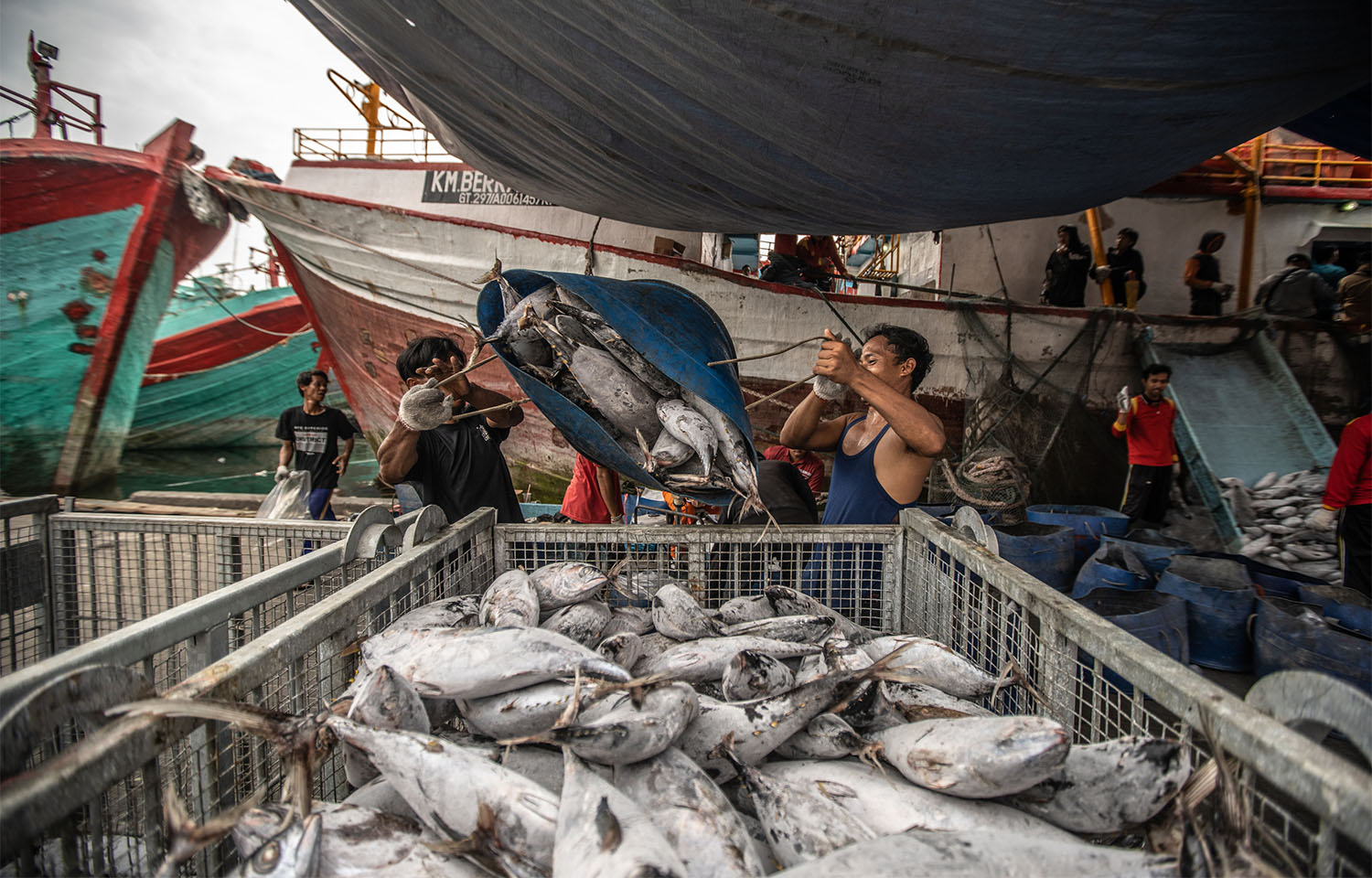
A recently-released investigation by Greenpeace in collaboration with the Uniting Church in Australia, Synod of Victoria and Tasmania, alleges the Indonesian tuna industry is engaging in environmentally destructive fishing and labor rights abuses.
A report on the investigation, “Forced to the Bottom: Squeezing Indonesian Fishers and Oceans for Dirty Tuna Profits,” alleges 17 different fishing vessels and multiple processing companies engaged in labor rights abuses, including instances of forced labor and debt bondage. It also alleged five processing companies – PT Aneka Tuna Indonesia, PT Samudera Mandiri Sentosa, PT Sinar Pure Food International, PT Pahala Bahari Nusantara, and PT Intimas Surya – purchase tuna from those vessels and supply 10 Australian seafood companies, including major brands.
The report said it interviewed fishers at four fishing ports between May and August 2025, with a research team identifying fishers that were either previously or currently employed on fishing vessels that were on a list as participating in a fisheries improvement project (FIP) or the Marine Stewardship Council. Greenpeace said it found 25 fishers on board the 17 different fishing vessels that qualified under its criteria.
The interviews focused on the recruitment process, working conditions, and salary payment methods, and found many experienced International Labor Organization (ILO) indicators of forced labor, with 56 percent experiencing abuse of vulnerability and debt bondage and 40 percent experiencing deception.
“The testimony of the crew on Indonesian tuna fishing boats is a clear signal that the Australian Government needs to require businesses importing goods from high-risk sectors to have to properly check that modern slavery is not being used in the production of the goods,” Uniting Church in Australia, Synod of Victoria and Tasmania Senior Social Justice Advocate Mark Zirnsak said in a release. “The vast majority of Australians want to be sure the goods they are buying have not involved suffering and exploitation of the people involved in producing them.”
The investigation found employment brokers would often lure workers onto vessels with promises of salaries and flexible advance loans, but then would charge illegal fees and in some cases withhold identification documents to assert control.
“At sea, fishers reported excessive working hours – up to 21 hours a day, often without proper rest, pay, or access to communication,” Greenpeace said. “Some of them were out at sea for 10–18 months without a port visit. Salary was paid at the end of each trip, with profit-sharing schemes that are unjustly designed to suppress the fishers’ income.”
Those profit-sharing schemes would often result in fishers not getting paid for a fishing trip if it was less successful. Even if a trip was successful, payments were often being manipulated by the captains of vessels to deny higher pay.
The report found that Indonesia’s regulation of employment on board fishing vessels lacks several technical guidelines and still “remains weak” when it comes to territorial fishers.
“The existing regulation does not cover how companies hire their fishers,” the report said. “High demand for fishers and turnover are combined with weak enforcement, unclear recruitment mechanisms, and the fishing companies allegedly relying on calo [employment brokers] to find fishers, resulting in a system that is rife with deception and debt bondage."
In addition to labor rights issues the interviews also revealed potential illegal, unreported, and unregulated (IUU) fishing. According to the report, instances of shark finning and deploying banned fish aggregating devices (FADs) were also found.
Greenpeace said the report brought to light the direct link between indications of forced labor and IUU fishing practices in the Indonesian fishing industry, and called on the Australian tuna market to push for action along the seafood supply chain.
Those actions can include free, accessible, and secure Wi-Fi on board fishing vessels; capping the amount of time that fishers can spend at sea to three months to reduce the risk of abuse; and 100 percent human or electronic observer coverage in Indonesia’s tuna fishery to ensure accurate data on catch composition, bycatch, encounters with any protected species, and “overall fishing practices.”
“Unless both Indonesian and Australian regulators enact and enforce binding due diligence and labour protections, the true cost of tuna will continue to be borne by those at the very bottom of the chain, which are the Indonesian fishers trapped in debt and stripped of their rights,” Greenpeace said.
