



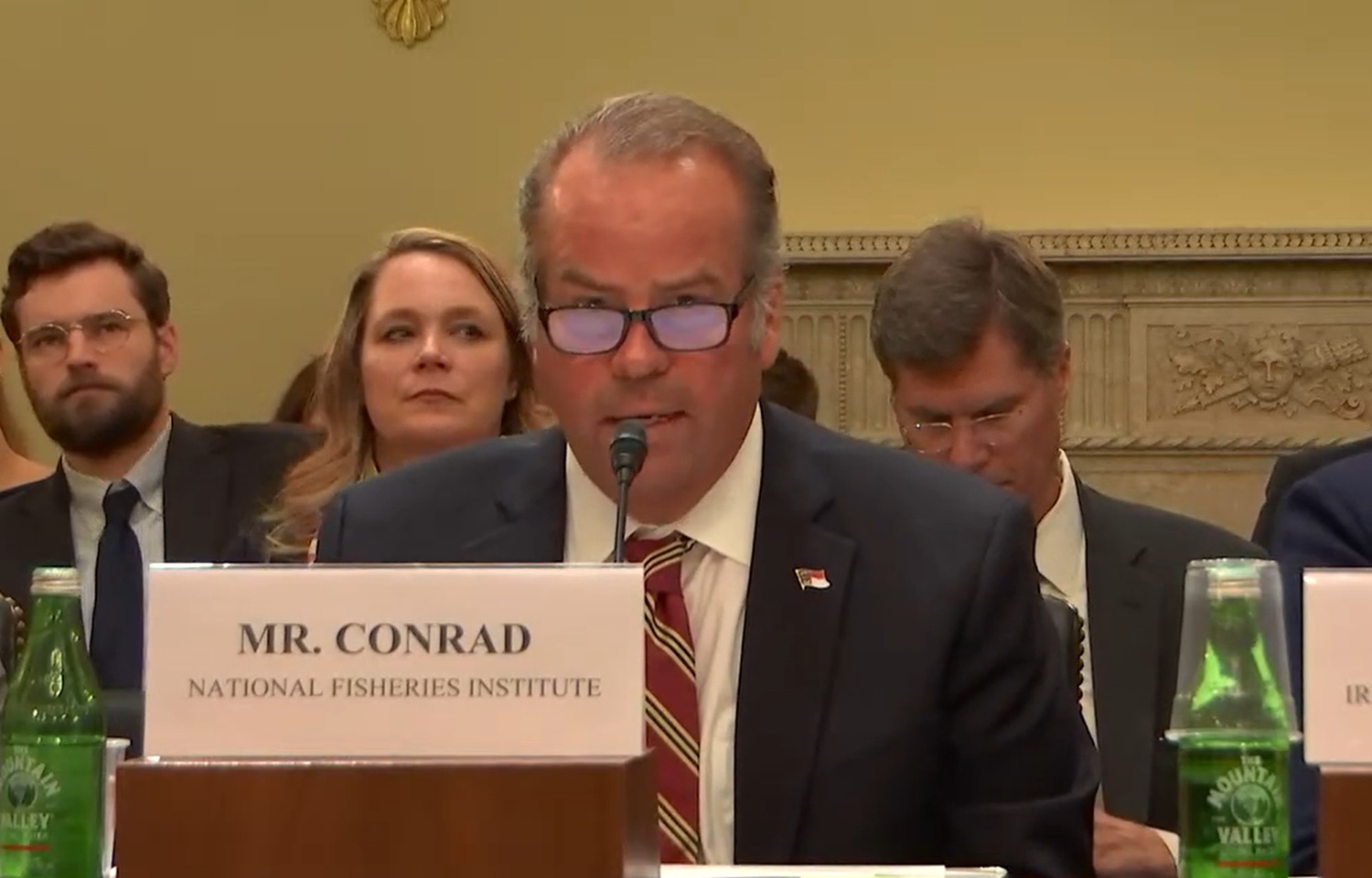
The incoming chair of the National Fisheries Institute (NFI), Bay Hill Seafood Sales President Justin Conrad, testified in favor of the Fighting Foreign Illegal Seafood Harvest (FISH) Act during a 19 November Congressional hearing, arguing that it would do more to combat illegal, unreported, and unregulated (IUU) fishing than current regulations.
“The FISH Act aims to help eliminate illegally caught seafood from entering the United States,” Conrad said. “IUU fishing, where it occurs, is a black mark on the global industry, bringing both direct and collateral harm that calls for deliberate and decisive policy action. IUU seafood damages our industry by undermining legitimate harvesters, undercutting fishery management systems, and eroding consumer confidence in the sustainability of seafood.”
Conrad’s testimony took place during a hearing of the U.S. House Natural Resources Committee’s Subcommittee on Water, Wildlife, and Fisheries.
First introduced in 2022 by U.S. Senator Dan Sullivan (R-Alaska) and U.S. Senator Sheldon Whitehouse (D-Rhode Island), the FISH Act would create a blacklist of vessels involved in IUU activities, banning them from U.S. waters and ports. The bill would also require more at-sea inspections by the U.S. Coast Guard.
“The FISH Act gives us more enforcement tools in response to illegal fishing,” U.S. Representative Val Hoyle (D-Oregon) said. “It creates a list for illegal vessels, holds vessel owners accountable, and improves tracking of foreign boats, which helps keep illegal seafood out of American stores through sanctions and import restrictions, protecting consumers and vulnerable workers. This is exactly the kind of bipartisan work that we should be doing. Illegal fishing is a massive problem. At least 11 million metric tons of fish are caught illegally every year, and in 2019 alone, USD 2.4 billion [EUR 2 billion] worth entered U.S. markets. Illegally caught fish reduces the demand for healthy and sustainable U.S. seafood. This hurts the fishermen in my state and across the country who play by the rules. It’s also bad for the environment and very bad for workers, who are often exploited or trafficked on illegal fishing boats.”
Comments on the legislation were overwhelmingly positive, with several representatives taking time to advocate for the bill.
“This is a global threat that steals from law-abiding American fishers, drives human rights abuses, and undermines sustainable seafood markets,” U.S. Representative Jared Huffman (D-California) said. “This bill would crack down on illegal imports by directing NOAA to track vessels that have engaged in IUU fishing to hold offenders accountable. It also strengthens the Coast Guard’s enforcement capabilities on illegal fishing and directs the executive branch to include provisions to confront illegal foreign fishing in future international treaties and agreements.”
In his testimony, Conrad contrasted the FISH Act with the Seafood Import Monitoring Program (SIMP), a policy implemented in 2016 to stop IUU fishing that the seafood industry has lambasted as ineffective and difficult to comply with.
“One effort that just hasn’t worked is SIMP,” Conrad told lawmakers. “From day one, it’s been burdensome and unworkable for us seafood producers, processors, and distributors. Even the National Marine Fisheries Service has said outright that SIMP does not prevent or stop IUU fishing products from entering U.S. commerce.”
Conrad called on lawmakers to “scrap SIMP in its entirety” instead of “burdening businesses with a blizzard of paperwork and endless audits.” For NFI and its members, the FISH Act is a major improvement and takes a holistic government approach to tackling the issue of IUU fishing, he added.
The Senate added language from the FISH Act to the annual military appropriations bill it passed in October; however, the House has still not passed its version of the legislation. Lawmakers are expecting to finalize the legislation in December. A Senate committee also approved the FISH Act in April.
Huffman also used the hearing to criticize the Trump administration, which he accused of undermining IUU enforcement efforts via its cuts to NOAA. In its push to rapidly shrink the federal workforce, the Trump administration laid off hundreds of NOAA employees in February and has since pushed to slash the agency’s budget.
“The Trump administration continually sends mixed signals on IUU fishing, calling it a priority one day and then gutting enforcement and weakening NOAA’s ability to act on it the next. This chaos hurts American fishers, who are playing by the rules,” Huffman said.
