






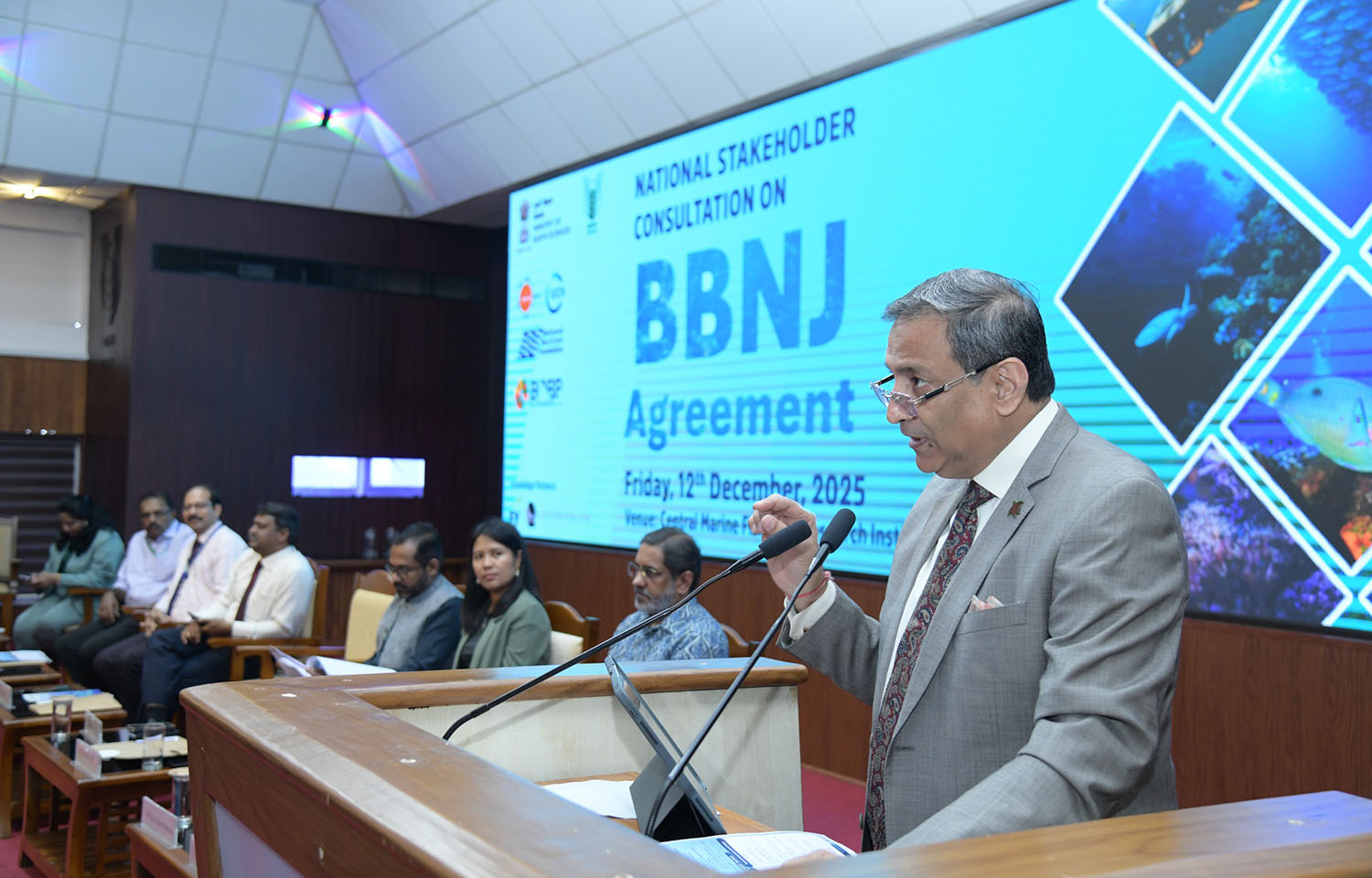
India has begun work to prepare a domestic framework for ratifying the High Seas Treaty, just over a month before it comes into force on 17 January, 2026.
The United Nations Agreement on Marine Biological Diversity of Areas beyond National Jurisdiction (BBNJ Agreement) – commonly referred to as the High Seas Treaty – was ratified in September 2025 with 60 countries signed on. First adopted in March 2023, the treaty is the result of nearly 20 years of U.N.-facilitated talks and first opened for ratification in September 2023.
Sierra Leone and Morocco joined the list of nations ratifying the treaty in September 2025, which brought it across the 60-vote threshold and began a 120-day countdown to it entering into force. On that date, oceans outside areas of national jurisdiction will be covered under the agreement, which will place 30 percent of the world’s oceans into protected areas, inject more money into marine conservation, and increase regulations around the use of, and access to, marine genetic resources.
As the High Seas Treaty closes in on reality, India’s Ministry of Earth Sciences held a stakeholder consultation to bring key fisheries and scientific research groups together to begin the process of ratifying the treaty in the country. India has signed the treaty, but has not yet followed through the ratification process.
The ministry brought together the Central Marine Fisheries Research Institute (CMFRI), Centre for Marine Living Resources and Ecology (CMLRE), and several domestic and international groups to discuss a plan to bring India closer to ratifying the treaty.
Senior Advocate of the Supreme Court of India Sanjay Upadhyay – who founded the first environmental law firm in the country – called the agreement a critical opportunity for India to bridge governance gaps over conserving biodiversity that exist between national jurisdictions, and said the treaty allows countries to preserve the environment while taking into account national interests.
CMFRI Director Grinson George also presented during the summit, pointing out that activity in the high seas can influence the availability of fish inside India’s exclusive economic zone.
India has increasingly become more and more focused on aquaculture production – according to national statistics, the country’s inland aquaculture production rose 167 percent from 2014 to 2023, from 1.5 million metric tons (MT) to nearly 4 million MT. Aquaculture also made up 40 percent of India’s fisheries employment in 2020 – up from just 17 percent in 1994.
However, the country also has a significant fleet of nearshore and small-scale fisheries, and CMFRI statistics indicate the country caught over 3.5 million MT of various species in 2023.
India is taking its steps ahead of the first Conference of Parties (CoP) on the treaty, scheduled in August 2026. At that conference, parties will adopt rules of procedure, determine the financial arrangements for the treaty, and agree on process that will begin establishing the conservation measures stipulated in the High Seas Treaty.
