






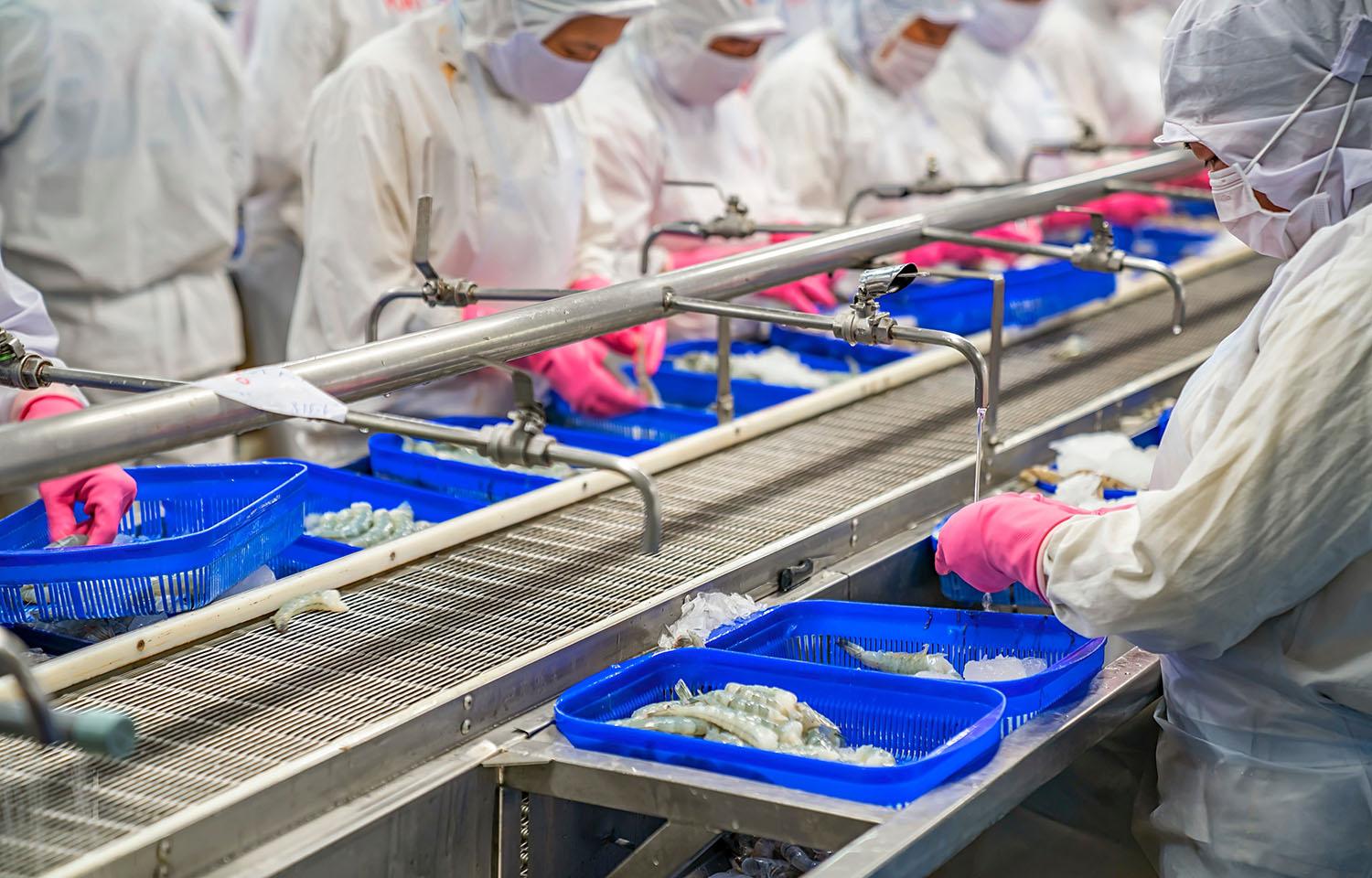
A recent investigation has discovered that since the onset of the Covid-19 pandemic, producers and workers in shrimp supply chain in Vietnam are facing declining wages and increased vulnerability to forced labor.
The new report, “Laboring for Less so Supermarkets Profit More,” comes after researchers – working with independent research teams in Vietnam that were kept anonymous to protect worker identities – talked with shrimp farmers and laborers from July 2023 through May 2024. The research team conducted more than 150 interviews across the sector and found that workers and farmers in Vietnam’s shrimp industry are facing an increasingly difficult financial environment due to the drop in shrimp prices, creating conditions conducive to the employment of forced labor.
According to the report, the take-home earnings of a shrimp worker in Vietnam have declined by between 20 percent and 60 percent since the start of the Covid pandemic. The root cause, it said, is retailers and wholesalers driving down the price of shrimp even as producers are hit with higher farming costs.
Katrina Nakamura, owner and operator of research organization The Sustainability Incubator and the author of the report, told SeafoodSource high costs and dropping prices are continuing even as demand for shrimp increases.
“We collected earnings, costs, and pricing data equally from workers and producers at every tier, and then went on to collect pricing data along the market side of the supply chain (earnings and costs where we could),” Nakamura said in an email. “The in-country data confirmed a very significant earnings decline at every tier since the pandemic for shrimp workers and producers other than middlemen and feed firms.”
That earnings decline across the sector is impacting farmers of all stripes.
“[Even] farmers who invested in super-intensive systems and new technology were not capturing the promised value addition, but were losing money year to year from low prices,” Nakamura said.
As prices fall and shrimp producers continue to struggle, research on the market side showed that other parts of the shrimp industry have been doing well – in the cases of some retailers, even posting unprecedented profits, Nakamura said.
“Empirically, it appears very much like producers and workers in Vietnam's shrimp sector are subsidizing those profits,” she said. “Vietnam is known for its innovation, value-addition and efficiency from highly skilled workers. The workers we spoke to said they are working faster and more hours to try to make up the lost earnings, but are not earning enough to save money.”
The report offered six key findings: A significant decline in worker earnings in Vietnam has taken place since the pandemic, market consolidation may be driving the wholesale shrimp price to drop, farmers are being squeezed by higher costs and lower prices, large processing and feed firms are hiring intermediaries to buy shrimp at lower prices, full traceability does not exist in the supply chain due to the nature of the marketplace, and “wider concerns” indicate the market could be becoming irrational.
Nakamura said the situation in Vietnam is different than the troubles facing India's shrimp sector, but one equally troubling for labor rights.
India’s shrimp industry recently came under fire after independent reports by the Corporate Accountability Lab, Associated Press, and Outlaw Ocean revealed suspected labor and human rights abuses at Indian shrimp companies, with one whistleblower giving SeafoodSource a first-hand account of labor abuses. In the wake of the reports, the U.S. Department of Labor added shrimp manufactured in India to the 2024 “List of Goods Produced by Child Labor or Forced Labor.”
“India and Vietnam might represent two ends of a spectrum of consequences from the race to the bottom for ever-cheaper shrimp. In the case of shrimp from Vietnam, the driver of exploitation is leverage over price on the import side of trade, with indications that the biggest driver of worsening conditions could actually be the procurement specifications of large supermarkets,” Nakamura said. “The large supermarkets require a lot of costly specifications but appear to have been paying prices for shrimp that are lower than what shrimp can be made for.”
Her research also found that supermarkets’ requirements for eco-labels such as Aquaculture Stewardship Council or Best Aquaculture Practices certifications on farmed shrimp are resulting in potential issues with fraud. According to the report, of the more than 2 million shrimp farms operating in India, Indonesia, Ecuador, Thailand, Bangladesh, and Vietnam, only roughly 0.05 percent are certified to one of the two standards.
“This means most of the shrimp procured and resold by large supermarkets purchasing 20,000 kilograms or more per month from these countries cannot all be from certified farms, again because the yield from most certified shrimp farms is very small,” the report said.
Increased global production has also had a potentially negative impact on worker salaries in Vietnam, Nakamura said. Ecuador’s emergence as a major shrimp producer has driven up global production but driven down prices due to the Ecuadorian shrimp-farming business model, which depends on farm size rather than efficiency, she said.
“It competes on a much lower price, which may have the effect of pitting Asian producers against each other, so you see India selling more shrimp at lower prices where it's not more efficient necessarily, but it has the advantage of being made with very, very, very low earnings for workers,” Nakamura said. “As competitive advantages go, that's a little sad, and the shift to India, while understandable from a bottom-line perspective, also reflects poorly on the market side of the industry.”
Buyers are beginning look away from smaller, more efficient farms in Southeast Asia toward much larger but less efficient farms elsewhere in a search for cheaper prices.
“It seems like a fairly rapid abandonment of the millions of small producers in Asia who have held this sector up by producing unbelievable quantities of shrimp at good prices for over 20 years,” Nakamura said.
It also raises a potentially worrying question, she said.
“What is happening in the market where the most efficient producers are not winning on price?” Nakamura said. “These results provide a new view of the consequences from current arrangements where consumer prices and wholesale prices are low, and supermarket profits appear to be completely disconnected and taking too much from the people hard at work.”
The report offered multiple recommendations to supermarkets to resolve the issues, including paying prices that reflect the true cost of producing shrimp, and being more specific on human rights and traceability. It called for companies to publish the names of processing plants they purchase from and to engage with key unions and civil society in the regions they are purchasing from.
Governments, too, could also do more in both shrimp-consuming and shrimp-producing countries, the report said. Governments of shrimp-producing nations should ensure domestic corporations are not profiting from unpaid or underpaid labor, and governments in importing countries should consider human rights and environmental due diligence legislation, or consider labor issues when determining trade measures or even tariffs.
“The FTC [Federal Trade Commission] should look further into supermarket procurement to support the efforts of several other U.S. government agencies with mandates to prevent forced labor,” Nakamura said.
