






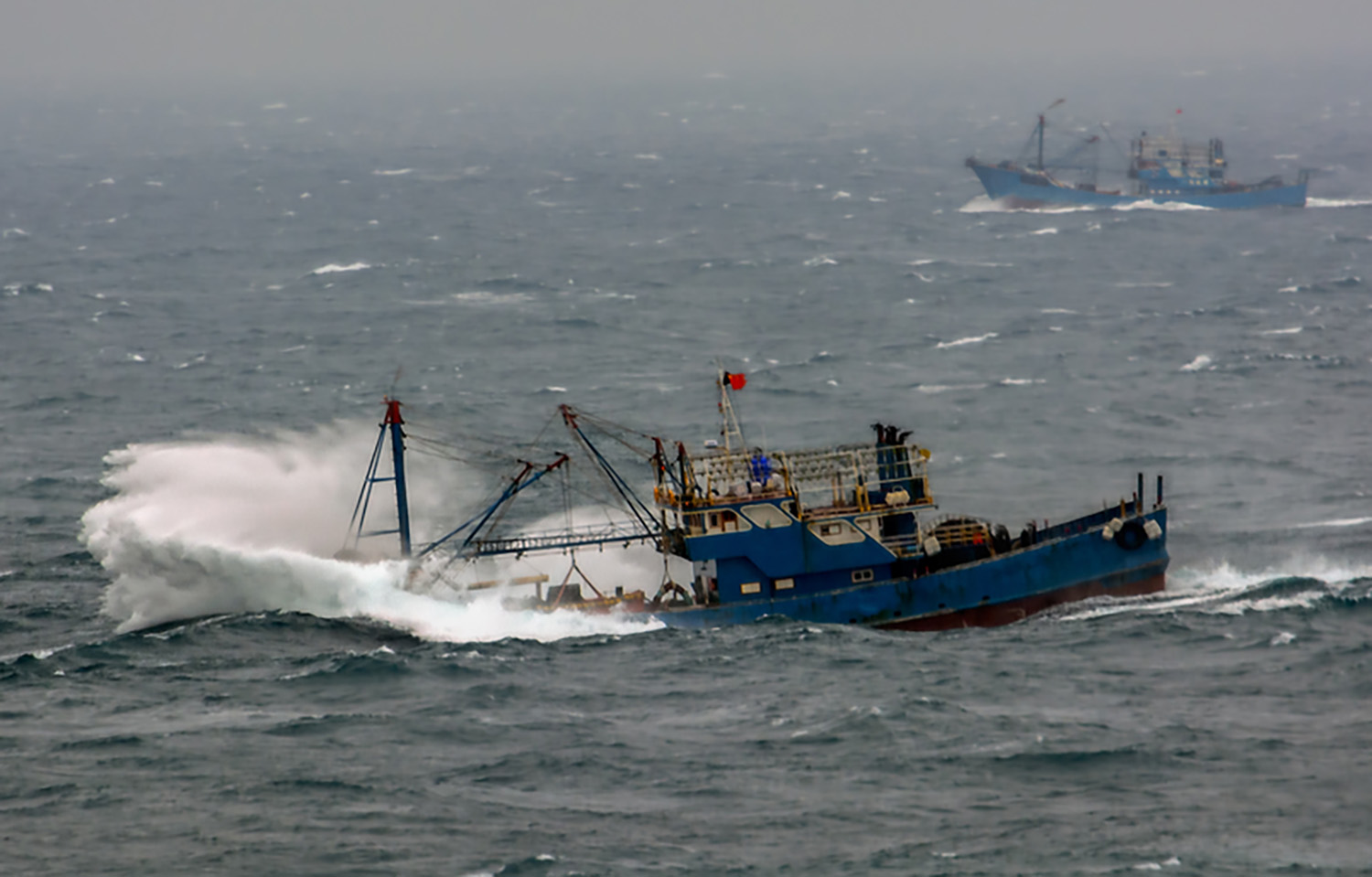
A new report from the International Union for the Conservation of Nature (IUCN) has highlighted China’s weak efforts to revive fish stocks in its own waters, suggesting a need for China to implement more stringent controls on its fleet’s landings and collect better data to effectively measure the impacts of those controls.
Titled “Unselective, unsustainable, and unmonitored trawl fisheries?” the report states that efforts made in the past decade by China to replenish fish stocks in its domestic waters, such as scrapping vessels and instituting annual moratoriums on fishing in the East and South China seas, have not been enforced strongly enough to combat dwindling fish populations.
“Major challenges overall are that despite many good measures and regulations, implementation and enforcement remain weak,” the report said. “Moreover, there are few indications that management measures are working or that measures such as restocking or artificial reefs are beneficial to recovery in the marine environment.”
The report suggests China’s publicized plans to reduce the size of its fleet “largely failed to contain the growth momentum of fishing effort and the total power of fishing vessels.”
Additionally, there has been “little improvement of control on offshore fishing capacity” or in enhancing transparency, according to the report.
“[China] struggles to safeguard its marine ecosystems due to ineffective laws, conflicting and vague objectives, insufficient public participation, the dominance of economic values over ecological ones, and weak enforcement and administration,” it said.
China’s priorities also seem to be doing active harm to domestic fish stocks, according to the report, with its desire to expand its mariculture operations and, therefore, its seafood supply seeming to supersede its desire to institute sustainable fishery management practices.
“There is no national fishery management strategy, and [the country has placed] a focus more on alternatives such as mariculture and meeting seafood needs through imports rather than directly addressing overfishing,” it said.
Worsening the matter, the Chinese government has censored open debate on the matter, according to the IUCN.
“In the development of regulations and management plans, sectors of society not directly involved in the extraction/exploitation, culturing, or processing of marine products are usually excluded from consultation to the detriment of widely accepted and more comprehensive sustainability agendas,” it said.
China is not alone in instituting weak management practices, according to the report.
Across Asia in general, including in Thailand and Vietnam, many management efforts have “simply transferred fishing activity somewhere else” by shifting trawlers from inshore to offshore areas in an attempt to alleviate fishing pressure.
“Arguably, some of these solutions have made things worse with subsidies to build larger vessels for offshore use coupled with inadequate stock assessments and no catch controls resulting in stock depletion and illegal activity,” the report said.
The report said that one of the largest issues across the continent is the business model of Asia’s fisheries, which have placed an emphasis on open access fisheries that allow for all sizes and species to be landed.
Governments have stated that these policies favor equity of access over economic and biological sustainability, according to the report, but these policies ultimately “generated fisheries that have minimal profit and fishers relying on all of the catch to break even financially.”
In China in particular, fishers land high volumes of juvenile fish, which are doubly detrimental because they are low-value products offering little to no economic return and contribute to the decline of stocks.
To alleviate the issue, IUCN suggests governments reduce fishing capacity, which in turn would reduce the extraction of juvenile fish from local seas.
“There are large benefits to increasing the number of mature fish that are able to spawn and restock the population, rather than harvesting them before they are able to reproduce,” the report said.
IUCN claims this can be achieved through “specific national fishery management plans which identify strategies to achieve the multiple and diverse goals of fisheries sustainability.”
The matter is more complicated in China than elsewhere in Asia, however, as the national government has a vested interest in maximizing fish production. The state owns companies in or investment firms that have injected capital into mariculture, aquaculture, distant-water fishing, domestic fishing operations, and more.
