






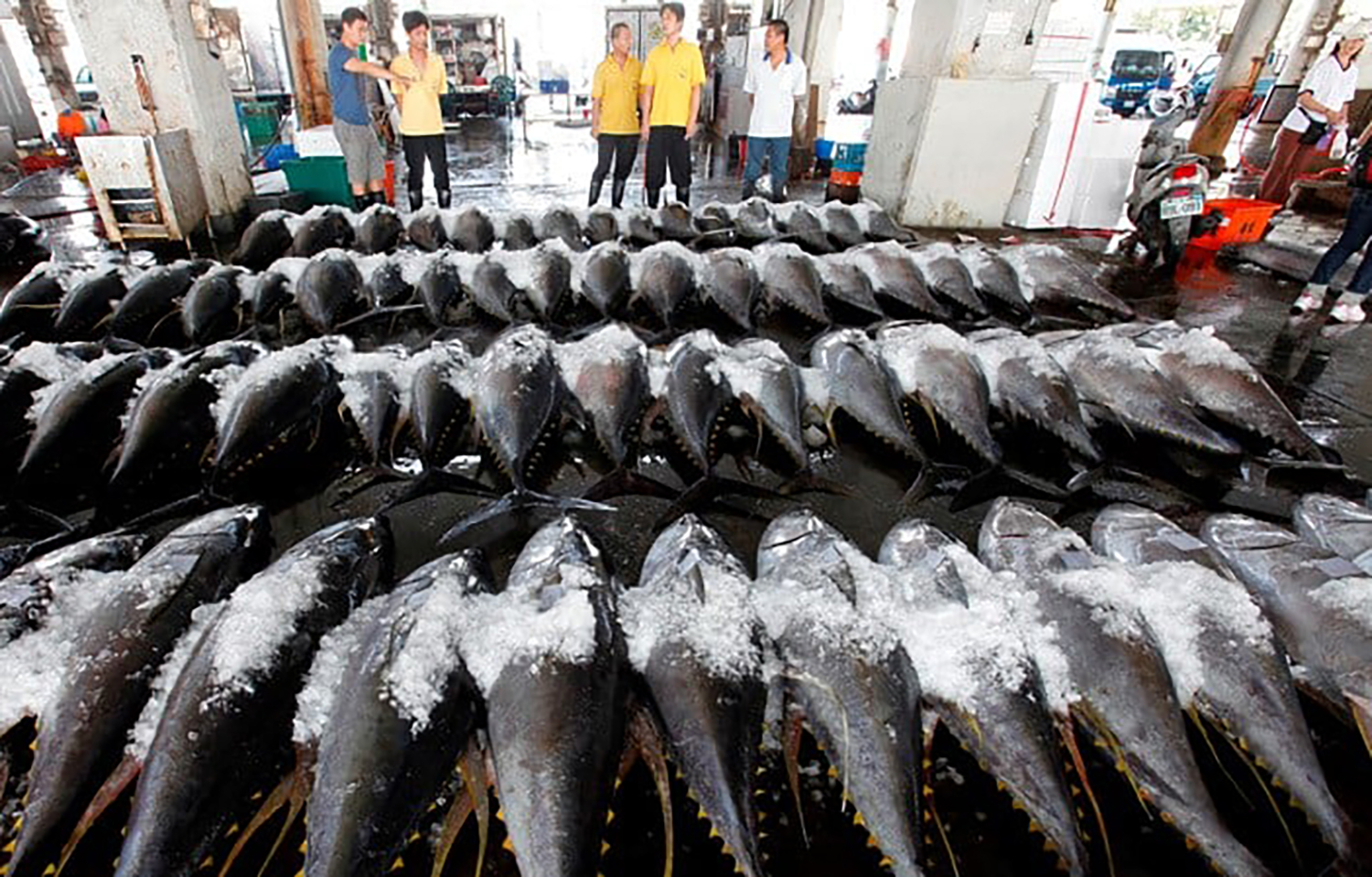
A report recently released by London, U.K.-based sustainable finance nonprofit Planet Tracker highlights how deeply China’s distant-water fleet is entrenched in the global tuna industry and whether the Chinese government has the ability, or desire, to effectively regulate its fishing industry.
Titled “Fishful Thinking,” the report points out China’s state-owned companies have cornered the tuna portion of the country’s massive distant-water fishing output, while private companies dominate the less-profitable squid-fishing sector.
The subsidies China hands out to its distant-water fleet have been the subject of scrutiny at ongoing World Trade Organization (WTO) negotiations to end subsidies leading to overfishing and overcapacity.
China acknowledged some of its vessels do not comply with a 2022 WTO deal limiting subsidies, but pledged to ensure it adheres to the deal’s terms. However, the depth at which the government is entrenched in the nation's tuna-fishing industry and the sector's profitability calls into question whether China will ever effectively regulate its own industry, according to the report.
“State-owned enterprises control at least half of tuna production, which is relatively concentrated, with just 20 vessels – all purse-seiners – accounting for 43 percent of the total catch,” the report said. “Tuna is also far more profitable than the average [species]. This is especially the case for tuna purse seining, with an average estimated gross margin of 37 percent, compared to 14 percent for the overall fleet.”
The Planet Tracker report ranked Chnia's fishing firms by 2022 revenue earnings, emphasizing just how profitable the industry is for the Chinese government and other major investors.
The state-owned China Agricultural Development Company (CADC) hauled in earnings of CNY 1.8 billion (USD 252 million, EUR 234 million) in 2022, ahead of second-ranked Zhejiang Ocean Family, a privately-owned firm that earned CNY 1.2 billion (USD 168 million, EUR 156 million) in revenue.
Ranked third was Pingtan Marine, a firm delisted from the Nasdaq Stock Exchange in 2023 after U.S. authorities placed a series of sanctions on the company due to illegal fishing.
Shanghai Kaichuang Marine International, another state-owned firm, ranked fourth, earning CNY 851 million (USD 119, EUR 110 million) in 2022. Kaichuang claims on its website to have the largest tuna purse-seine and trawler fleets in China.
Beijing is not the only place where officials are looking to cash in on tuna profits in the country. A share of the tuna spoils trickles down to municipal governments, such as Shenzhen in the nation’s southeast, which has sought to become a global tuna hub by paying subsidies to local fishing companies to land tuna for processing and trading.
That profitability, mixed with the fact that the country’s national and local governments have plans already in place to expand government involvement in distant-water fishing, serves to undermine thorough regulation of the sector, according to the report.
In order to ensure the continued profitability of the Chinese tuna fleet, the industry relies on access to the exclusive economic zones (EEZs) of West and Central Pacific island nations.
Thus, China’s government has focused its vast diplomatic resources on building ties to Pacific island states with major tuna resources, such as through development aid and fisheries training to countries including Kiribati, which boasts one of the world’s largest EEZs at 3.5 million square kilometers and one of the world’s most productive tuna-fishing grounds.
This push into foreign EEZs is likely to continue, according to the report, as the warming effect of climate change on the world’s oceans is expected to push tuna-fishing efforts away from the Pacific islands into the high seas. This is likely to push Chinese fleets into Western Africa, which is already subject to “high exploitation” by Chinese and European fleets.
With bad behavior in China’s seafood industry unlikely to end any time soon, Planet Tracker warned that international investors are exposing themselves to major risk by getting involved in the sector.
It also recommends China issue a “Hai Feng” bond to the sector, which is a blue sustainability-linked sovereign bond that would reward traceability and transparency in the nation’s fleet, paving the way for a transition within its fleet to sustainable and traceable fishery operations.
By reforming its subsidy system to penalize illegal fishing and labor abuse, China can reduce risk for investors and ensure a more sustainable long-term future for the sector, the report said.
