



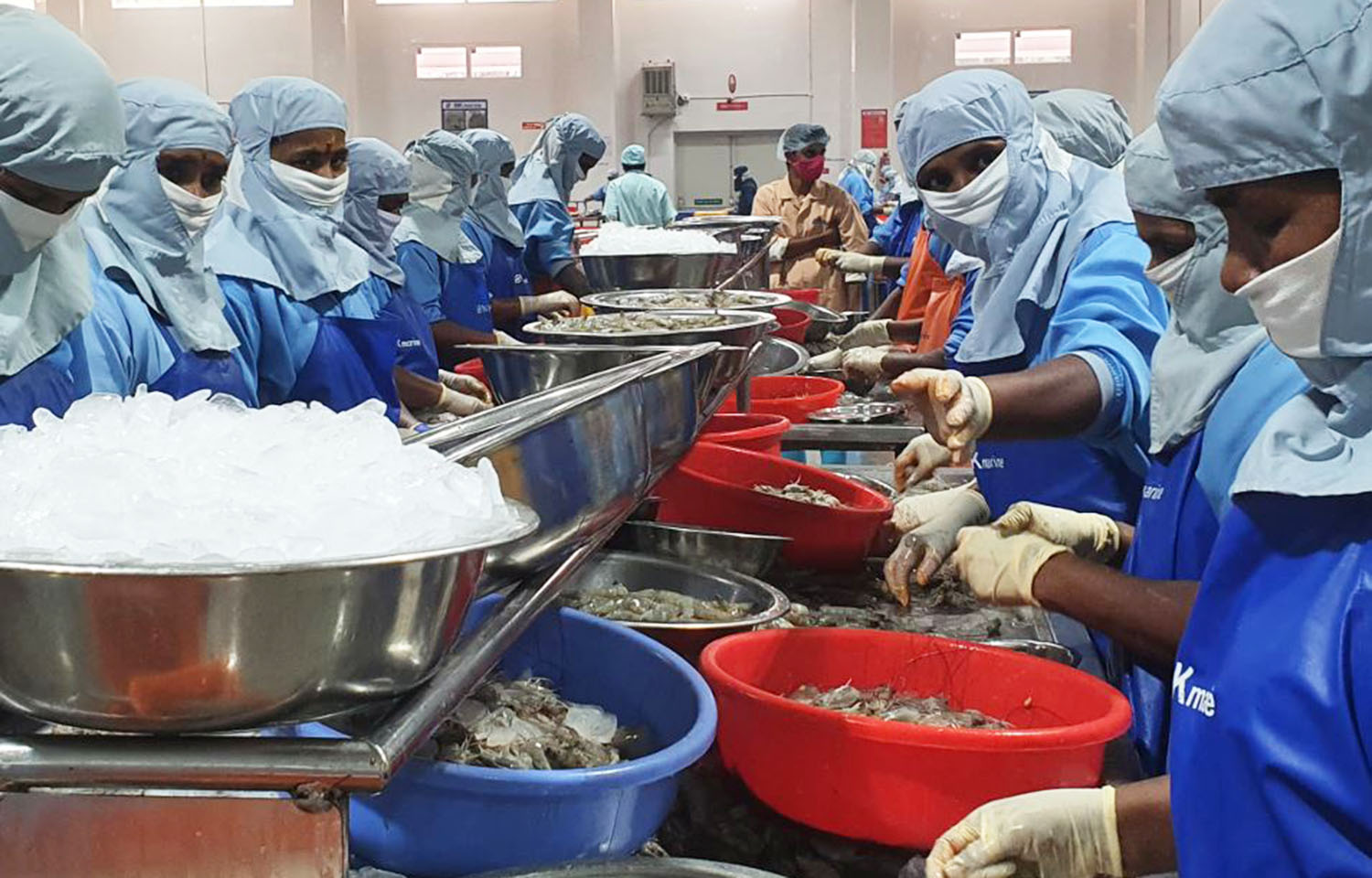
A new reporting series by CNN has focused on India’s shrimp-processing industry, alleging ongoing labor issues and a lack of oversight.
The report, which is part of CNN’s ongoing “The Great Illusion” series, interviewed migrant women and girls working at seafood plants in Andhra Pradesh, India. While the majority of those interviewed said their lives had improved overall thanks to the jobs, it also revealed what CNN described as extreme working and living conditions with long shifts and no days off – in violation of India’s labor laws.
According to CNN, some of the women interviewed would work 12-hour days every day and did not get paid for overtime or days off. Under India’s Factories Act, the country mandates a maximum 60-hour work week, with overtime to be paid after 48 hours of work.
The report also said the women – many of whom migrated from other Indian provinces to work in Andhra Pradesh – were only allowed to leave the premises once a month for shopping trips. The monthly pay of the women also stood at roughly INR 11,000 (USD 127, EUR 122), less than the legal minimum monthly wage.
Interviews with recruiters for the processing positions also revealed incentives for them to keep workers on site.
“Recruiters said there were company restrictions on the movement of employees, and some contractors did not allow workers to return home when they wanted to,” CNN wrote. “Another recruiter, Santosh, alleged some contractors – either employed directly by the companies or acting as third parties to bring in laborers – did not allow workers out to visit their families as the time off meant ‘their commission becomes less.’”
The new report in CNN adds to existing reporting on alleged forced labor and exploitation in India’s shrimp-processing industry. In March 2024, separate reports from the Corporate Accountability Lab (CAL), the Associated Press, and the Outlaw Ocean Project all detailed stories of labor issues in Indian shrimp hatcheries, farms, peeling sheds, and processing plants.
After the separate reports, the U.S. Department of Labor added shrimp manufactured in India to the 2024 “List of Goods Produced by Child Labor or Forced Labor.” The DOL’s Bureau of International Labor Affairs (ILAB) issued a report that highlighted poor conditions at peeling sheds in Andhra Pradesh, and cited the CAL, AP, and Outlaw Ocean reports.
“Workers often reside at or near the worksite in employer-provided housing – typically in a remote location – and severe security measures including lock-ins and surveillance preventing workers from freely leaving the premises,” the ILAB report states.
CNN’s new investigation highlighted CAL’s report and also said interviews with the Marine Products Export Development Authority (MPEDA), Ministry of Commerce and Industry, and the Ministry of Labor and Employment revealed efforts to charge companies for labor violations. MPEDA told CNN the Labor Department of Andhra Pradesh had investigated 496 establishments and issued charge sheets against 192 for labor violations.
One official told CNN the labor officials have no power to inspect any factories and that power lies solely with the state labor commissioner.
“The official added that a mid-2024 inspection of processing plants in the district, found them all to be in violation of various laws, ranging from missing attendance and overtime registers to absent appointment letters and pay slips. CNN requested documentation of the inspection but has not received it,” CNN wrote.
The report also said it discovered instances of illegal child labor and interviewed one girl of 12 who worked in a processing plant.
MPEDA told CNN it has been working since the initial investigations to address concerns about the labor rights violations and that it has formed a task force to identify more issues.
The Indian shrimp industry, when the three initial reports on labor issues were published, denied some of the allegations and claimed they were causing harm to the workers they claimed to be protecting.
“We are the leading trade association in India representing shrimp exporters, yet AP reporters never reached out to us for comment or input prior to publication,” Seafood Exporters Association of India President Pawan Kumar told SeafoodSource.
