




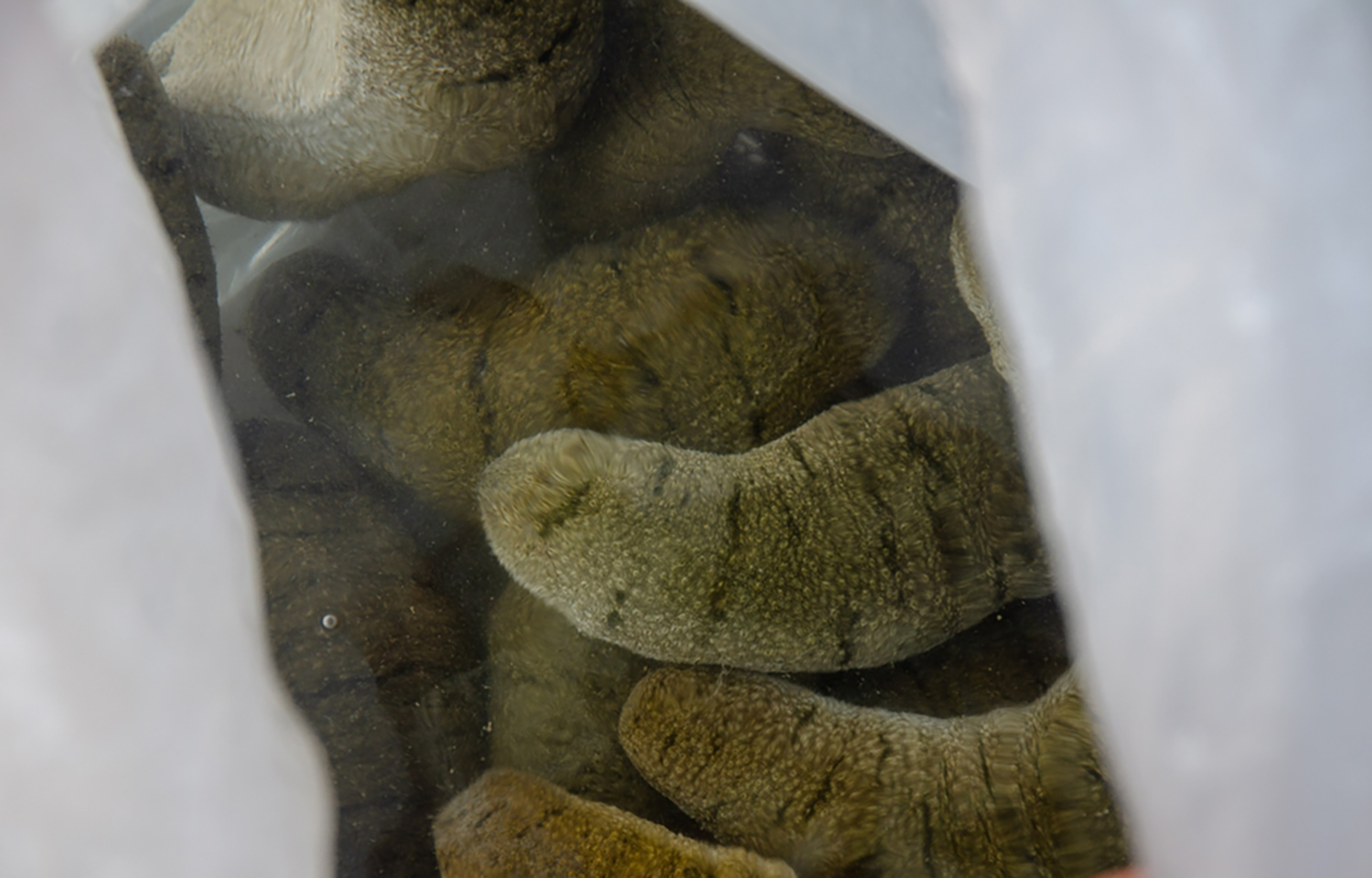
Oman has extended a ban on fishing for sea cucumbers as a regulatory measure to protect the species from overfishing and allow the stock to grow back to healthy levels.
Oman Minister of Agriculture, Fisheries, and Water Resources Saud bin Hamoud Habisi said the extended ban will be in force until 2030 – a five-year period the government intends to use to attempt to stabilize the population of the country's main sea cucumber species, Holothurian scabra, which is the most harvested species in Oman.
The minister also said the ban has been extended to buying, selling, transporting, storing, and exporting the species.
In the past, Oman allowed fishers to collect sea cucumbers for six months each year before enforcing a closed season. In 2018, Oman banned fishing for sea cucumbers for a year and then imposed a two-year ban to the end of 2020. The ban extended for another year in 2021 and then three years to the end of 2025, making the newest ban the fifth such action in the last seven years.
These actions come after studies have found falling density and size of Holothuria scabra in the Omani waters of the Arabian Sea.
One study conducted by Sultan Qaboos University found evidence of overfishing, including "a sharp decrease in population density, critically reduced to fewer than one individual per hectare, a trend observed in Oman and globally."
The study, which was carried out across six fishing sites, said that the "mean size of sea cucumbers and population densities were much lower in populations closer to human settlements, suggestive of overfishing."
Oman is not the only place where sea cucumber populations have plummeted.
A 2022 survey found that the number of sea cucumbers in waters off the Seychelles dropped 30 percent between 2004 and 2021.
Among the findings was that the black teatfish in the Seychelles is under serious threat, with the species’ population crashing from 7.5 million in 2004 to 1.4 million in 2021. Numbers of two other species, white teatfish and pentard, declined from 4.5 million for each species in 2004 to 500,000 and 2.4 million in 2021, respectively.
In the past, the Convention on International Trade in Endangered Species (CITES) has suggested listing sea cucumbers under its Appendix II, which allows species to be traded only under regulations that ensure the business involved in the trade are implementing sustainable practices that don’t affect the viability of the species.
Some of these efforts to designate certain sea cucumber species have been allegedly blocked by governments such as China’s, where sea cucumber trade is extremely lucrative.
According to the latest edition of the China fishery yearbook published by the Chinese Ministry of Agriculture and Rural Affairs, Chinese sea cucumber output grew from 174,340 metric tons (MT) in 2018 to 248,500 MT by 2022 – a trend that would be stymied by a CITES designation.
