


One of the largest blue swimming crab importers in the U.S. is looking for creative ways around higher prices for the species due to import restrictions and shipping issues.
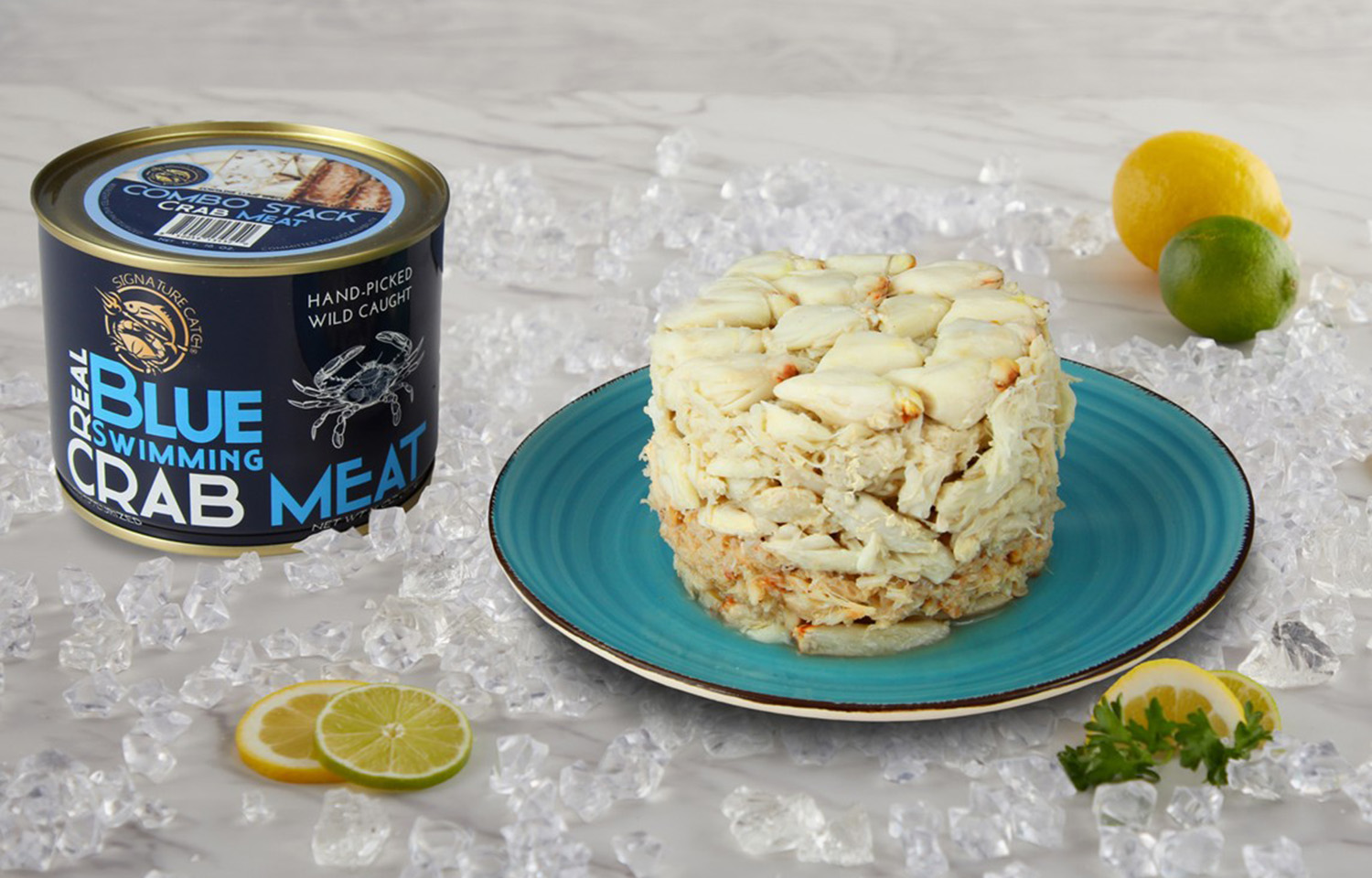
Weston, Florida, U.S.A.-based Supreme Crab & Seafood, Inc., which imports blue swimming crab, red swimming crab, tuna, and related seafood products, recently debuted a new “Signature Catch Blue Swimming Crab Combo Stack” at the Summer Fancy Food Show in late June.
The company told SeafoodSource the Signature Catch Blue Swimming Crab Combo Stack was developed to make the most of every part of the crab’s natural yield.
“Rather than producing the typical size or grade, the combo stack encompasses the natural yield of the crab as it comes, combining the most flavorful meat (claw) with white meat and the larger, show-stopping presentation pieces of jumbo lump,” Supreme Crab Manager of Brand Assurance Alyssa Chowdhury told SeafoodSource.
Since the full natural yield is used rather than isolating premium sizes only, it comes in at a significantly lower price point than higher grades, giving customers an accessible way to stay in the category as raw material costs continue to climb industrywide, the company said in a release.
The larger grades of blue swimming crab meat have hiked up around 30 to 40 percent over the past year, Supreme Crab CEO Troy Turkin told SeafoodSource.
The core driver behind higher costs are the updated Marine Mammal Protection Act (MMPA) import provisions being enforced by NOAA.
The MMPA battle has been waged since August 2025, when NOAA Fisheries announced that 240 fisheries from 46 nations were denied comparability findings. Those findings included several swimming crab fisheries in multiple countries; based on estimates by the National Fisheries Institute, those denials would have cut off as much as 89 percent of all imports of the species.
A group of companies and NFI sued over the findings, and NOAA and NFI ultimately settled the lawsuit by allowing nations who were denied comparability findings to update their regulations and reapply, and some – such as Vietnam, Indonesia, and Sri Lanka – were able to successfully demonstrate compliance, secure a comparability finding, and regain access to the U.S. market.
However, other key countries did not obtain a compatibility finding. Bans on imports from the Philippines and Venezuela resulted in more than 20 percent of blue swimming crab that would normally enter the U.S. market no longer being imported, Turkin said.
"These were significant source countries, and their absence has tightened available volume across the category,” he said.
More recently, a shortage of empty shipping containers in Vietnam and Indonesia is resulting in higher costs and lead times, Turkin said.
"Exporters are struggling to secure containers to move product, which is extending import timeframes. As a direct consequence, ocean freight costs have doubled for us in recent shipments,” he said.
That has only added to the costs facing the crab industry, Turkin said.
“Between regulatory-driven sourcing restrictions and the compounding logistics squeeze on freight, the crab supply chain is facing pressure from multiple directions simultaneously, on availability, cost and timing,” Turkin said. "Products like the Combo Stack, which make efficient use of full natural yield, are one-way we are working to preserve value for customers in this environment.”
The company said the Combo Stack is versatile for foodservice and retail and can be used in crab cakes, dips, salads, bisques, and composed entrées.
"Its balanced mix of texture and appearance makes it a fit for manufacturers, broadliners, retailers, and restaurant chains looking for a single product that performs well in both flavor-forward and presentation-forward applications,” the company said.
