



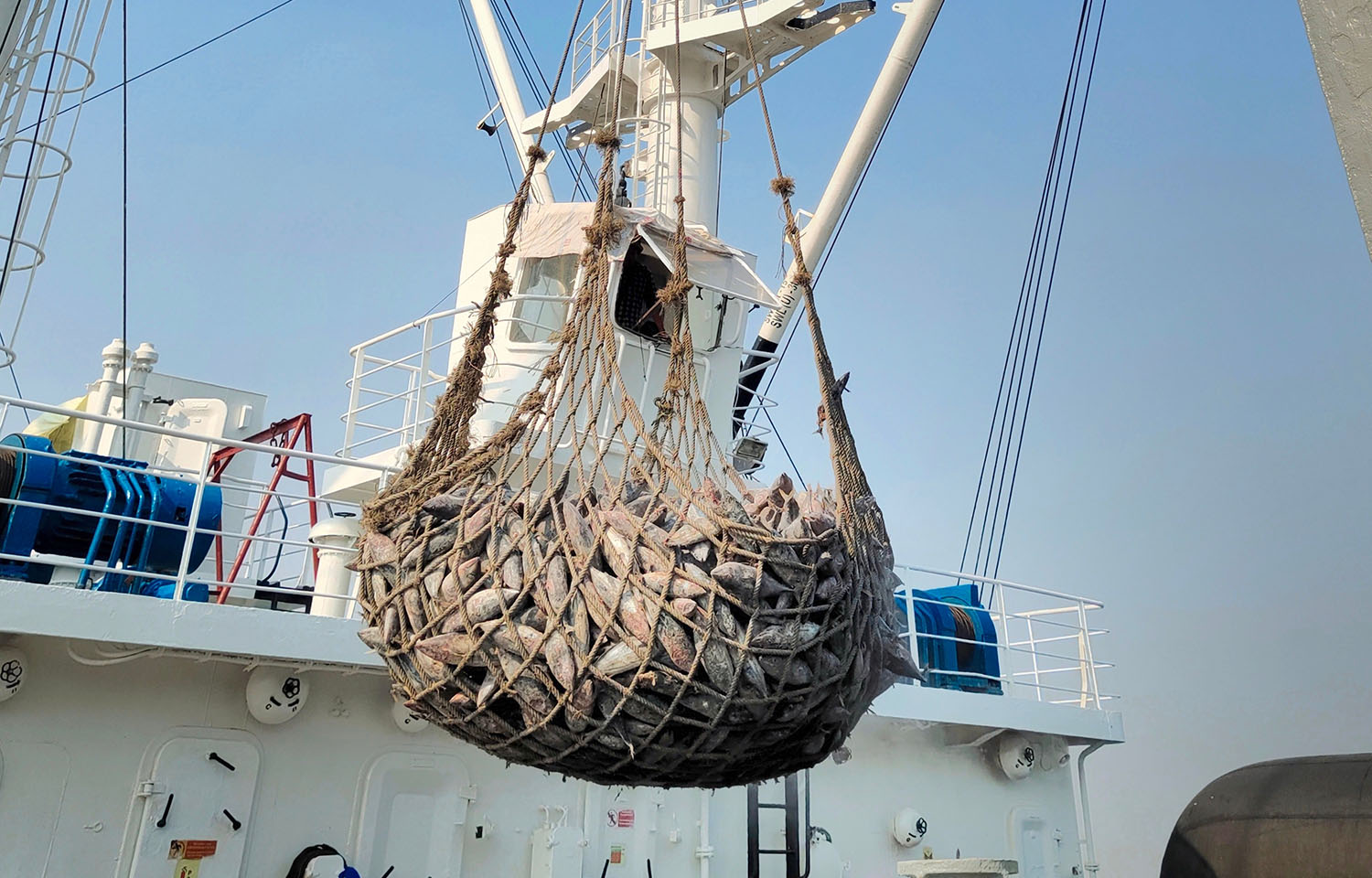
A recently published study performed by The Pew Charitable Trusts found that tuna transshipment within regional fishery management organization (RFMO)-managed fisheries represents as much as a quarter of all tuna sales globally.
The study looked at data collected by RFMOs like the Indian Ocean Tuna Commission (IOTC) and the Inter-American Tropical Tuna Commission (IATTC) on transshipment from 2012 to 2018. According to Pew, in 2018, 1.4 million metric tons (MT) of tuna were transshipped in 2018, with a total value of roughly USD 10.4 billion (EUR 9.3 billion).
That means transshipment is responsible for roughly one-fourth of the value of global tuna fisheries, which Pew estimates is valued at USD 40 billion (EUR 36 billion) each year.
The Pew Charitable Trusts Senior Associate Raiana McKinney – who works on Pew’s international fisheries project – told SeafoodSource that the study is the first compilation of global data of its type.
“This chart book is a compilation of the data that was reported by observers on board those vessels, as well as the vessels themselves,” she said.
McKinney said the goal of the research was to get a more holistic picture of how many products are actually being transshipped and what the total value is of all of those products.
“This is the first compilation of this data on such a global scale,” she said. “Most of the time this data is focused in each of these regions, but no one has taken all of these puzzle pieces and put it together to look at what’s at stake globally – especially for such a global industry and such a highly migratory species.”
McKinney said transshipment is not an issue in and of itself. Transshipment refers to the practice of fishing vessels transferring their catch to another vessel that can either store or bring that catch to shore, minimizing interruptions to fishing.
“Transshipment is simply logistics,” she said. “It’s a process in which many fisheries rely on to get their catch to shore quickly.”
Pew has already performed studies on transshipment to shine more light on the practice and identify where it is used and why. A study it performed in 2023 identified that just a few countries performed most transshipment globally, and the subject is often included in other studies.
Transshipment can, however, be a means for bad actors within the fishing industry to get around oversight.
“It’s not been well-regulated, which has opened a lot of regulatory gaps and loopholes that have allowed for illegal products to end up in the marketplace,” McKinney said. “It has also facilitated conditions for other transnational crimes such as human trafficking and drug trafficking.”
Vessels that transship products without being observed can allow illegal catch to get mixed in with legal catch, effectively “laundering” those products and allowing illegal, unreported, and unregulated (IUU) fishing to continue.
“Transshipment is often a vehicle for IUU fishing, so we’re really trying to get a better sense of how much is at stake for this specific part of the supply chain,” she said.
Tuna vessels are also transshipping more than just tuna, the Pew study found. Billfish, sharks, and oilfish were also all transshipped, but often, those fish aren’t a part of an RFMO’s management.
“A significant amount of oil fish is being transshipped and reported to the IOTC,” McKinney said. “However, IOTC doesn't have any legal mandates to actually regulate or manage those species, and so it begs the question of greater cooperation between regional fishery bodies – particularly for data that should be going to other RFMOs to better regulate those fisheries.”
According to McKinney, a key takeaway from the study circles back to one of Pew’s other priorities – observation onboard vessels. While the majority of tuna transshipped at sea comes from purse seine vessels, a little over 15 percent of it comes from longline vessels which often carry lower observation thresholds.
Pew and other organizations like the International Seafood Sustainability Foundation have called on RFMOs like the IATTC to establish more robust observation standards on longline vessels. Currently, only 5 percent of all longline vessels in the IATTC have observer coverage.
“5 percent of most things usually isn’t quite enough,” McKinney said. “In fact, scientists have recommended that they need at least 20 percent observer coverage in order to do their scientific assessments and to get a better understanding of the impact of these fisheries on the wider ecosystem.”
McKinney added that RFMOs also need to update their transshipment standards to give a better understanding of its role and the volumes it is handling.
“WCPFC [Western and Central Pacific Fisheries Commission] hasn't updated their transshipment standards in over 15 years, and still has a lot of the reporting loopholes,” McKinney said.
The Food and Agriculture Organization has issued transshipment guidelines that have been adopted by a number of RFMOs, and McKinney said that adopting those rules would go a long way toward better understanding the practice.
“In an ideal world, five years from now, all of the tuna RFMOs will have updated their transshipment measures in line with those FAO guidelines, and that you can get a better holistic sense of the full scope and scale of these operations,” she said.
