



Canadian watchdog organization SeaChoice has issued a report condemning nearly all major Canadian retailers for failing to address human rights abuses in their supply chains.
“Voluntary efforts from retailers are far from enough, and regulations in North America remain largely inadequate to address the issues of illegal product and forced labour [in the seafood chain],” SeaChoice Representative Christina Callegari said.
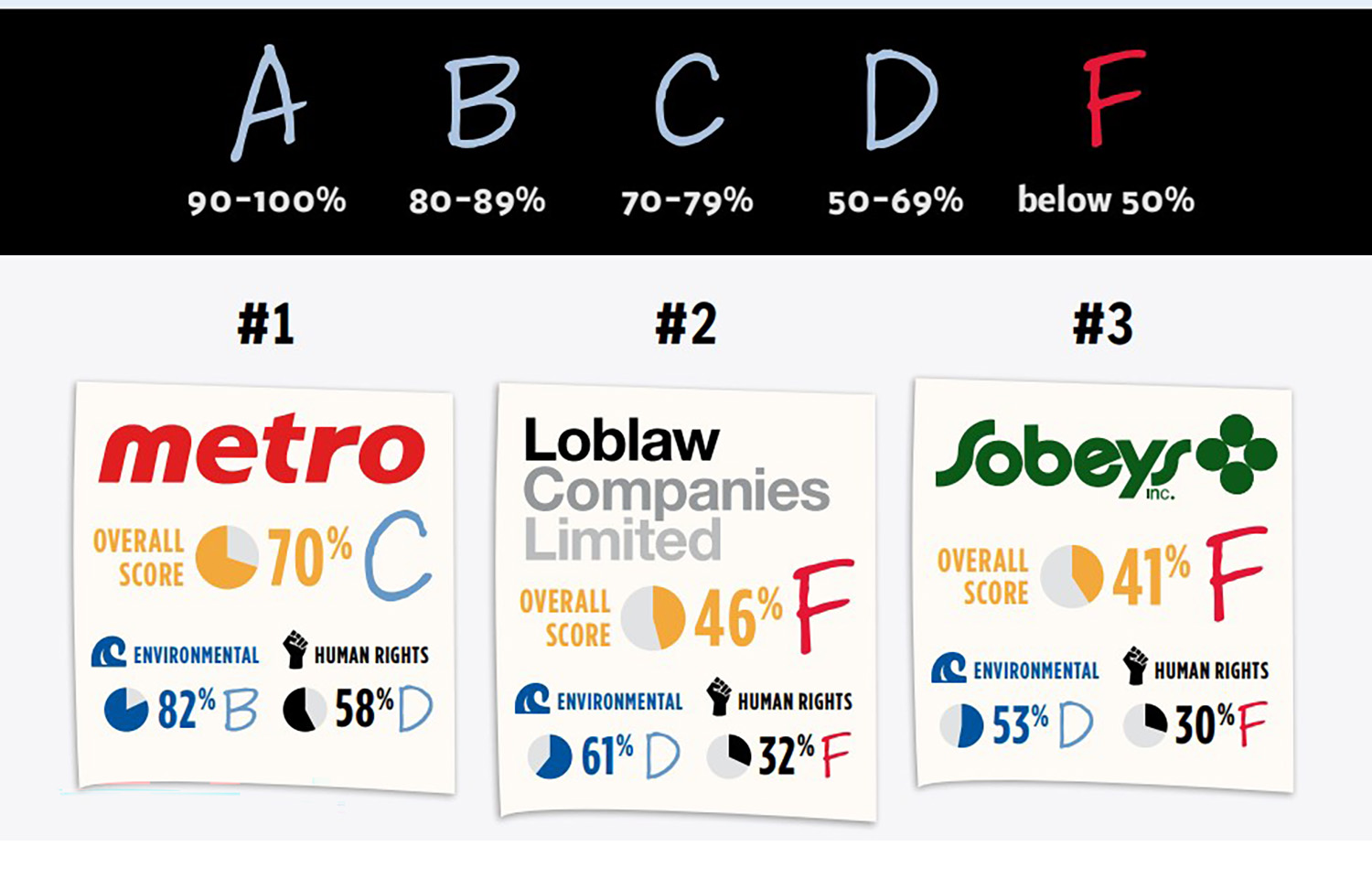
The allegations emerged from SeaChoice’s new “Seafood Progress Report,” which assigns grades to retailers by assessing the company’s seafood policies and procurement processes against 22 key performance indicators derived from the Conservation Alliance for Seafood Solutions’ Common Vision for Sustainable Seafood. The companies assessed included Metro, Loblaw Companies Limited, Sobeys, Costco, Walmart Canada, and Pattison Food Group.
Only Metro received a passing grade of C. All the other companies failed the assessment.
The grades reflected what SeaChoice called the retailers’ “lack of due diligence (especially on human rights) and avoidance of responsibility for much of their seafood.”
A key takeaway the report produced, according to SeaChoice, was that retailers were willfully ignoring the problem, despite mounting evidence of illegality and human rights abuses in the seafood supply chain.
“Major retailers need to use their position to advocate for better data capture and traceability, as well as to improve enforcement to deter illegal practices and trade,” Callegari said.
One way that retailers failed to reckon with abuses in their supply chains, according to the report, was by excluding much of the seafood they sell from their own sustainability policies.
These omissions, the report said, sometimes allowed retailers to ignore the conditions which produced as much as half the seafood products in their stores.
“The investigations on seafood supply chains are piling up. Retailers simply can’t afford to consciously avoid taking responsibility for seafood products tainted by human rights and environmental crimes anymore,” SeaChoice Supply Chain Analyst Dana Cleaveley said.
The report also said that at least half the retailers it assessed do not trace critical information on their seafood products back to their sources.
Retailers have the power to demand that their suppliers give them complete traceability and sourcing information, Callegari said, especially as recent geopolitical developments have increased competition.
“With the recent trade tariffs increasing demand for local products that are, for the most part, easier to trace than imported seafood, retailers are in a position to focus their sourcing efforts closer to home,” she said.
This was not only an ethical imperative but a risk management necessity, Cleaveley added.
“The rampant abuse behind seafood puts retailers at risk of legal action, reputational damage, and supply chain interference. A due diligence approach to sourcing seafood is the only way forward for retailers,” she said.
SeaChoice is a partnership between three sustainability organizations: The David Suzuki Foundation, Living Oceans, and the Ecology Action Centre. It has long been active on the issue of traceability among retailers and has criticized Canadian grocers in the past, alleging that they made unverifiable sustainability claims and that they failed to live up to their traceability goals.
It has long campaigned for federal requirements on traceability, and with a number of other environmental groups, it recently criticized the Aquaculture Stewardship Council’s new Farm Standard for failing to address issues in salmon farming.
