






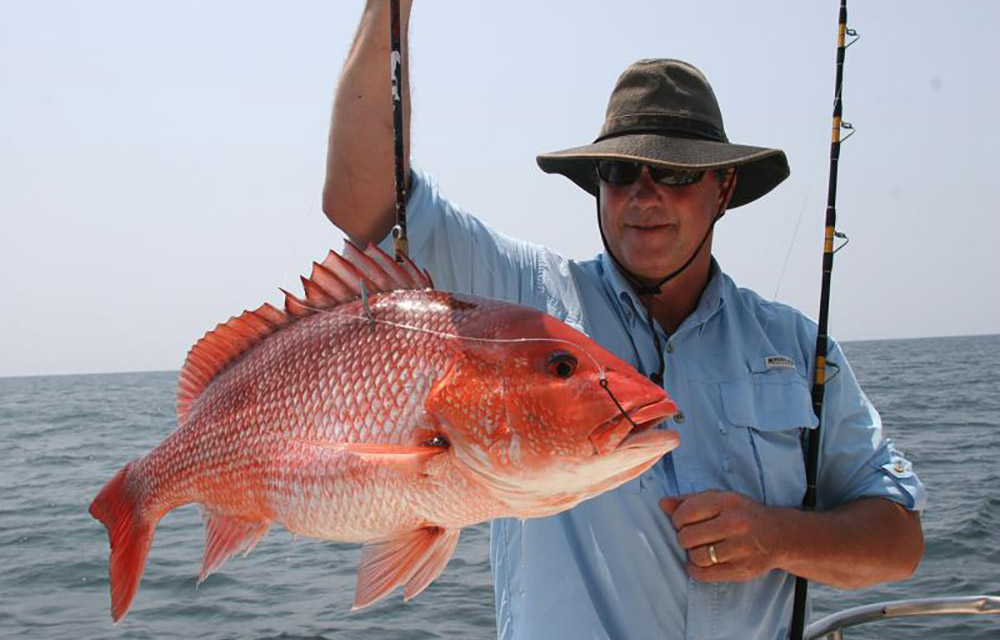
Officials from three Southern states are again asking the U.S. federal government to cede its regulatory authority over red snapper fishing in the South Atlantic Ocean to state governments, arguing that more local control of the species will be better for the fisheries.
While the South Atlantic red snapper fishery is federally designated as subject to overfishing, recreational fishers claim the fish population is far greater than official numbers, and state representatives and officials have resisted all efforts to limit fishing.
However, federal regulators have been forced into action due to three lawsuits filed by conservation groups. In settling those lawsuits, NOAA Fisheries agreed to create a new management plan for the fisheries by June 2025 that addresses overfishing. That plan – known as Amendment 59 – was released in June, setting a total annual catch limit (ACL) of 509,000 fish.
Upset with federal limits on recreational red snapper fishing, state government officials and representatives have been asking the federal government to hand over control of red snapper to the state governments.
Early in October, attorneys general for the states of Florida, Georgia, and South Carolina sent a letter to U.S. Secretary of Commerce Howard Lutnick requesting the government transfer fishery management to the states.
“In short, states – not the federal bureaucracy – are the best managers of their own natural resources. To better facilitate the transfer of fishery management authority to the states, we would encourage you to consider taking the following steps,” the state officials said in the joint letter. “We ask you to restore balance to our federalist system and empower states to manage their own resources. We are confident that the results will speak for themselves.”
The letter goes on to make three main requests – first, that regulators rely on the forthcoming Great Red Snapper Count (GRSC) in managing red snapper stocks.
The GRSC is a Congressionally funded, independent effort to assess the red snapper population in the South Atlantic. Critics of the federal government’s red snapper management have pushed the GRSC as a better data source that will report a healthier population. Lawmakers in Congress have attempted to block NOAA Fisheries from making major changes to red snapper management until the count is completed.
Accordingly, the officials also asked Lutnick in their second request to transfer data gathering to the states, giving them say over the data used to manage the stock, not NOAA Fisheries.
“The states are already performing much of this work, and we have already seen the positive results of a state-centered approach in the Gulf of America,” the officials said.
Most importantly, however, the attorneys general also asked the department to transfer management authority of red snapper over to the state governments.
“In doing so, you should use whatever tools are at your disposal, including exempted fishing permits and emergency regulations. This should include immediate consideration of state-led experimental fishing permits [EFP] to fully manage the fishery while the management amendment process is completed,” the officials said.
The letter follows a similar request sent to Lutnick in June by the states’ respective governors, who disputed official data on the South Atlantic red snapper fishery.
“The current situation in the South Atlantic is clear: 1) There is an unprecedented abundance of red snapper; 2) red snapper is no longer overfished or undergoing overfishing; and 3) a large quota increase is warranted. While prior leadership has struggled with accepting these facts, our states are equipped to effectively manage the stock to balance public access to the resource while maintaining a healthy stock for the long-term health of our fishery,” the governors said.
The governors asked Lutnick to approve EFPs that would allow state governments control of recreational fishing.
According to an action plan signed by the state governments of Florida, Georgia, South Carolina, and North Carolina and sent to the U.S. Congress South Atlantic Red Snapper Task Force in September, the states would apply for EFPs annually to develop and test data collection programs for up to three years while the South Atlantic Fishery Management Council formalizes state management.
“State management of South Atlantic red snapper is the right idea at the right time,” Center for Sportfishing Policy Director Jeff Angers said in a September statement. “We’ve seen in the Gulf of America that when states lead with sound science and local common sense, everyone wins. Anglers get more days on the water; conservation outcomes improve, and coastal economies thrive. The leadership shown by Florida, Georgia, South Carolina, and North Carolina offers real hope that the broken federal system will finally give way to a management model that reflects the reality on the water.”
While the requests to Lutnick focus on recreational fishers, regulation of both the recreational and commercial fisheries have been tied as both sides fight for a larger share of the limited quota of fish.
That fight has continued with Amendment 59, which gave 72 percent of the ACL to the recreational sector and 28 percent to the commercial sector.
Commercial fishers and processors claim this plan was unfair since the top issue in the red snapper fishery is dead discards and, virtually all of the red snapper discard mortalities that were recorded from 2021 to 2023, took place in the recreational sector, according to NOAA Fisheries.
In July, commercial fishers, seafood processors, and buyers from North Carolina and Florida filed a joint lawsuit challenging Amendment 59 for not actually addressing the issue of dead discards.
“By consigning dead discards to management outside the ACL system, the Amendment 59 Final Rule also allows a de facto reallocation of red snapper catch away from the commercial sector and toward the recreational sector – which is responsible for virtually all of the dead discards,” the lawsuit states.
If states plan to use EFPs to increase the number of fish they harvest above the ACL, it could exacerbate tensions with the commercial sector over the shared resource.
The South Atlantic state governments have stated that they want to increase the number of fish recreational fishers can harvest, and an EFP request submitted by Florida earlier this year would “exempt that harvest from the red snapper recreational bag and possession limits, recreational ACLs, general reporting requirements for charter vessels and headboats, and accountability measures.”
The states’ requests to Lutnick have been silent on how their plan would impact the commercial sector, and it’s unclear whether increased recreational fishing would require cuts to commercial opportunities.
