





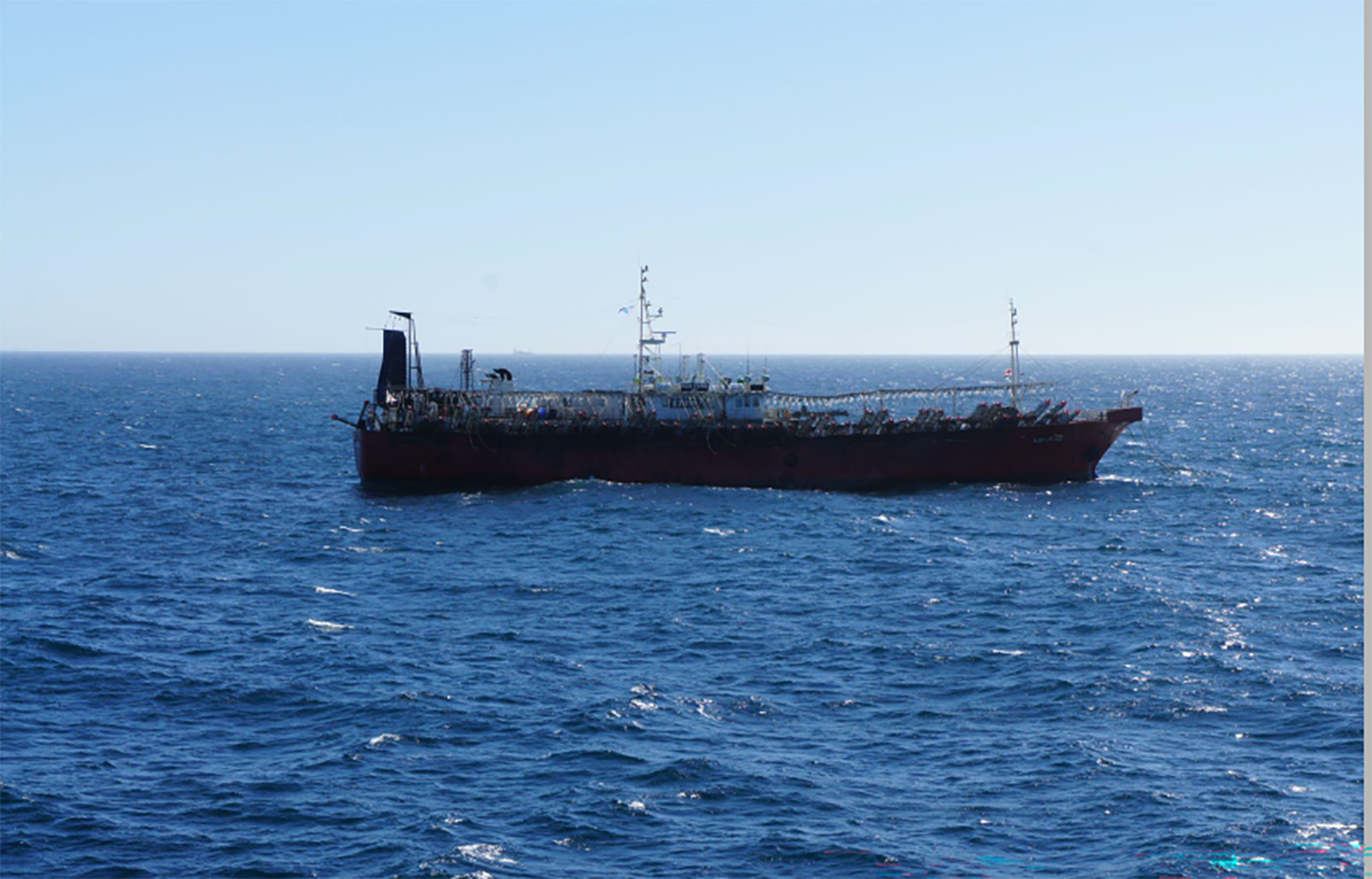
Chinese corporations now control 63.1 percent of Argentina’s squid fleet, while actual Argentine capital accounts for just 17.9 percent of ownership, according to Milko Schvartzman, the ocean policy coordinator at Argentina-based environmental NGO Circulo de Politicas Ambientales.
Schvartzman’s recently released report, titled “China and the Control of Fishing Within Argentina’s EEZ,” investigates the transfer of power within Argentina’s squid fishery.
The report analyzes all 84 vessels with cephalopod permits in Argentina’s exclusive economic zone (EEZ), identifying the ownership structures behind them. After conducting analysis of fishing permits, corporate ownership records, customs regulations, and satellite vessel tracking, the report found Chinese capital – even that linked to illegal, unreported, and unregulated (IUU) activity – has progressively entered the sector over the past two decades through acquisitions, local subsidiaries, and vessel reflagging.
At the same time, the report asserts Argentina’s fisheries authorities enabled this process by relaxing regulatory oversight.
Epitomizing the trend, the report points to China National Fisheries Corporation (CNFC) and Shanghai Fishery Group (SFG) to illustrate how companies linked to illegal fishing were later allowed to legally enter the Argentine system.
In the case of CNFC, the report shows that in 2006, Argentina initially rejected permit applications from CNFC-linked companies because of their association with vessels previously caught fishing illegally inside Argentina’s EEZ. However, after regulatory changes in 2013 removed stricter disclosure requirements regarding ownership structures, those same corporate networks successfully gained entry to operate legally under Argentine permits, according to the report.
“I always monitor the fleet, and this year, I detected several incursions of foreign jiggers into the exclusive zone that were not detected by the prefecture or the Navy and I reported this to them,” Schvartzman told SeafoodSource. “Before, when there was illegal fishing happening, Argentine fishing vessels often denounced it … but now, none of the Argentine fishing vessels that were nearby had reported anything. I understand it clearly: These are the same companies, the same shipowners, and even some are controlled by Chinese crews who are inside Argentina’s EEZ and outside of it.”
The Shanghai Fishery Group case follows a similar pattern.
Satellite maps in the report show three vessels making simultaneous incursions into Argentine waters in 2016 under conditions consistent with illegal squid fishing. Yet, by 2024, those same vessels had been formally incorporated into Argentina’s national fleet through a local subsidiary.
The report argues that Chinese dominance is not accidental but structural. One graphic maps the operations of Zhejiang Ocean Family, demonstrating how companies use both Argentine-licensed vessels inside the nation’s EEZ and distant-water fleets outside it to exploit the same squid stocks.
Further down the supply chain, Schvartzman’s report highlights a strategic system in which Chinese law treats catch from foreign waters as “domestic products.” According to Chinese regulations cited in the report, seafood caught by Chinese companies abroad can re-enter China exempt from import duties and VAT.
This tax treatment creates a major competitive distortion, the report argues, because while Argentine companies exporting to China face 12 percent tariffs and 9 percent value-added tax (VAT), Chinese-controlled companies operating from Argentina circumvent these costs entirely. In other words, the Chinese fleet gets a 21 percent price advantage.
According to the report, in 2025, Argentina exported 193,385 metric tons of squid worth USD 550 million (EUR 479 million), with China receiving 61 percent of total exports. Based on catch shares from early 2026, the report estimates Chinese-owned companies captured 64 percent of the total. Applying the 21 percent tax advantage to those exports, it calculates an annual subsidy benefit of approximately USD 45.3 million (EUR 39.5 million).
In turn, this transformative surplus allows Chinese firms to absorb Argentina’s high operating costs, outcompete independent local operators, and continue buying vessels and companies. The analysis, using average vessel market prices, calculates that this annual advantage is equivalent to the purchase of around 10 industrial squid vessels per year. At that pace, the remaining Argentine fleet could be fully acquired within a few years, the report warns.
Elsewhere in the report, Schvartzman raised another major concern: “biowashing,” or the practice of mixing legally caught squid from Argentina’s EEZ with squid caught through unregulated fishing outside the EEZ.
Figures showing processing chains and product labeling in the report illustrate how squid from different origins ends up combined in Chinese processing plants. For example, the report shows a Chinese-labeled squid product which lists a catch season extending from October to May, which is well beyond Argentina’s regulated season, suggesting a blending of regulated and unregulated supply.
The report argues this destroys traceability because once the squid is processed in China, buyers in Europe, the United States, or elsewhere cannot distinguish what portion was legally caught under Argentine regulation and what portion came from unregulated fishing.
Human rights concerns are another focus of this report and others, including documented abuse and deaths aboard Chinese fishing vessels, and are what led Schvartzman to begin investigating China’s distant-water fishing fleet.
One such instance occurred in 2021, when the only crew member of the Argentine fishing fleet who died of Covid-19 was 68-year-old Manuel Quiquinte, who had embarked on his last deployment to save money and finish building his house before retiring.
“That case started a scandal because the [Chinese fishing] company refused to take him to port, and he was agonizing for five days in his cabin on a ship that was 10 hours from port,” Schvartzman said. “Some crew members recorded the conversations they had with those who commanded the boat, who were Chinese crew members who did not even speak Spanish.”
The case revealed that some Argentine-flagged vessels had Chinese captains and naval officers, which is in violation of Argentine laws.
“After these ships would leave port, the Argentinean captains and officers on board would retire to their cabins and spend the whole deployment watching movies while the ship remained in Chinese command,” he said, explaining that Chinese captains and officers control the vessels while being listed as passengers. “I started to investigate, and I got through a request for information from the authorities to obtain the lists of crew members of a dozen vessels of a company whose final beneficiary is Chinese. They are companies based in Argentina with vessels flagged in Argentina and that have Argentine fishing licenses.”
To begin alleviating the issues rife within the fishery, the report recommends the elimination of competitive asymmetries, stronger disclosure requirements for fishing permits, stricter vetting of applicants, mandatory onboard observers, digital catch certificates, public access to fleet registries, and regional governance mechanisms for international waters.
Without these changes, Argentina’s squid fishery may become entirely controlled by Chinese capital within a decade, the report warns.
