





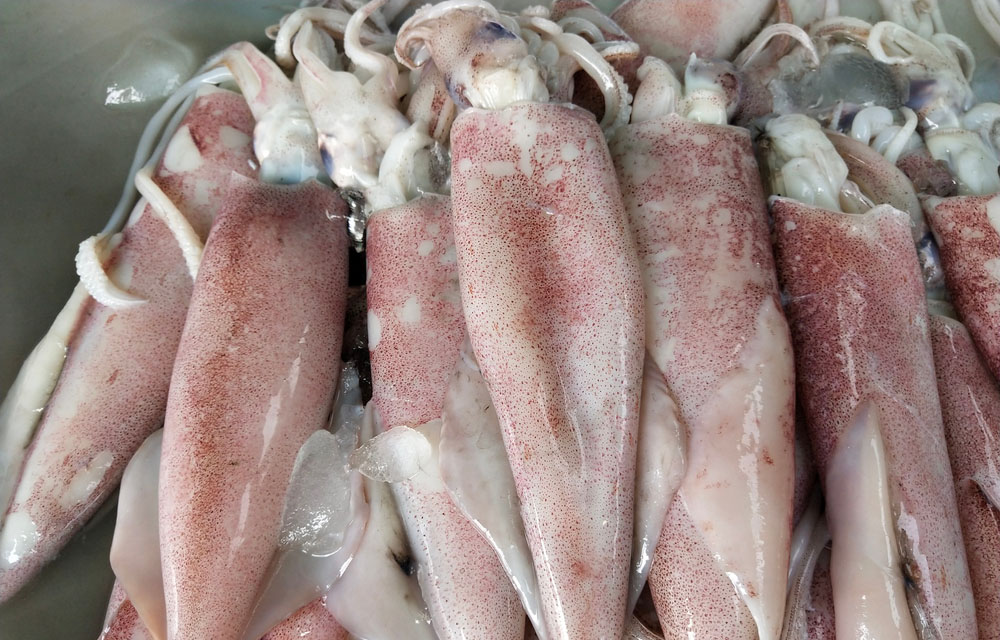
Two major advisory councils to the European Commission have called on regulators to increase scrutiny of squid imports, especially those originating from China’s fleet, to better combat illegal, unreported, and unregulated (IUU) fishing.
In a new advice issued 1 July, the Markey Advisory Council and the Long Distance Advisory Council called on the European Union to increase verifications and audits of consignments to better address IUU fishing in weak, fragmented, and largely unregulated global squid fisheries.
Global squid fishing pressure has increased drastically in recent years, with annual landings growing roughly 45 percent since the early 1990s, according to the United Nation’s Food and Agriculture Organization. China has been a major driver of that growth, with landings from its distant-water fleet growing 150 percent since 2000 and accounting for a third of the global catch.
However, that growth has also come with allegations of forced labor abuses and evidence of IUU fishing among commercial squid fleets, and China’s distant water fleet has been at the center of many of those allegations. The Environmental Justice Foundation (EJF) has reported that the growing fishing pressure on some of the largest squid fisheries is unsustainable, while documenting widespread evidence of abuse and violence towards workers. In 2023, a series of bombshell reports by the Outlaw Ocean Project on labor abuse in global seafood supply chains also highlighted illegal fishing and labor violations being committed by China’s distant water fleet of squid jiggers.
“The opacity of China’s fishing operations in the South Pacific, coupled with the extensive use of at-sea transshipment and an extremely efficient processing industry which incentives aggregation of squid supply, make it almost impossible for seafood buyers to say for certain their product is not tainted by abuse,” EJF Director of Squid Fisheries Dominic Thompson previously told SeafoodSource. “Tainted squid from vessels engaging in either fisheries or labor abuse can easily be mixed with legitimately caught squid throughout the supply chain, compromising the entire supply. Seafood buyers from the E.U., U.S., and U.K. should demand that Chinese squid suppliers work to disaggregate squid supply chains as much as possible to ensure more robust supply chain scrutiny and traceability.”
According to the advisory councils, E.U. regulations are not consistently enforced to weed out squid being sourced from IUU fishing or other unethical business practices from reaching E.U. markets.
“Uneven enforcement and lack of effective implementation of the existing legal framework creates a distortion of the E.U. single market and undermines the principle of a level playing field for fishers, both Europeans and from third countries, who comply with fisheries management and labor standards, while rewarding those that externalize environmental and social costs,” the councils stated. “In the context of largely unregulated squid fisheries, weak and uneven controls risk reinforcing precisely the practices the [EU IUU Regulation] was designed to prevent.”
Spain is the primary gateway for squid products entering the E.U., and the councils acknowledged that nation has “been at the forefront” of implementing verification and scrutinizing catch certificates. However, weakness in enforcement in other member states undermines those efforts, the councils noted.
As the world’s largest importer of squid, the E.U. can take action to reduce IUU fishing within global squid fisheries, the councils stated, and its advice included several recommendations. The advice calls on the trade bloc to reject consignments under the E.U. IUU regulation and encourages stronger implementation of CATCH digital certificates to validate fishery product origins. The councils also recommend the E.U. support Fisheries Improvement Projects, stronger management from squid fisheries RFMOs – including the establishing of an RFMO for the South West Atlantic – and digital traceability systems to improve transparency around global squid supplies.
