

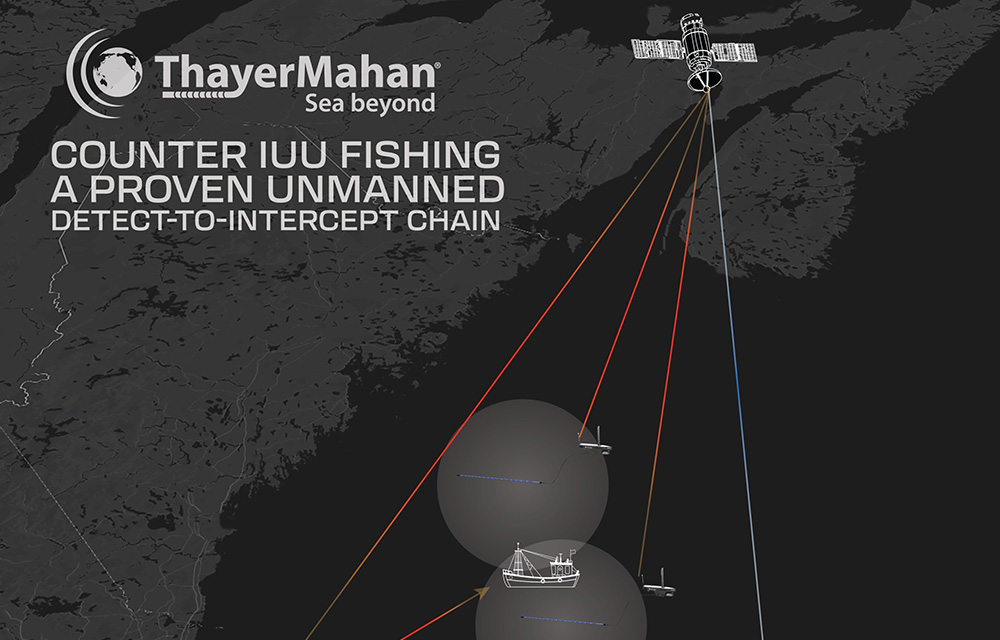
Maritime technology and surveillance company ThayerMahan reported a positive demonstration of its counter illegal, unregulated, and unreported (IUU) fishing solution with NOAA Fisheries Office of Law Enforcement, validating its technologies for future use.
"This demonstration is important for our maritime national security, and the preservation of U.S. marine resources," ThayerMahan Vice President Offshore Programs Greg Sabra said in a release. "We've proven to NOAA, the Coast Guard, and their partners that ThayerMahan's advanced sensing and data flows give them a dependable, scalable, and repeatable way to observe protected waters and areas of interest, around the clock, with no crewed vessels or aircraft in the loop. This is how the United States can combat illicit actors at operational scale."
The Groton, Connecticut, U.S.A.-based company said its Outpost systems, which are floating platforms that can be towed into place and host an array of sensors, were deployed in the Gulf of Maine for an 18-day demonstration. Even amidst high winds and heavy seas, Outpost was able to detect vessels and classify their activity. The system was able to pick up vessels that had turned off their Automatic Identification System (AIS), a common tactic in IUU fishing. Data collected by Outpost was transmitted to the U.S. Naval Research Laboratory's PROTEUS COP Maritime Domain Awareness (MDA) system for review by NOAA analysts.
The company claims its uncrewed Outpost system can fill IUU fishing enforcement gaps for the U.S. government, helping to detect illegal activities in the U.S. Exclusive Economic Zone.
"Autonomous systems can fundamentally change how we observe activity at sea," ThayerMahan Vice President Marketing & Sales Kevin Lopes said. "The ability to detect beyond visual range, characterize behavior acoustically, and corroborate those observations provides a level of situational awareness not previously achievable at this scale. This kind of persistent, data-driven monitoring strengthens the ability to protect marine resources, understand activity in managed areas, and support enforcement decisions."
Last year, the U.S. Department of Homeland Security’s (DHS) Office of the Inspector General reported that the U.S. Coast Guard was not prioritizing its IUU fishing mission and was regularly missing its interdiction goals. While the Coast Guard aimed to interdict 40 percent of illegal foreign fishing vessels in U.S. waters, it only interdicted 21 percent.
“The Coast Guard attributed its low interdiction rates to competing priorities and insufficient resources,” the Office of the Inspector General said in the report. “As a result, the Coast Guard missed opportunities to potentially interdict 79 percent of the foreign fishing vessels suspected of illegally fishing in U.S. waters and protect the ecosystem from illicit fishing practices that threaten the sustainability of the fishing industry.”
Coast Guard officials testified to Congress in January 2026 that the service lacked the resources to tackle IUU fishing and needed new technologies to support its mission.
