


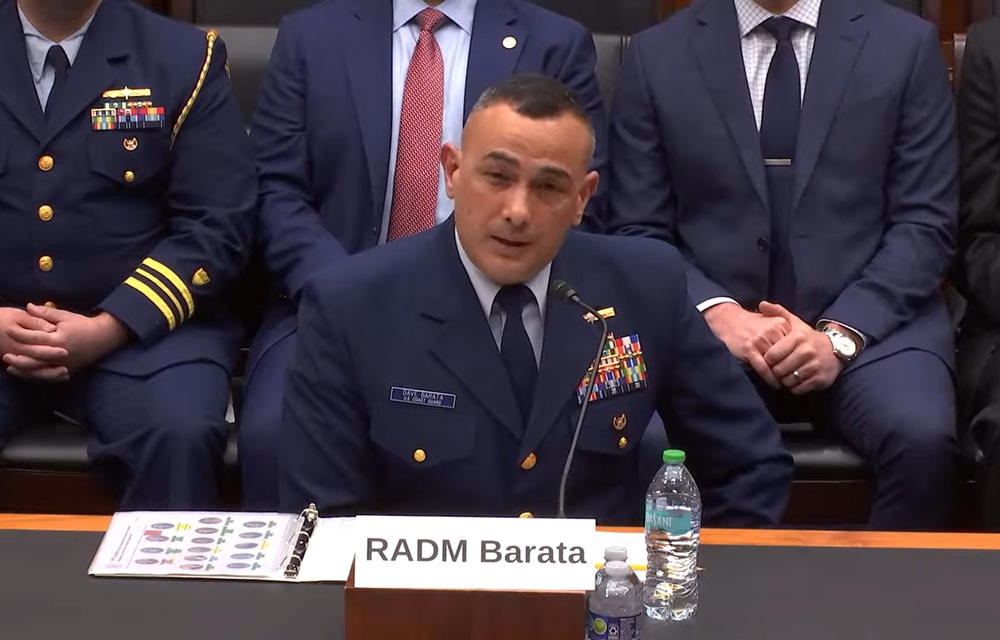
U.S. government officials told Congressional lawmakers the Coast Guard needs more vessels, personnel, and tools to prevent illegal, unreported, and unregulated fishing (IUU) in U.S. and distant waters.
“IUU is a threat to both the global economy and the U.S. economy. The illegal catch that is brought into the United States ... impacts the USD 150 billion [EUR 129 billion] that our fishermen bring to the global domestic product,” Rear Admiral David Barata, the Coast Guard’s deputy commandant for operations policy, testified to lawmakers during a 13 January House Coast Guard and Maritime Transportation Subcommittee hearing.
In his written testimony, Barata reported that IUU fishing costs USD 50 billion (EUR 43 billion) in lost global revenue annually.
A recurring theme of the hearing was the problem posed by China’s massive distant-water fishing fleet in particular, which has been heavily criticized for labor violations, environmental concerns, and undermining local fishing fleets.
“In 2020, the Coast Guard declared that IUU fishing replaced piracy as the leading global maritime security threat. IUU fishing robs nations of their fish stocks and their food, and it costs legal fishing operators tens of billions of dollars a year in revenue. China is the world's worst offender of this harm. The Chinese Communist Party provides billions of dollars in subsidies to its distant-water fishing fleet, which plunders fishing stocks worldwide,” U.S. Representative Addison McDowell (R-North Carolina) said in introducing the hearing, titled “Drugs, Thugs, and Fish.”
“From our standpoint, it's a very difficult issue to deal with,” Barata said. “As we look at the number of [vessels] that are out there, the distant-water [vessels], there are about 6,000 that we know were registered with China and almost 17,000 that we think are registered in other flags that are conducting this type of work.”
Barata told legislators that the Coast Guard needs more data to understand how those vessels are operating, especially in remote areas.
“In the far reaches of the Pacific, some of the things that we're going to need are ... satellite assistance in order to compare the location of those vessels against their actual location. Then, we're going to need data and artificial intelligence to kind of help us suss out which vessels are operating illegally,” Barata said.
Both lawmakers and Coast Guard officials claimed that the service lacked the resources it needs to successfully interdict and stop IUU fishing vessels. In her testimony, Heather MacLeod, the director of justice and homeland security programs for the Government Accountability Office (GAO), noted that delays in acquiring new vessels were a longstanding issue for the service.
“For example, the Coast Guard's newest cutters, the offshore patrol cutter and the polar security cutter, are intended to support law enforcement missions like drug interdiction and prevention of illegal fishing, but we found that combined, these two programs are billions of dollars over their initial cost estimates and years behind schedule,” MacLeod told lawmakers.
In addition to delays in acquiring new vessels, MacLeod noted that the service also remains below its enlisted workforce target.
“Despite its best efforts, the Coast Guard's ability to interdict drugs, aliens, and IUU fishing has long been hindered by a lack of resources and personnel. Through the USD 25 billion [EUR 22 billion] generational investment that Congress authorized in the One Big Beautiful Bill Act, we have helped change the tide with new vessels and aircraft coming online, but there is more to be done,” McDowell added.
The Coast Guard has long struggled to reach its interdiction goals in its IUU enforcement mission.
The U.S. Department of Homeland Security’s (DHS) Office of the Inspector General released a report earlier this year claiming the Coast Guard was not prioritizing its IUU mission. According to the report, the Coast Guard spent just 4 percent of its mission hours on IUU fishing in 2023 and 2024.
“In fiscal year fiscal years ‘23 and ‘24, the Coast Guard set its interdiction goal at 40 percent of the detected fishing vessels conducting IUU fishing within the U.S. exclusive economic zone [EEZ]. Each of those years, the service interdicted 21 percent of detected vessels,” U.S. Representative Rick Larsen (D-Washington) said. “Over the same period, the Coast Guard boarded and inspected 274 fishing vessels on the high seas or within the EEZ of a foreign nation, resulting in 75 violations. So, with more resources, I'm hopeful we can improve those numbers.”
Still, Barata highlighted the Coast Guard’s new policy of prosecuting Mexican fishers caught illegally harvesting red snapper and other fish from the U.S.'s EEZ. Prior to 2025, the Coast Guard simply processed the fishers and then sent them back to Mexico.
“We've had luck prosecuting some of those operators under the Lacey Act just in the last year alone. We're measuring the deterrent effect there, and what we have seen is that prosecuting and having some of these mariners plead guilty has had a deterrent effect in other locations,” Barata testified.
