


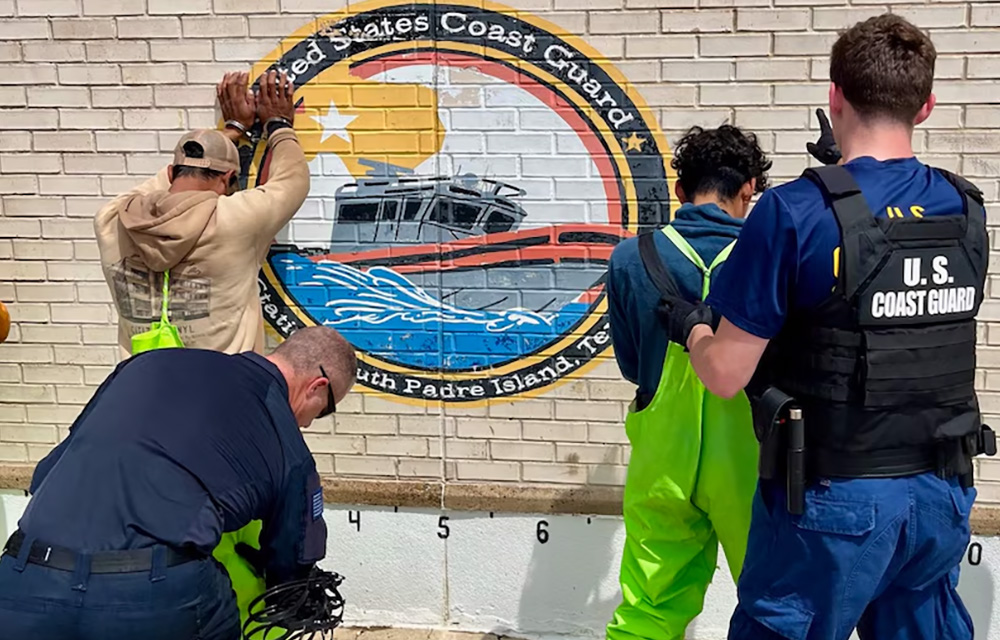
The U.S. Coast Guard reported interdicting 47 Mexican fishing vessels illegally operating in U.S. territorial waters in fiscal year 2025 – the fewest number in five years – after the government adopted a new policy of prosecuting individuals detained on those missions.
Despite the decrease in interdictions, the Coast Guard seized more illegally harvested red snapper than it has in any single year since 2021. According to a briefing given by Coast Guard LT Jackson Morton to the Gulf Council at its November meeting, the service seized 15,859 pounds of red snapper – a 28 percent increase over the 12,376 pounds seized in 2024, when the Coast Guard conducted 57 interdictions.
The Coast Guard frequently catches Mexican fishers illegally crossing the maritime boundary into the U.S.'s exclusive economic zone (EEZ) in the Gulf of Mexico, currently referred to as the Gulf of America by the U.S. government, on lanchas – small, slender vessels typically between 20 to 30 feet in length. The fishers are typically searching for red snapper, but they have illegally harvested shark as well, which they intend to bring back across the boundary into Mexico for sale. The Coast Guard has previously claimed that its cutters regularly recover miles of illegal longline each patrol of the EEZ.
The U.S. government has prioritized cracking down on the illegal fishing operations, which the Department of Treasury has linked to the Gulf Cartel of Mexico. In 2024, the department sanctioned five Mexican individuals it claimed were organizing the lancha missions into U.S. waters.
“The Coast Guard will continue to defend our maritime borders, uphold our nation's sovereignty and ensure that those who threaten the sustainability of our resources are held accountable,” the Coast Guard stated after its most recently publicized interdiction, which occurred in September. “The illegal harvest and trade of red snapper and other fish species is often a revenue stream for criminal organizations. Apart from their use for illegal seafood harvesting in U.S. waters, lanchas may also be used to move illicit drugs and aliens into the United States.”
The Coast Guard claims the number of lancha incursions it detected decreased in 2025 after the government implemented its new policy of recommending prosecution for Mexican fishers caught in U.S. waters under the Lacey Act. Previously, the U.S. government would simply send the fishers back to Mexico after destroying both gear and lanchas. However, the Coast Guard has reported that recidivism is an issue in the illegal red snapper trade, and in June, the U.S. Attorney's Office for the Southern District of Texas announced it was changing that policy.
“Any commercial fisherman now apprehended in U.S. waters caught violating the Lacey Act face potential fines and imprisonment,” the office said, announcing that four members of a lancha crew had already plead guilty.
Those fishers face a sentence of up to five years in prison and a maximum fine of USD 250,000 (EUR 223,669).
Morton reported that the Coast Guard referred six cases to U.S. prosecutors in 2025, and 11 of the 25 individuals facing prosecution in those cases pled guilty.
The Coast Guard’s decision to begin referring Mexican fishers to prosecutors was a direct response to a U.S. Department of Homeland Security’s (DHS) Office of the Inspector General report that accused the Coast Guard of not prioritizing its illegal, unregulated, and unreported (IUU) fishing mission.
According to its report, the Coast Guard missed its interdiction goals for the last two years while devoting only 4 percent of its mission hours to the IUU mission. The Coast Guard interdicted just 21 percent of foreign fishing vessels detected illegally operating in U.S. waters, boarding, and inspecting 274 vessels in a two-year span.
“Although the Coast Guard recognizes IUU fishing as one of the world’s top maritime security threats, its low interdiction rates and limited enforcement hours show a significant gap between the severity of the threat and the level of commitment required to effectively address it,” the Office of the Inspector General concluded its report.
The Coast Guard told the office that the low number of interdictions was due to a lack of resources and competing priorities. The report recommended that the Coast Guard conduct an analysis on improving Gulf of Mexico interdictions of IUU fishing vessels.
The report found that 98 percent of Coast Guard interdictions in 2023 and 2024 occurred in the Gulf of Mexico.
