


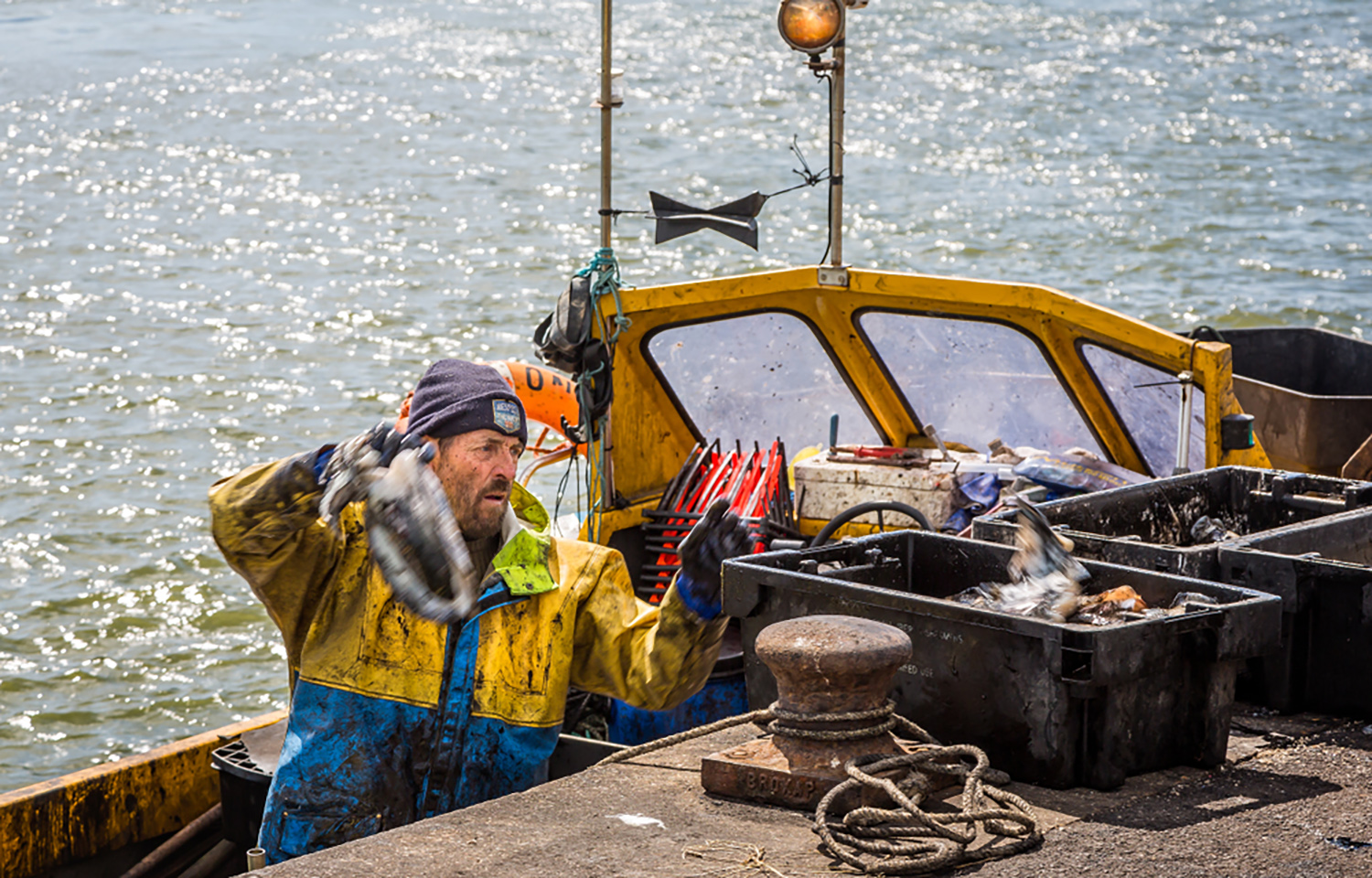
The U.K.’s seafood industry has begun taking steps to battle the effects of climate change.
But for the sector keep pace with the rapid pace of environmental changes brought on by global warming, focusing on factors like stakeholder behavior may be key, according to Seafish Head of Horizon Scanning and Long-Term Issues Angus Garrett, who is the co-author of a new report on the topic.
Titled “Climate change risk adaptation in U.K. seafood: Understanding and responding to a changing climate in the wild capture seafood industry,” the report intends to help the sector adapt to future climate-related challenges.
Researchers conducted their work for the study in 2022 and 2023, with around 30 seafood stakeholders engaging in the process by sharing data and opinions. The report’s primary focus is on climate-related impacts for species groups relevant to the U.K. market, namely whitefish, pelagic species, and shellfish.
Garrett told SeafoodSource that the U.K. seafood industry and its supply chain are now “reasonably engaged” with the shifting challenges of climate change, certainly more than they used to be.
“This engagement is not so much a result of experiencing dramatic impacts that may have arisen from a changing climate; such impacts tend to be slower-moving and very difficult to attribute to climate change,” he said. “Rather, engagement is driven more by the prominence of climate change in the media and political discourse.”
That engagement is going to become more essential, according to the report, as higher emissions in coming years bring greater consequences for the seafood industry through changes in sea level, larger storms and waves, shifting air and water temperatures, ocean acidification, and heavy bouts of terrestrial rainfall.
“A changing climate is highly uncertain, which makes it difficult for industry to invest and prepare for. In consequence, industry operators will tend to be more reactive, with responses delayed until impacts are much clearer. Seafood businesses recognize they’ll be affected by a changing climate in ways in which they’re unlikely to gain and have mixed views as to how far these changes can be anticipated,” the report said. “Seafood business concerns about a changing climate are nuanced and reflect their position in seafood supply chains. For example, catching sector concerns [mainly center on] fishing opportunities and the changing ranges of fish species, ports [are concerned about] the increased frequency of severe meteorological impacts, and processors [worry] about the challenge to responsible sourcing.”
In response to these potential impacts, the industry has already undertaken some adaptive actions, and further measures have been outlined.
For example, in U.K. capture fisheries, action has focused on enhancing fisheries science; ensuring flexibility in fisheries management regimes and governance; building port resilience and improving port risk management; assessing the vulnerability of fleets; and keeping a watch on a changing climate and industry response.
But further action is needed to address ongoing and emerging impacts, according to the report. For instance, action will be needed to further improve fisheries science and quota management, adopt safer fishing practices, improve port risk management, and contribute to local sea defense measures.
Longer-term action includes investing in a strategic fisheries knowledge base, ensuring flexibility in fisheries governance and management, understanding fleet vulnerability, instituting new practices for fishermen, investing in portside infrastructure, ensuring onshore capacity to handle changes in species, and improving the market perception of seafood.
On the U.K. sourcing side, independent stakeholder action over the last decade has mainly focused on understanding broad impacts in specific regions, but the report suggests within the next five years, there will be a need to understand changes to key regional seafood sources and their impact on supply. Additionally, the U.K. needs to prepare for more congested logistics in key source regions and routes, manage associated supply chain risks, and improve product acceptability for customers.
This all requires an uptick in funding, but which may be difficult to secure. Recent difficulties such as the Covid-19 pandemic and Brexit brought much-needed, targeted government funding to the industry, but it’s less likely this will be the case with climate change and will require some ingenuity to lock down.
“Climate change is a challenge influencing much of human endeavor and can be thought of as a ‘risk multiplier.’ Many of the existing challenges and opportunities the seafood industry engages with may be amplified by a changing climate,” Garrett said. “An example, readily grasped, is safety at sea; clearly, this may become a much greater challenge if storminess and extreme weather events become more commonplace. Likewise, new species moving into warming U.K. waters will introduce further impetus to ensure fisheries are utilized fully and managed responsibly, as well as efforts directed to creating markets for these new species. There’s nothing new about managing fisheries responsibly or encouraging consumers to consider new species. When looked at in this light, perhaps some of the resources available to help industry respond to this challenge are all around us. Rather than a dedicated climate fund, it might be more about using existing funds in a climate-smart fashion.”
Besides funding, regulatory arrangements that allow a “flexible and agile management regime” would support a much faster response and at a much bigger scale in the face of anticipated changes, according to the report.
Sectors better-placed to respond to climate change’s effects are likely large pelagic and whitefish operators in mainland hubs. These stakeholders may have higher adaptive capacity and lower vulnerability than those in diffuse sectors like shellfish, with smaller operators across disparate locations, the report found.
For international stakeholders, operators better able to respond to climate-related impacts appear to be those in pelagic and shellfish – and, to a lesser extent, whitefish – particularly vessels in offshore fleets and those with a mainland location with large operational and processing capabilities. In contrast, those that appear less able to respond – and consequently more vulnerable – are inshore vessels, those with an island location, and smaller operators.
“The more the world warms, then the more we can reasonably expect dramatic impacts. This will present opportunities as well as threats for seafood businesses,” Garrett said. “Louis Pasteur once said, ‘Chance favors the prepared mind.’ Amid the uncertainty, anticipating some of the changes ahead and the potential impacts should help prepare businesses. This will help better position businesses to manage impacts that do arise – taking advantage of the opportunities presented while averting the worst aspects of the threats.”
