






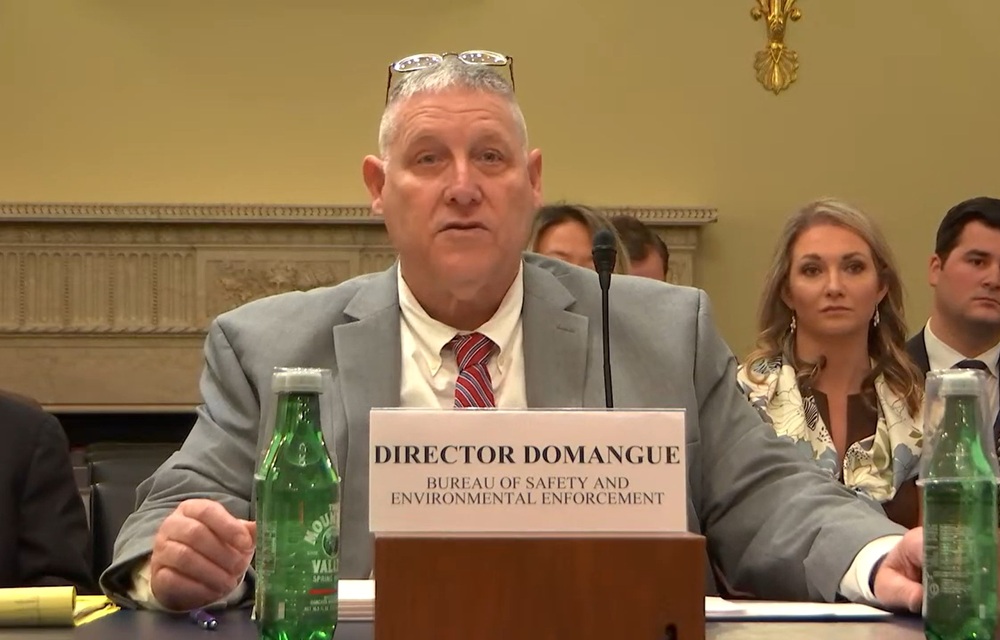
The U.S. House Committee on Natural Resources recently held a hearing on the Marine Fisheries Habitat Protection Act, which was introduced last year to overhaul regulations for transforming decommissioned oil rigs into artificial reefs.
While advocates presented the bill as necessary to eliminate red tape, other lawmakers accused it of weakening government oversight of gas and oil decommissioning in the Gulf of Mexico, currently referred to as the Gulf of America by the Trump administration.
Lawmakers from both sides of the aisle have supported the Rigs-to-Reefs Program, which enables energy companies to turn decommissioned rigs into artificial reefs that can continue serving as fish habitat.
“Within months of an offshore rig’s construction, marine life begins to gather on and around it. By the time a platform completes production, it has become a central part of the local marine ecosystem, hosting coral, various fish species and marine mammals, and more,” U.S. Representative Pete Stauber (R-Minnesota) said during the 13 January hearing. “These existing structures would otherwise cost millions of dollars to build from scratch. Commonly known as Rigs-to-Reefs, this program provides wide benefits to Gulf Coast states and fishermen by creating thriving marine populations while also providing critical funding for state conservation efforts.”
The U.S. has allowed energy companies to turn decommissioned oil rigs into artificial reefs since the passage of the National Fishing Enhancement Act in 1984. According to a Government Accountability Office (GAO) report, 634 platforms in the Gulf of Mexico have been transformed into reefs as of June 2023. Stauber and other advocates of the legislation argue that far more rigs should be transformed into reefs but federal regulations make it too difficult.
“Unnecessary red tape at the federal level is preventing the Rigs-to-Reefs Program from reaching its full potential. In fact, since 2000, most inactive oil rigs in the Gulf waters have been fully removed, disrupting habitats that support billions of dollars in annual recreational fishing activity across the Gulf Coast states,” Stauber said.
Stauber said the Marine Fisheries Habitat Protection Act would streamline the reefing process, codifying the Bureau of Safety and Environmental Enforcement (BSEE) as the lead agency for the Rigs-to-Reef Program. The legislation would remove multiple layers of review in the reefing process, allowing the bureau – in coordination with NOAA and the U.S. Coast Guard – to oversee the reefing process within three years. It would also allow states to assume liability for converted artificial reefs.
“This standardized process eliminates the need for lengthy, duplicative reviews across multiple federal agencies,” Stauber noted. “The bill also makes it easier for states and operators to reef the structures in place, avoiding towing reefs to planned areas which could disrupt the marine ecosystem.”
However, other lawmakers questioned whether the changes in the bill would reduce government oversight, removing key environmental safeguards.
“Unfortunately, this bill falls into a pattern that we’ve seen before from the majority, pushing legislation that they claim will have some benefit for the economy or our society, but no surprise, it’s really yet another way to subsidize big oil and leave the taxpayer holding the bag,” U.S. Representative Yassamin Ansari (D-Arizona) said. “This bill is an extreme waiver of responsibilities already. Instead of paying to clean up their mess, oil and gas companies have shifted billions in cleanup costs to the American taxpayer. Right now, over 75 percent of end-of-lease and idle offshore infrastructure is overdue for decommissioning.”
Ansari pointed to Government Accountability Office (GAO) reporting that the U.S. Department of Interior holds just USD 3.5 billion (EUR 3 billion) in bonds to cover USD 40 billion to USD 70 billion (EUR 35 billion to EUR 60 billion) in estimated cleanup costs.
“If the oil companies don’t pay for this, guess who will? The taxpayers,” Ansari said.
“When the inevitable happens, it is pretty hard to get big oil to live up to their end of the bargain – the obligation to clean up after themselves. In the Gulf of Mexico, there are 2,700 wells, 500 platforms, and 18,000 miles of pipelines left in the ocean that are either overdue for decommissioning or have simply been allowed to languish on the seafloor,” U.S. Representative Jared Huffman (D-California) added.
Similar legislation was introduced in 2023, but it was never taken up by Congress. Under then-U.S. President Joe Biden, BSEE raised concerns with how the legislation would impact government oversight of decommissioned oil and gas infrastructure. However, BSEE has come out in support of the current version of the bill, testifying that it would like to work with lawmakers on improving the proposal.
“BSEE supports the intent of the bill and would like to work with the sponsors on modifications to account for key coordination, implications, and opportunities,” BSEE Gulf of America Regional Director Bryan Domangue testified. “Technical assistance would aim to clarify authorities, liability, and cost-sharing timelines and enforcement and in balancing habitat enhancement objectives with multiple uses of the [Outer Continental Shelf] to ensure safe, efficient, and environmentally responsive reefing practices.”
