



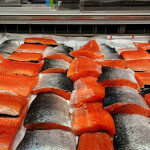



Though seafood consumption rates have dropped in the U.K., retailers that decide to overlook the category could be missing out on one of the most valuable shopper segments in the country, according to Sofina Foods Europe Director of Insights Iain Lowrie.
Speaking at the inaugural U.K. Seafood Federation (UKSF) conference, held recently in London, Lowrie said seafood buyers are “one of the most valuable shoppers you can have in your store.”
“A regular seafood shopper will typically spend GBP 1,000 [USD 1,337, EUR 1,152] more per year on their groceries than the average customer. That’s a GBP 1,000 bonus for every single shopper you can convert in-store to buy seafood,” he said. “The value of inspiring somebody to have a seafood occasion at home is much more valuable than some of the other categories. So, if you inspire somebody to eat seafood, not only does it benefit the seafood category, but it also benefits the entire store.”
Combining in-home and out-of-home consumption, the U.K. seafood market is worth an estimated GBP 7.6 billion (USD 10.2 billion, EUR 8.8 billion) annually. Of that total, out-of-home consumption accounts for around GBP 3.3 billion (USD 4.4 billion, EUR 3.8 billion), while at-home seafood consumption, which mostly comprises chilled and frozen categories, represents sales of GBP 3.6 billion (USD 4.8 billion, EUR 4.1 billion).
“To put that into context … when you take the total grocery spend, we are the 10th-biggest category overall,” Lowrie said. “It’s the second-biggest protein in grocery behind chicken and bigger than beef.”
While seafood has grown its value by over GBP 2 billion (USD 2.7 billion, EUR 2.3 billion) in annual sales over the past 20 years, according to Lowrie, consumption has gone in the opposite direction. Per capita, the drop since 2005 is approximately 13 percent, with U.K. consumers on average now eating 4.3 kilograms of seafood a year – around 600 grams fewer than 20 years ago.
Presenters at the conference highlighted that the drop could be attributed to several factors, including inflationary pressures, with many households increasingly unable to buy many of the available offerings and some dropping out of the category altogether.
“Seafood has become less relevant to a larger proportion of the population. Older generations are being inspired elsewhere, while seafood doesn’t feel very relevant to younger generations,” Lowrie said. “When I started back in 2001 at Young’s [Seafood], we were talking about how to inspire younger generations to come into seafood. While there has been some progress, we're still not doing it effectively enough.”
What’s key moving forward, Lowrie said, is to ensure that seafood appeals to the demographic of people under 28.
“These are the people we need to be inspiring for the future of our industry,” he said. “If we don't get these people to come into the category, in 20 or 30 years’ time, we won't have a seafood industry.”
To achieve this, Lowrie proposed a three-pronged industry approach.
The approach includes regaining and retaining the core older shopper demographic, then driving baby, child, and Gen-Z conversions into the category, and finally making seafood more relevant to more people.
“Thirty percent of all evening meals are inspired by some sort of global cuisine. We've got to think about how we can present seafood in different ways that capitalize on some of these trends,” Lowrie said. “We also need to make it achievable. We talk a lot about eating fish twice a week, while on average, people consume fish once a week. But, that's quite difficult for somebody who perhaps eats fish just once a year. The point is, if you eat fish once a year, just eat it twice a year. If you eat it once a month, eat it twice a month – just one more [occassion]. It doesn't matter how you engage in seafood; just think about doing slightly more.”
The Marine Stewardship Council (MSC) is targeting that exact issue through its “Buy Blue, Protect Dinner” campaign. Backed by such retailers and seafood brands as Tesco, Waitrose, Birds Eye, and Princes, the initiative aims to help younger consumers make small, sustainable choices.
“Sustainability has to be the foundation of any notion that we can increase seafood consumption up toward the [National Health Service’s] recommended levels of two portions a week,” MSC UK and Ireland Program Director George Clark said.
MSC has seen positive signs from Gen Zers in particular, he said.
“I think there’s some encouraging signs there – a real opportunity to capture the imagination of a generation who’s savvy about what they eat and their needs,” he said. “They are more health-focused and not shy about cooking fish, unlike the preceding generations. I think there's certainly a bright future ahead for fish and seafood.”
Restaurateur and CEO of the Rockfish restaurant chain Mitch Tonks said rebuilding demand also must entail reframing seafood’s value and getting consumers to appreciate products in a way in which they can accept it’s going to be a bit more expensive than other proteins.
“I feel that if we're going to have well-controlled fisheries, if we're going to have fishing boats that are up to spec, if we're going to have good control measures in aquaculture, there is a price to pay for those things,” he said. “I think the U.K. seafood industry needs to be quite bold. It's well-harvested here. It's beautifully farmed here. The cost of it reflects that, so we shouldn't shy away from it.”
For retailers in particular, Tonks proposed the creation of in-store “seafood centers” that bring fresh, frozen, and ambient offerings together, accompanied by complementary ingredients and manned by knowledgeable staff who can educate shoppers and make them aware there’s something available for a wide variety of taste preferences.
“By having it all in one place, you’ll give people wonderful choices,” he said. “Put it all together, and you create a seafood experience for people and a reason for them to embrace the category.”
