





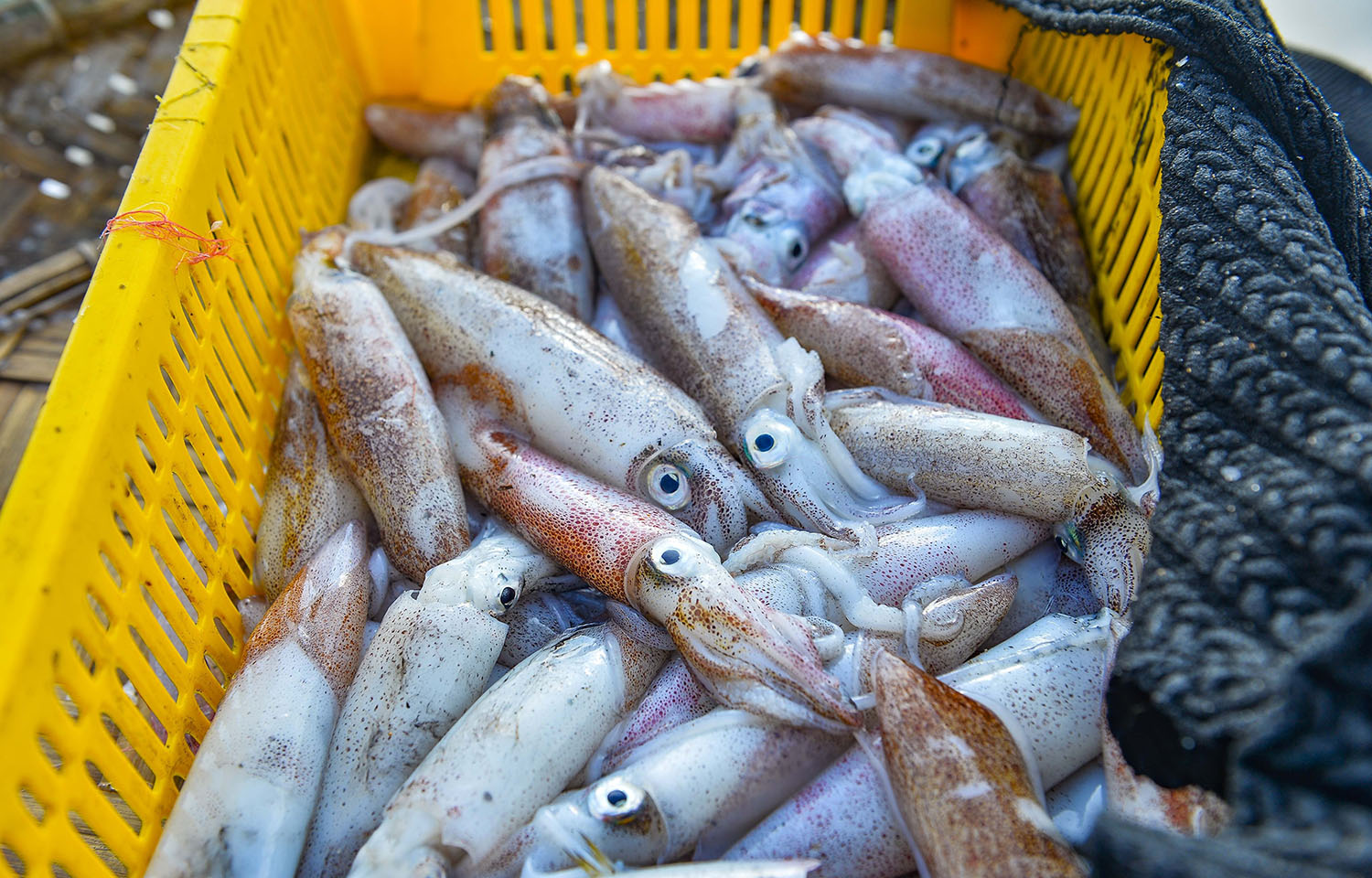
Scientists specializing in population dynamics, fisheries biology, and scientific assessment of fish populations recently met in Vigo, Spain for the fourth International Scientific Workshop on Argentine shortfin squid.
According to a release by the Sustainable Fisheries Partnership (SFP), the Argentine shortfin squid supports one of the leading South American fisheries in landed volume and is harvested by several fleets across the Southwest Atlantic. By holding this workshop, industry experts are able to extrapolate information gathered globally by fleets to create a single database for future scientific work.
Funding for the workshop came from the Spanish fishing sector – the Organization of Producers of Freezer Vessels for Hake, Cephalopods, and Miscellaneous Species (OPPC3). The organization aimed to advance the development of Argentine shortfin squid regional databases and gain more scientific knowledge of the species’ stock, productivity, and exploitation status, according to a release by SFP, who also provided facilitation support for the workshop. Prior to the 30 September – 2 October meeting in Spain, the groups organized workshops in Chile and Panama and a scientific meeting in Bangkok.
“The sustainability of a shared fishery requires the fleets operating on the resource to cooperate in improving the information available,” OPPC3 Managing Director Edelmiro Ulloa said. “In the case of [Argentine short squid], reducing uncertainty benefits everyone: companies, workers, public authorities, and scientists. This collaboration should not be understood as a threat to any fleet, but as an opportunity to build a common knowledge base and advance toward more responsible, predictable and sustainable management of the resource.”
SFP added that the fishery operates in a marine area with many countries and fleets, meaning there is no fully operational regional governance framework in place that’s consistent for managing the species effectively. The goal of the fourth-year conference is to encourage fleets and businesses to participate in information gathering under confidential safeguards to protect competitiveness while maintaining scientific accuracy.
“As an independent scientist who neither belongs to nor represents any of the nations participating in this fishery, I believe that we have a professional responsibility to contribute to generating the best possible knowledge of the population,” Scientific Group Chair Rubén Roa-Ureta said in a release. “That responsibility must remain separate from any political or jurisdictional conflicts that may exist between the countries sharing the ecosystem. From a scientific and ecological perspective, conserving this population is a shared responsibility.”
Additionally, SFP said the initiative to modernize and condense the database for this species requires coordination across the value chain, including fishery ports, logistics providers, commercial fishers, and seafood processing companies.
“This initiative does not seek to replace States or interfere with their competences, responsibilities or rights under international law,” SFP Director of Fisheries Governance and Livelihoods Pedro Ferreiro said. “Its purpose is to contribute, through science and cooperation among economic actors, to generating the information and trust needed for stakeholders to engage in dialogue and explore possible avenues of cooperation that could, in due course, contribute to regional management. Any progress in this direction must involve the participation and support of States.”
Recent reports by the Environmental Justice Foundation (EJF) showed allegations of labor violations within the fishery, and later reports connected those alleged violations to illegal, unreported, and unregulated (IUU) fishing. China controls two-thirds of the Argentine shortfin squid industry, while Argentina only controls a small percentage. Improvement projects to bettering the industry have been in the works for several years.
