

A new study, published by Mowi Canada West, has once again found an abundance of sea lice in regions of British Columbia where salmon farms were removed.
The monitoring program examined juvenile salmon in the Discovery Islands and in the Broughton Archipelago, areas where salmon farms were removed in 2022 and 2024, respectively. Targeting both juvenile chum and pink salmon, the study found sea lice were still prevalent in young salmon, at numbers as high or even greater than the presence was when salmon farms were still operational.
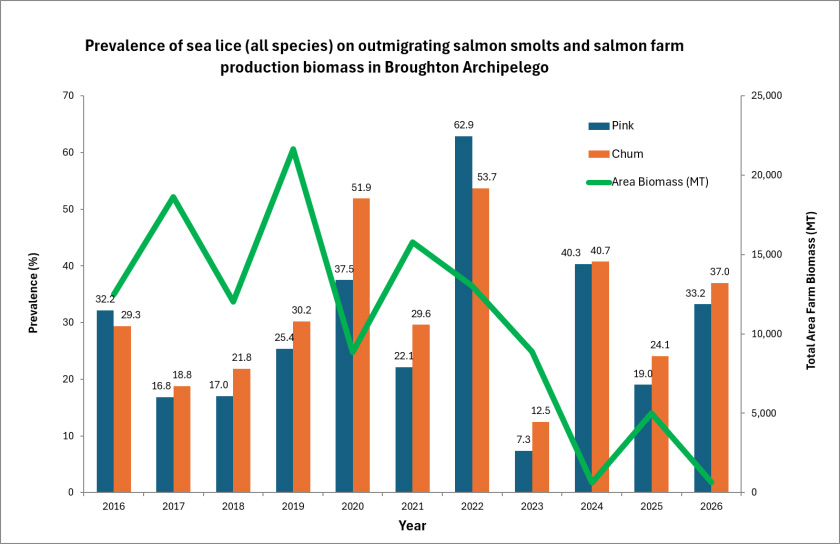
The Broughton study captured a total of 312 chum salmon, and kept 200 of those for laboratory analysis. That analysis found a total of 75 smolts infested with a total of 156 lice – resulting in a calculated prevalence of 37 percent. The study caught 5,361 pink salmon, representing more than 94 percent of the catch, and 292 of those salmon smolt were kept for further lab study. Of those, 97 were found to be infested, with a total of 170 lice across them – resulting in a prevalence of 33.2 percent.
Those figures are similar to, or worse than, when salmon farming was still permitted in the region, as sea lice prevalence in 2021 – a year when salmon farming was still ongoing in the region – were 29.6 percent for chum and 22.1 percent for pink salmon.
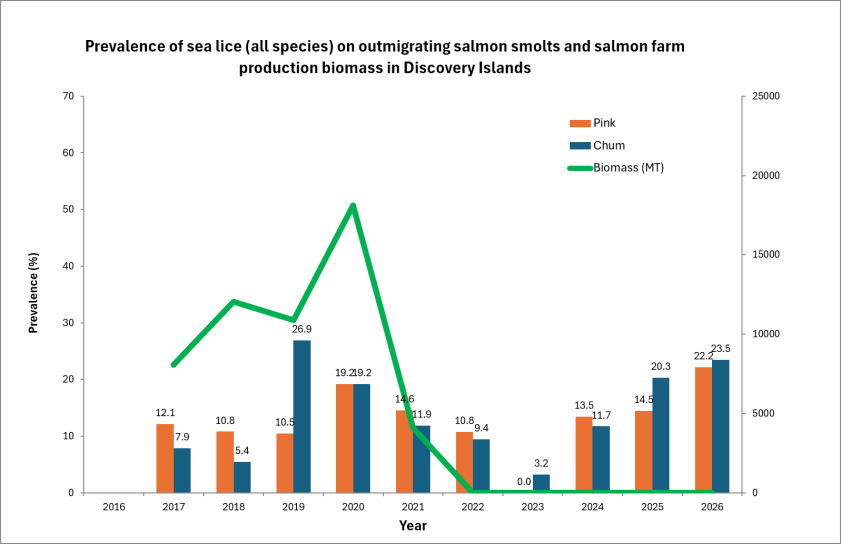
Data for the Discovery Islands is similar. In 2026, sea lice prevalence on wild juvenile pink salmon was found to be 22.2 percent, and prevalence on chum salmon was found to be 23.5 percent. Those numbers are higher than nearly every year from 2017 to 2022 – when salmon farming was permitted in the region – excepting chum salmon in 2019.
“The report adds to the growing body of evidence that salmon farms are not driving sea lice levels in wild Pacific salmon, challenging claims made by anti-salmon farming activists,” the BC Salmon Farmers Association (BCSFA) said in a release.
The study adds to the body of evidence the BCSFA has cited to make the case that salmon farming is not responsible for sea lice prevalence in wild salmon populations, even as salmon farming in B.C. continues to face a looming deadline of 30 June, 2029 – the date Canada’s Department of Fisheries and Oceans chose as the last day salmon farming would be allowed in the province. Even before that decision was made, the BCSFA cited a DFO study which found little connection between salmon aquaculture and sea lice on wild salmon, science which was later backed up by research in Norway.
Despite those arguments, DFO has moved forward with closures in regions of B.C., and farming in the Discovery Islands has been banned since a 2020 DFO decision to phase out farms in 18 months.
Since that time, more studies have been done of sea lice prevalence, and BCSFA has used the continued high levels of sea lice in salmon populations that likely never encountered salmon farms as evidence the prevalence is tied more to natural cycles and phenomenon than salmon farming.
“BC Salmon Farmers are committed to ensuring that salmon farms coexist with wild salmon in coastal British Columbia. Sea lice monitoring and innovation to ensure that sea lice levels on farmed salmon cannot spread to wild salmon are a critical part of operations,” BCSFA Executive Director Brian Kingzett said. “During a time of unprecedented economic instability and rising food costs, BC Salmon Farmers are ready to answer the call in support of the government’s National Food Security Strategy by producing more Canadian-made food for Canadian plates.”
