





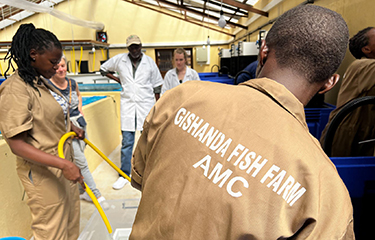
A new private sector-driven tilapia fingerling farm utilizing recirculating aquaculture system (RAS) technology has been unveiled in Rwanda, as part of a multi-organization effort to tackle key value chain investment barriers to aquaculture in the country.
The investment is being spearheaded by African Parks, a nonprofit conservation organization that manages Akagera National Park in Rwanda – Central Africa’s largest protected wetland. The group is working in partnership with FoodTechAfrica, a consortium of Dutch private companies, with the support of the governments of both Rwanda and The Netherlands. The new facility, dubbed the Gishanda Fish Farm, was commissioned on 18 October and is roughly 10 kilometers from the Akagera National Park’s main gate.
“The Gishanda Fish Farm illustrates the sustainable impact of public-private partnerships and the long-term benefits for the growth of the aquaculture sector in Rwanda,” The Netherlands Ambassador to Rwanda Matthijs Wolters said.
The farm will serve as an additional source of tilapia fingerlings and a training site to catalyze fish farming in Rwanda and across East Africa, a region that has identified inadequate supplies of fingerlings as one of the leading constraints to its fast-growing aquaculture sector.
“This fish farm will be a producer of quality tilapia fingerlings,” Larive International Marketing and Communication Manager Sjoerd van der Vlugt said.
The farm was co-financed by the SHV family of companies and the Netherlands Enterprise Agency (RVO). SHV’s subsidiary – Nutreco Middle East – and Africa, “will act as a key sponsor and feed partner for the aqua-farming activities," Gishanda Fish Farm said in a press release.
Currently, Rwanda’s supply of fingerlings comes from two main locations: Kigembe Fish Farm, a government-owned tilapia hatchery with a capacity of 10 million Nile tilapia fingerlings annually, and Lakeside Fish Farm, a private aquaculture firm based near Lake Mugesera, producing fingerlings for its own activity and for other fish farmers.
The new fish farm is expected to boost that production by between 1 million and 1.5 million tilapia fingerlings annually, of which 110,000 will be retained for Gishanda Fish Farm's own production.
“A high-quality strain of tilapia, the commercial sale of around one million fingerlings, will bolster the Rwandan aquaculture sector,” van der Vlugt said.
Between 300,000 and 400,000 fingerlings will be used to re-stock lakes in the region, generating locally viable sources of protein and economic growth on a national scale. At least 10 percent of the harvest will be devoted to combating local nutritional deficits, with the ultimate goal of boosting incomes in the country.
“Gishanda Fish Farm, and the RAS system of sustainable farming, embodies many of the principles that will enable Rwanda to achieve its long-term vision for becoming an upper-middle-income country by 2035 and a high-income country by 2050,” Rwanda Minister of Agriculture and Animal Resources Gerardine Mukeshimana said.
Another major purpose of the new RAS, and part of why the Akagera National Park spearheded its construction, is combating local poaching. Malnutrition and inadequate animal protein supplies has led to bush meat poaching in the area around Akagera.
“It may seem an unusual move for a conservation organization to be building and running a fish farm, but our goal at African Parks is to leave a legacy of sustainability, for both communities and wild places,” Akagera National Park Manager Ladis Ndahiriwe said.
Photo courtesy of Food Tech Africa
