






Lysaker, Norway-based biotech and krill-harvesting company Aker BioMarine continued its string of revenue increases in Q2 2023, but the gains were not enough to offset high fuel prices and higher production costs.
The company, which posted a net loss in FY 2021, reversed the negative trend in FY 2022 but has since been hit with shrinking margins. Fuel prices, along with higher interest expenses included in financial terms, resulted in a Q2 2023 loss – adding to a previous loss in Q1 2023.
The company posted revenue of USD 88.6 million (EUR 78.8 million) in Q2 2023, up 21 percent from the same period last year. Adjusted earnings before interest, taxes, depreciation, and amortization (EBITDA) were USD 21.5 million (EUR 19.1 million) for the quarter, on par with the USD 21.4 million (EUR 19 million) posted in the same period last year.
“Despite strong growth in revenue, EBITDA margins don’t fully mirror the sales development,” Aker BioMarine CFO Katrine Klaveness said.
The company's quarterly EBIDTA margin was 24 percent, compared to 29 percent last year, which it blamed on a higher unit cost for the company’s Superba krill oil product due to lower production at the company’s plant in Houston, Texas, U.S.A. and higher fuel prices.
The company also faced higher interest expenses included in its financial terms and higher debt, which Klaveness said was driven by high fuel costs and the completion of payments for a new protein plant in Norway.
The revenue increase was not enough to offset those increased costs, and the company posted a net loss of USD 2.4 million (EUR 2.1 million) for the quarter. Year-to-date, the company has lost USD 20 million (EUR 17.7 million), despite revenue of USD 157.8 million (EUR 140.3 million), a USD 27.5 million (EUR 24.4 million) increase compared to the same period in 2022.
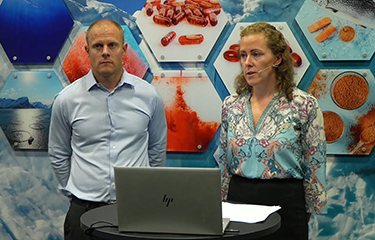
The flat EBITDA, Aker BioMarine CEO Matts Johansen said during the results presentation, was driven by three factors.
“Number one, is that we onboarded a large customer in the second quarter with a one-off investment to get them on board. Number two, the fuel prices in South America is extraordinarily high compared to Europe, driving costs for our aquaculture segment up, and number three, as we’re building down inventory of krill oil in Houston, we have limited production, and therefore it’s driving cost of goods for Superba up,” Johansen said.
The quarter was “eventful," Johansen said, as Aker managed to gain approval for its Superba krill oil product – a human health supplement – in South Korea.
“Now our customers and partners are preparing for going live to consumers in the Korean market,” he said.
The company also took delivery of an autonomous drone, which it plans to use in its harvesting operations. Johansen said the new drone will go into operation this season.
“It will help our fleet to make sure that we are at the right spot at the right time,” he said. “Both avoiding using the big fishing boats to search for krill, but also making decisions when fishing is okay where we are, but maybe it is better somewhere else.”
The company also finalized construction of its new protein factory in Ski, Norway on time and on budget, according to Johansen.
Aker achieved solid krill harvests in the quarter, with production up 9 percent year-over-year to 17,846 metric tons (MT). Johansen said harvests at the start of Q3 2023 have been solid thus far.
“Year-to-date, as of yesterday, we have produced almost 40,000 tons of product, slightly ahead of the same period last year,” Johansen said.
Johansen said the company is planning a switch to a new financial reporting structure. The previous reporting structure separated segments of the business into ingredients and brands, a move that was intended to help the company build its scale.
“Now, the time is right to do a different type of segmentation, and we’re going to divide Aker BioMarine into four segments or business units,” Johansen said.
The business will be separated into feed ingredients, human health ingredients, consumer health products, and emerging businesses, he said, with the intention of providing better transparency on profit and loss drivers.
“We have gotten feedback that it’s really hard to do valuation of Aker BioMarine because you really can’t find any peers that look exactly like Aker BioMarine,” Johansen said.
Dividing the business into new segments will also increase the company’s focus and strategy, and increase accountability for each segment’s results, he said. And the legal restructuring will allow greater flexibility for transaction on each business unit, Johansen said.
The company plans to start reporting in the new structure in Q1 2024.
Photo courtesy of Aker BioMarine
