





The manager of a leading Argentine red shrimp firm has said that Chinese investment has allowed his firm to expand its fleet and add more workers.
“Our sales volume continues to grow,” said Hugo Vence, CEO of Altamare SA, a shrimp and fishing fleet operator and processor based in Puerto Madryn, Argentina. Vence said the company has hired 393 more workers – 357 of them Argentinian – since state-owned Shanghai Fishery Group Co. bought Altamare in 2014 through its subsidiary Shanghai Jinyou Deep Sea Fisheries Co.
Since SFGC took over, the company has purchased three new vessels, the Huyo 960, 961, and 962, according to Vence. Additionally, the company has reinvested profits in expanding its cold-chain warehousing capacity.
“[Its] choice of investing rather than taking dividends is of benefit to the entire community of Puerto Madryn,” Vence said.
At the time of its Altamare purchase, during a boom period for Chinese overseas direct investment that has since cooled, SFGC said the acquisition was part of the company’s strategy to “go global” through acquiring fishing companies and resources around the world. Today, SFGC controls the Dongfang wholesale market in Shanghai and, in 2017, launched a range of seafood products in the ‘Lu Di’ (G-Super) chain of high-end supermarkets operated by Greenland Properties. SFGC also distributes its Long Men and Shui Jin Yang brands through Chinese supermarkets.
China is a major purchaser of Argentinian agricultural products and is also a creditor to the country’s government, having lent the country USD 17 billion (EUR 16.9 billion) since 2005. Earlier in 2022, China signaled it would invest an additional USD 23 billion (EUR 22.9 billion) for infrastructure projects in the South American country.
Vence’s interview was part of a video series on the topic of foreign talent at Chinese companies, produced by a group of Chinese media companies in conjunction with the Shanghai’s city government. Titled “How Foreign Workers See China,” the series features upbeat interviews with a wide range of international executives. Interviewees also describe their visits to China and affection for the country’s culture and economic growth.
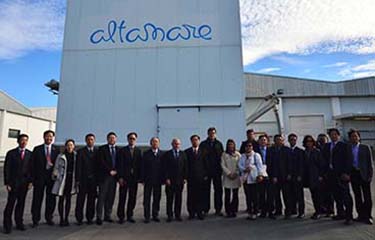
Photo courtesy of Altamare
