


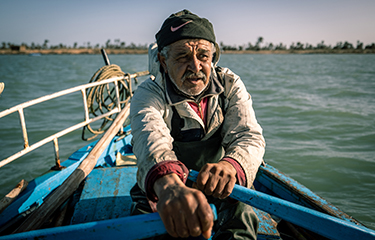
Scant enforcement of laws against illegal trawling in Tunisia is exacerbating marine seagrass erosion, damaging a habitat critical for marine life in the Mediterranean Sea.
To highlight this issue, the Environmental Justice Foundation (EJF), in partnership with FishAct, has released a detailed report showcasing rampant kiss trawling, a form of illegal bottom-trawling, in Tunisia’s Gulf of Gabes.
The gulf is home to large forests of Posidonia oceanica seagrass, more commonly known as Neptune seagrass, which is native to the Mediterranean and valued for the pivotal role it plays in safeguarding marine life.
The seagrass serves as an important nursery and habitat for many marine species including sharks, sea turtles, and commercially valuable fisheries in Tunisia and the larger Mediterranean ecosystem. Globally, seagrass such as Posidonia oceanica supports up to 20 percent of the world’s largest fisheries, with valuable species such as crab and shrimp using it as shelter from predators.
The EJF report claims that Tunisia has turned a blind eye to illegal fishing that involves use of vessels less than 10 meters in length operating in shallow waters. These vessels often discard up to 95 percent of their catch, according to the environmental non-governmental organization.
“These investigations make it clear that illegal bottom-trawling directly harms a critically important ecosystem in the Gulf of Gabes and the wildlife and people dependent on it,” EJF CEO and Founder Steve Trent said. “A sustainable way of life is disappearing, and the important role of seagrasses in sequestering carbon is seriously threatened.”
In the report, EJF and FishAct cite a 2020 study that estimated the economic loss from seagrass degradation in the Gulf of Gabes to be around EUR 60 million (USD 65.5 million) in 2014 alone. Cumulatively, the economic loss from diminishing coastal fisheries in Tunisia totaled approximately EUR 750 million (USD 819 million) between 1990 and 2014.
Despite kiss trawling being “one of the most unselective and destructive forms of fishing that has led to [the] disappearance of local traditions, economies, and rich marine habitats,” the report states, Tunisia and the E.U. – its biggest seafood export market – have ignored pleas for action to stop the practice.
Findings from the EJF investigation show that the number of kiss trawlers in Tunisia, a country with 1,300 kilometers of Mediterranean coastline, increased by one-third between 2018 and 2022, with artisanal fishers in the country now unable to compete fairly for available fish.
The report found that local fishers who use the traditional and unique charfia fishing method – a practice passed down generationally that features on UNESCO’s Representative List of the Intangible Cultural Heritage of Humanity – are giving up on the form of fishing due to disappearing fish populations in the Gulf of Gabes attributable to kiss trawling.
Exacerbating the issue, some of the fishers practicing charfia fishing and other artisanal fishers have opted to join in the illegal kiss trawling after seeing it flourish unabated in the Gulf of Gabes, EJF said.
Some of the same fish caught using this method may be on sale in E.U. markets.
“The fish caught by kiss trawlers is suspected of being laundered into legal supply chains, primarily in Italy and Spain,” the report says.
Japan, the U.A.E, South Korea, and the U.S. also import significant amounts of fishery products from Tunisia, according to Tunisian export statistics.
Trent said as seafood traceability efforts are improved and consumers continue to place increasing value on sustainably sourced seafood, he believes the time is now for Tunisian officials to act on eliminating illegal fishing in Tunisia.
“Tunisian, E.U., and General Fisheries Commission for the Mediterranean leaders must take action to protect the Gulf of Gabes now and ensure a just transition for impacted communities,” Trent said.
Photo courtesy of the Environmental Justice Foundation
