






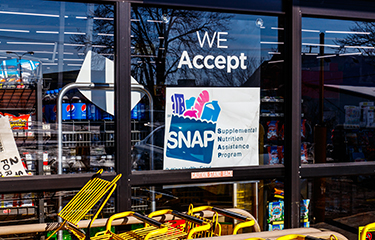
Already facing numerous challenges, U.S. seafood sales are expected to be further dampened by a rollback of Supplemental Nutrition Assistance Program (SNAP) benefits.
Emergency SNAP funding provided during the height of the Covid-19 pandemic ended in March in most U.S. states.. The expiration of emergency allotments is estimated to be a USD 40 billion (EUR 37 billion) headwind, equating to around a 20 percent decline per beneficiary, according to a new Numerator report, “Helping SNAP Consumers During Economic Headwinds.”
Around 41 million Americans receive SNAP benefits, and SNAP recipients account for 24 percent of total consumer products spending, the report found. When SNAP consumers utilize their benefits during a shopping trip, their basket is worth USD 15.00 (EUR 13.83) more and their spend per trip on groceries is nearly USD 18.00 (EUR 16.60) higher.
The cuts are expected to further dampen consumer spending power and will impact grocery chains including Walmart, which recently laid off hundreds of employees at its e-commerce fulfillment centers, according to Reuters. And, after announcing 18,000 layoffs in January, Amazon said it will eliminate another 9,000 jobs in the next few weeks.
Amazon is also closing eight U.S. Amazon Go grocery stores in Seattle, New York City, and San Francisco.
Retail and foodservice price inflation has now exceeded levels reached during the Great Recession, according to new data from Circana, formerly IRI and The NPD Group.
“Even with inflation currently moderating, higher food prices will continue influencing consumers’ spending and eating behaviors this year,” the research firm said. Food will always be consumers' priority in tough and good economic times, whether eaten at or away from home, it said.
“Inflation is affecting the shopping habits of the vast majority of consumers,” echoed 210 Analytics Principal Anne-Marie Roerink. “All categories are struggling with inflation taking a big bite out of consumers’ spending power.”
Seafood sales could be further dampened because “consumers don’t associate affordability with seafood – especially fresh,” Roerink said. “This, in part, also explains the strength of shelf-stable [seafood].”
As a result of inflation sales of all seafood product types dropped 5.2 percent to USD 548 million (EUR 505 million), while unit sales plunged 10.9 percent, according to Circana and 210 Analytics. Fresh seafood sales also declined 1.8 percent to USD 484 million (EUR 446 million), while unit sales dropped 4.9 percent.
While seafood is not seeing its prices rise as fast as other categories, any increase is still a negative for the category, Roerink said.
“A 5 percent increase on something that is USD 10.00 [EUR 9.22] per pound to start is more than a 10 percent increase on something that is USD 3.00 [EUR 2.77] per pound," Roerink said. "So, the gap between the protein choices can actually widen even though the rate of inflation may be favorable.”
Even though fresh produce, meat, and seafood have all had below-average inflation over the past year, they are still among the most-mentioned items by consumers when referring to grocery cost increases, according to Roerink.
“So it really becomes about underscoring value,” Roerink said.
But, while inflation is impacting seafood sales, other factors are at play according to Circana Food and Foodservice Industry Advisor David Portalatin.
“Price will always be important, but consumers define value differently. For example, consumers who visit a restaurant aren’t necessarily looking for the cheapest meal. They’re looking for the menu items they crave or foodservice outlets that offer quality and variety and enable them to treat themselves,” Portalatin said.
Consumers are constantly balancing price and other attributes, such as experience and enjoyment, which might lead them to buy a less-expensive private-label item while adding a higher-priced convenience or luxury item to the same cart, according to Roerink.
As a result, convenience- and trend-forward products such as sushi, bowls, and ceviche are rising in popularity, especially among younger customers, Roerink said.
“Fresh seafood in particular has very high engagement with [Baby] Boomers, but lacks engagement among millennials. As the grocery dollar is rapidly shifting from Boomers to Gen X-ers and millennials, that means automatically fresh seafood isn’t as well-positioned as other categories where millennials over index,” Roerink said. “This is why I love seeing all the innovation in sushi, bowls, ceviche, etcetera. That is the millennial take on seafood and they can very much be a gateway into greater seafood engagement in general.”
Circana Principal of CPG Client Engagement Cara Loeys said she expects consumers to manage high food costs in 2023 with the same behavior they used last year, like trading down to private-label items, buying in bulk, using more leftovers, shifting to value retail channels, and switching restaurant visits from full-service to fast-casual restaurants.
“One of the behaviors consumers have historically used to manage higher food costs is trading down. Consumers gravitate to larger pack sizes in the grocery store for a lower price per volume. They’ve also traded from premium to mainstay and value brands to get as much as possible without spending more,” Loeys said. “These behaviors are a correction from the pandemic when consumers, flush with cash, purchased premium grocery items.”
However, consumers are likely to get “frugal fatigue” and start to acclimate to the current pricing situation, indicating there is no need to race to the bottom of the price ladder, according to Circana.
Photo courtesy of Jonathan Weiss/Shutterstock
