






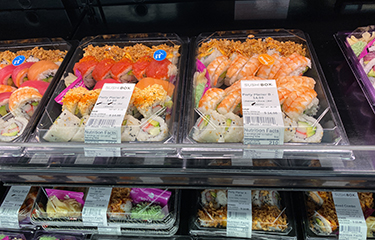
Americans are buying more sushi and fresh prepared seafood items from supermarket delis, but higher prices are pushing down unit sales.
Sushi sales at U.S. retail locations across the United States climbed 3.8 percent by value to USD 2.58 billion (EUR 2.4 billion) for the year ending 13 May, according to Nielsen data provided by Idaho Falls, Idaho, U.S.A.-based strategic insights company Category Partners.
In the most recent quarter ending 23 April, sales of sushi in U.S. retail outlets reached USD 563 million (EUR 525 million), up 0.9 percent year-over-year, according to Circana OmniMarket Integrated Fresh data.
“Sushi growth has been explosive over the past few years and certainly benefited during the pandemic,” Category Partners Senior Vice President of Marketing Eric Le Blanc told SeafoodSource. “Clearly, sushi has not reached the end of its growth trajectory, even though the total market is leveling off.”
However, sales by volume declined slightly over the past year as the average price per unit spiked 14.2 percent for the 12 months ending 13 May, according to Nielsen. Sushi now costs an average of USD 8.99 (EUR 8.39) per unit, Le Blanc said.
“That is the largest 52-week increase in average selling price since 2019-2020,” he said. “The price increase has caused some erosion in demand, with units down by 1 percent.”
Sushi, faced with comparable inflation to the aggregate of food-at-home inflation, is seeing demand destruction, according to Le Blanc.
“It certainly could be the case that shoppers are keeping tighter rein on their higher dollar purchases and are cutting back on the frequency of their sushi purchases for lower-cost alternatives,” he said.
At the same time, more stores are carrying sushi products, and the variety of sushi products available at retail are growing, 210 Analytics Principal Anne-Marie Roerink told SeafoodSource. Besides greater assortment, Roerink said U.S. retail sushi offerings are improving due to better production scheduling and improved flavors.
“Combine that with added assortment in poke bowls, ceviche, and more, and it is not surprising to see the enormous sales totals [in overall prepared seafood],” she said.
Generation Z and millennial customers are leading the growth in sushi’s popularity, Roerink said, providing retailers “a great way to get them involved with seafood but also a great way … to get these younger generations into the deli-prepared foods area of the store.”
Sushi has been the biggest seafood seller in delis, but sales of seafood entrees and salads have also grown. In the most recent quarter, seafood entrée sales jumped 7.2 percent to nearly USD 115 million (EUR 107 million), sales of seafood salads soared 13.5 percent to USD 13.8 million (EUR 2.9 million), and ales of seafood sandwiches rose 2.3 percent by value for the quarter ending 23 April. However, seafood salad and sandwich unit sales have declined over the past year, according to Roerink.
More U.S. grocery delis are carrying sushi items as a result of a trend of declining restaurant visits nationwide, combined with consumers finding more of the products they want at supermarkets, according to Roerink.
“Rotisserie and fried chicken rule the deli-prepared foods areas, but retailers that have added things like pork roast, ribs, or salmon to the assortment have seen robust growth, underscoring that protein variety is indeed something that can move the needle,” she said. “As seafood was a strong seller in restaurant foodservice prior to the pandemic, it is likely that some of those restaurant dollars moved to the retail deli instead.”
Delis are more frequently featuring seafood items with high household penetration such as shrimp and salmon, according to Roerink.
“Salmon is also versatile, much like chicken, where it can go on pasta, rice, etcetera. Those are the types of items retailers like,” Roerink said.
One of the biggest winners from rising retail sushi sales is Snowfox/JFE Franchising, which operates more than 2,300 sushi kiosks globally, including hundreds placed inside Costco and Kroger locations. Last August, Snowfox Group reported record sales of GBP 197.3 million (USD 244 million, EUR 228 million) in fiscal year 2021.
Another major U.S. sushi retailer benefiting from the trend is American popularity is Hissho Sushi, whose CEO, Dan Beem, recently told SeafoodSource sells 80,000 pounds of seafood weekly and more than 2,000 tons annually. The company supplies major grocery chains including Sprouts Farmers Market, Meijer, and Giant Food Stores.
Photo courtesy of Joni Hanebutt/Shutterstock
