






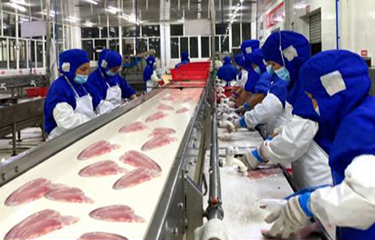
Chinese seafood processors are sounding the alarm over fears of a supply glut, labor issues, high inflation, and weak demand.
They’re claiming they have experienced potentially irreparable damage from the Covid-19 pandemic, from which some fear they might never fully recover.
David Jiang, managing director at Unibond Seafood International, which sources seafood in China for European customers, is predicting a dire outlook for the sector – a problem that will begin to heavily affect consumers later this year.
“High inflation and weak demand, compounded with high stocks in the E.U. and the U.S., have put a lot of pressure on every seafood processor in China,” he explained.
In particular, Jiang told SeafoodSource that production capacity in China for whitefish has “reduced significantly” – to half its pre-pandemic levels.
“If the situation is not improved by the fourth quarter of this year, there will be severe damage to the market supply as factory workers will go elsewhere, and there is likely an unrecoverable shortage of production capacity before the Chinese New Year of 2024,” Jiang said.
In response to the issues occurring domestically, certain companies have moved their production from China to Southeast Asian countries like Vietnam and Indonesia, according to Jiang. Thus far, he said, “the volume is not significant – maybe 5 percent to 10 percent,” but Jiang believes that problem could worsen if the situation doesn’t improve.
Chinese processors came under severe financial pressure during China’s pandemic lockdowns, with access to raw materials and workers constrained by the country’s efforts to control the spread of Covid-19.
Landy Chow, who manages the China office of trading firm Siam Canadian, said processors supplying his company have continued to report challenges post-pandemic.
“They lost quite [a lot of] money in 2022,” he told SeafoodSource. “In 2023, they are struggling, too. At this moment, the processors we talk to are running their factory at about 70 percent capacity as the demand from customers is weak in general.”
Oliver Nikolovski, the general director of China-based seafood sourcing firm Ocean Treasure, echoed the alarm, pointing to “the high quantity of raw material” that many processors have in storage with nowhere to sell it to.
China’s processing-for-export sector has also struggled to recover to pre-pandemic levels. Perhaps most significantly, China’s imports of fish from Russia – a traditionally essential supplier of whitefish for Chinese factories – have fallen off from 2019, slashing about 50 percent from 1.13 million metric tons (MT) in 2019 to half that figure in 2021, before recovering somewhat to 886,237 MT in 2022.
However, with some of that Russian product, China is reprocessing it and selling it to countries that have banned Russian imports, such as the U.S.
Even as many seafood processing companies continue to express concerns, some companies targeting the domestic market appear to be faring better, as there are niche pockets of demand throughout the country.
Anjoy Foods Group Co., which processes quick-frozen seafood products for restaurants and consumers, is projecting a 56.7 percent to 63.6 percent jump in profits for the first half of 2023, compared to the same period last year, on revenues of CNY 710 million to CNY 740 million (USD 99.4 million to USD 103 million, EUR 85.2 million to EUR 88 million). The company, which produces frozen meals in supermarkets nationwide, also benefited from a surge in at-home dining during the pandemic.
Anjoy’s success suggests that lower-priced products continue to sell well domestically as Chinese consumers, who are facing a gloomy economic outlook, tighten their wallets. China’s total retail sales – the data includes spending by governments, businesses, and households – grew by 3.1 percent year over year in June.
China has announced a new series of policies aimed at stimulating consumer spending, with the National Development and Reform Commission (NDRC), a policy-setting body within China’s central government, suggesting subsidies for consumers buying cars and electronic products. The NDRC has also suggested that local governments should offer subsidies for home renovation, as consumers remain wary of spending.
The Chinese economy is facing record levels of unemployment, especially among younger generations, weaker than expected GDP growth, and a general lack of innovative policymaking – regardless of the NDRC’s efforts – to pull the country out of its financial woes.
Photo courtesy of Tongwei
