




 Oregon shrimp
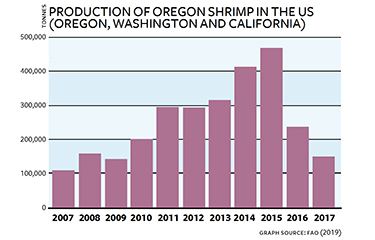
The Oregon shrimp – also known as Oregon pink shrimp – catch makes up almost 3 percent of the world’s catches of coldwater shrimp. Roughly 80 percent are landed in the U.S. state of Oregon, with some catches sprawled out in the adjacent states of Washington and California. Catches of Oregon shrimp reached a record high of 46,659 MT in 2015 but has since dropped sharply to only 15,145 MT in 2017.
Recent reports from MSC indicate that volumes have slightly increased to 20,048 MT in 2018, with large quantities of small shrimp. Catches are expected to improve further in 2019 and 2020. The annual catch landed at Oregon ports averages about 13,600 MT.
Survival is the name of the game in Oregon shrimp fisheries. Massive drops in landings were recorded in the last three years as supplies were affected by El Niño conditions in 2016 as well as the longer period needed for the shrimp to mature.
“When supply is low, fishermen shift to other fisheries, which also contributes to lower landings of shrimp,” said Andrew Bornstein, the vice president of Bornstein Seafoods.
According to the Oregon Department of Fish and Wildlife (ODFW), the abundance of Oregon shrimp, which have a four-year lifespan, is hard to predict because of the variability in oceanographic conditions.
Oregon shrimp fisheries are mostly dominated by onshore fisheries comprising of about 50 to 70 vessels. The Oregon shrimp fleet comprises of bottom or otter trawler vessels ranging in length from 11.5 to 32 meters, with an average length of 20 meters. Most vessels fish with double-rigged box trawl gear.
Onboard handling of the catch consists of emptying the trawl net cod ends into a hopper, conveying, sorting, and finally packing the shrimp on ice for transport to port. The shrimp are then usually processed, cooked, and peeled in processing plants before they are delivered into the main markets in the U.S. and western Europe.
