






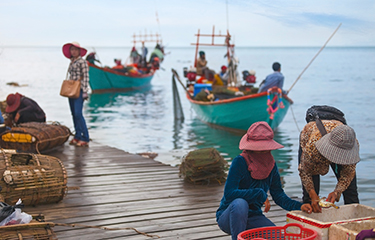
China’s customs body has signed protocols with the governments of Cambodia and Tanzania to allow wild-caught seafood from the two nations to enter China.
A statement from China’s General Administration of Customs said the protocol doesn’t cover live animals or wild species listed in the appendix of the Convention on International Trade in Endangered Species of Wild Fauna and Flora (CITES).
The seafood industry accounts for 8 to 10 percent of Cambodia’s gross domestic product, with wild-catch fisheries representing 13 percent of the industry’s sales. On Thursday, 8 December, the Asian Development Bank approved a USD 73 million (EUR 68.6 million) financing package targeted at improving the climate resilience and sustainability of coastal and marine fisheries in Cambodia, split between a USD 41 million (EUR 38.5 million) loan and a USD 22 million (EUR 20.7 million) grant.
"This project is ADB's first significant investment in marine fisheries and represents an important milestone for its Action Plan for Healthy Oceans and Sustainable Blue Economies," ADB Senior Natural Resources And Agriculture Specialist for Southeast Asia Alvin Lopez said in a press release. "It will help the country's four coastal provinces, including Kampot, Kep, Koh Kong, and Preah Sihanouk reverse the sharp decline in fish [abundance], promote sustainable mariculture, and enhance fish-landing sites to improve seafood safety.”
Lopez said the funding came in response to Cambodia’s strategic planning framework for fisheries development, which includes a plan to enact sustainable management, conservation, and development of marine fisheries resources.
"It is expected that under the project about 40 percent of the nearshore fishery will be regenerated into more productive and sustainable enterprises," Lopez said.
Climate change, hydropower projects, sand mining, deforestation, and wetland conversion – much of it taking place in China – have resulted in dramatic drops in water levels in Cambodia’s rivers, severely disrupting fishing and threatening food supplies for millions of its citizens, according to Reuters.
“Basically the entire system is under stress and changing,” WWF Freshwater Lead for Asia Pacific Marc Goichot said. “We need to address the root causes of those changes and reestablish the key processes like movement of fish.”
China has provided aquaculture training and support to both Cambodia and Tanzania as part of skills-for-market-access deals, which have resulted in increasing bilateral trade in recent years, including an uptick in exports of Cambodian basa fish to China, according to China Daily.
Photo courtesy of Lena Serditova/Shutterstock
