




Soon after NOAA released a report identifying China as one of several nations it alleges have habitually engaged in illegal, unreported, and unregulated (IUU) fishing, Chinese officials pushed back on such claims by bringing Beijing-based diplomats on a guided tour of fishery facilities in the southeastern province of Fujian.
In combination with the report, NOAA handed China – alongside Mexico and Russia – a negative certification for failing to properly combat IUU fishing activities. The certification could lead to import bans, as well as the U.S. denying the countries’ vessels access to American ports.
The report also identified fishing vessels from China and Vanuatu as allegedly targeting and catching sharks incidentally without a sustainable regulatory framework.
Environmental groups, including ocean conservation nonprofit Oceana, applauded the report, but called on the U.S. government to follow through by leveraging access to its vast market as a tool to force action against IUU activities committed by Chinese operators, who count on the U.S. as a top destination for their seafood exports.
“Oceana applauds the Biden administration for taking decisive action to fight illegal, unreported, and unregulated fishing, combat forced labor, and protect marine wildlife and key species like sharks,” Oceana U.S. Vice President Beth Lowell said. “All seafood sold in the U.S. should be safe, legally caught, responsibly sourced, and honestly labeled. NOAA taking action against countries that fail to follow the rules is one essential tool in the U.S. government toolbox to improve fisheries around the world.”
Responding to this public pressure, officials from China’s agriculture and foreign ministries guided diplomats from several African, Latin American, and Asian countries – including Angola, Somalia, Ecuador, Peru, Suriname, and Papua New Guinea – to “objectively evaluate” the way in which Chinese fisheries operate, according to Liu Xian Zhong, deputy director of the fisheries governance office at the Chinese Ministry of Agriculture and Rural Affairs. Zhong disputed claims of China’s involvement in IUU activities, stating to the diplomats present that some countries “don’t have enough knowledge of China’s distant-water fisheries sector, and some misunderstand it.”
Zhong then encouraged the diplomats to tell their governments what they’d seen in Fujian in the hope they will become “bridges” for fishery cooperation between China and third-party countries.
Also addressing the group, Can Jin Yan, the deputy head of the Maritime Boundaries and Ocean Affairs Bureau at the Chinese Ministry of Foreign Affairs, said China wanted to cooperate with other countries in ensuring effective fisheries governance and development while also combating IUU fishing.
The tour also aimed to establish business ties between Chinese companies and the countries present. The diplomats visited the headquarters of the Fuzhou Hong Dong Pelagic Fishery, a leading distant-water fishing company that has a large processing presence in Mauritania.
Suriname Ambassador to China Chong Pick Fung, who also goes by Zhang Bifen, has praised the “very standardized management” of Hong Dong, adding that such companies would be welcome to invest in Suriname.
The relationship between Suriname and Hong Dong stems back to at least 2021, when Hong Dong’s chairman and CEO Lan Ping Yong told Minyang News, a business paper covering the Fujian region, that he was looking at Suriname as a possible location for operational expansion after his company had heavily invested in neighboring Guyana, building a USD 25 million (EUR 21.4 million) prawn-processing plant in the country.
Following the tour, Chinese Ministry of Agriculture and Rural Affairs Deputy Minister Mu You Xiang met with Senegalese Fishery Minister Papu Sagena Mbaye in Beijing. Claiming that Chinese fisheries “have operated with integrity and are law-abiding,” Xiang emphasized that China aims to cooperate more with Senegal and offer expertise to the African country’s aquaculture sector.
Chinese provincial officials, also seemingly unperturbed by NOAA’s and others’ accusations, have appeared to double down on expanding China’s distant-water fishery operations. A representative from the Fujian Ocean and Fisheries Bureau said soon after the tour that the province planned to increase the number of vessels operating in distant waters from 450 to 650 without providing a time frame for the expansion. The province, the representative said, also aimed for an annual catch of 600,000 metric tons, with 65 percent of that total returning to Fujian for processing and consumption.
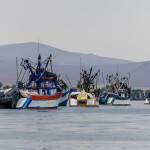
Photo courtesy of Fujian Foreign Affairs Department
