


Trout production in the far western Chinese region of Xinjiang has an advantage over imports and can ultimately supply eastern European markets, according to Zhang Yu Ru, the head of Xinjiang Tianyun Organic Agriculture Co.
Even China’s far-flung production bases producing trout (which uses the same Mandarin marketing appellation as salmon) have a proximity to the market that imports can’t match, said Zhang. Her company’s operations are located in Kalasu township in Yili, a prefecture bordering the central Asian state of Kazakhstan – nearly 2,500 kilometers from Beijing. Tianyun’s rainbow trout is shipped to Beijing by air – a five-hour flight from Xinjiang’s provincial capital of Urumqi.
“We can get to market in any Chinese cities from pond to market within 24 hours,” Zhang told SeafoodSource.
Because of this, Zhang said she believes her firm has a domestic market advantage.
“We have reduced a lot of middlemen. We have more advantages in price,” she said. “[And] our supply price and supply should be more stable.”
Likewise, Zhang sees a market for her salmon in central Asia and into eastern Europe.
“A small percentage of our production is exported,” she said. “We have an advantage in international markets, [as] our fishing ground is only 200 kilometers away from the Khorgos port, which directly connects to Europe.”
Khorgos, on the border between China and Kazakhstan, is the location of a major free trade park where traders from central Asia buy Chinese products. China has sought to expand railway links connecting its railway freight routes through central Asia to Europe.
“The product can be shipped to the European market in the same way as the domestic shipment, especially to Eastern Europe,” Zhang said.
Tianyun produces 6,000 metric tons (MT) of fish per year and will produce 15,000 MT by 2022, according to Zhang. It recently became the latest Chinese firm to achieve Best Aquaculture Practices certification from the Global Aquaculture Alliance (GAA). The certification is useful for domestic and export markets, Zhang said.
“[It] is certainly of great help to us, because the certification of aquaculture environment is very influential on a global scale, so customers are very confident in our product traceability system,” she said.
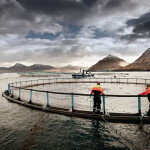
Photo courtesy of Xinjiang Tianyun Organic Agriculture Co.
