






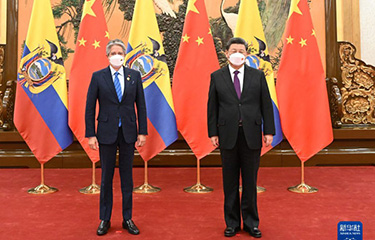
Ecuador hopes to sign a free trade agreement with China by December, even as the country has just secured a USD 1.5 billion (EUR 1.5 billion) restructuring of debt owed to Chinese banks.
Rumors of a bilateral trade deal have been floated throughout 2022, but Ecuador’s commitment to signing a FTA with China was confirmed by Ecuador Production, Trade, and Investments Minister Julio Jose Prado on 17 August, 2022, and confirmed by a Latin American trade source based in China speaking to SeafoodSource in mid-September.
Ecuadorian shrimp exporters have long called for a free trade deal with China so they can compete with seafood trade rivals such as Vietnam, which enjoys favorable trading status through the ASEAN bloc. Chile and Peru also have negotiated free trade deals with China.
China, which has been a major buyer of Ecuadorian oil, bought 59,800 metric tons (MT) of frozen warmwater shrimp from Ecuador in July 2022, according to Chinese customs, out of a total import volume of 93,000 MT for the category. India supplied 16,000 MT of that total, while Vietnam supplied 6,500 MT.
A free trade deal will further integrate Ecuador into China’s orbit, alongside other countries which have borrowed heavily from Chinese lenders, such as Pakistan and Venezuela. Argentina, Pakistan, and Sri Lanka have borrowed a combined USD 32.8 billion (EUR 32.8 billion) from China since 2017, according to AidData, a research lab at the College of William and Mary.
China, which has sought to position itself as an alternative financing option to international lending institutions like the International Monetary Fund, has in recent months been arranging restructuring of USD 838 billion (EUR 852 billion) in loans handed out as part of china’s Belt and Road Initiative. This practice has brought diplomatic wins for China, with Muslim nations like Pakistan remaining silent on the issue of Uyghur rights and the Solomon Islands and Kiribati switching diplomatic ties from Taiwan to China.
Western officials have pointed out that Chinese loans and lending practices lack transparency and act as levers by China for diplomatic support from debtor nations. This has implications for Latin American nations like Ecuador that have suffered incursions into their territorial waters by China’s disant-water fishing fleet.
China has a track record of using trade access as a political weapon: A free trade deal with Canberra didn’t prevent China from slapping various non-tariff barriers on Australian goods, including rock lobsters, when political relations soured in 2020.
Photo courtesy of Ministry of Foreign Affairs of the People’s Republic of China
