


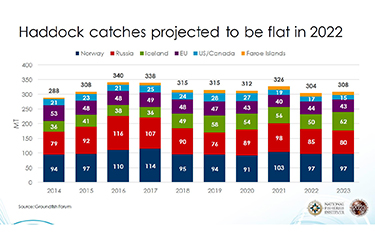
The global supply of haddock in 2022 held at just over 300,000 metric tons (MT), and the supply for 2023 will likely remain at that level as well.
Global catches of haddock have remained relatively flat over the last several years, with the highest catch total at 340,000 MT in 2016, and the lowest catch occurring in 2014 at 288,000 MT. Groundfish Forum predictions shared at the National Fisheries Institute Global Seafood Market Conference – held from 15 to 19 January in La Quinta, California, U.S.A. – indicate that the 2023 catch will be roughly 308,000 MT.
“We see very little change in the catch from 2022 to 2023,” Genuine Alaska Pollock Producers Director of Industry Relations, Partnerships, and Fishery Analysis Ron Rogness said during a panel on whitefish.
The United States is a significant market for the species, with the country taking in 19,700 MT of twice-frozen haddock and 3,800 MT of single-frozen fillets, for a total of 23,500 MT. The U.K. market purchased 15,900 MT of single-frozen fillets and 9,600 MT of twice-frozen fillets, for a total of 25,500 MT.
“The U.S actually is a more-substantial market for frozen haddock fillets than it is for cod,” Rogness said. “Overall, it’s split in terms of the market size.”
In 2022, a large amount of product came in to the market thanks to uncertainty regarding certain tariff exclusions. The Sino-U.S. trade war, launched by former U.S. President Donald Trump, resulted in the U.S. placing a 25 percent tariff on many goods. However, haddock was on a list of United States Trade Representative exclusions.
Its exclusion was extended in March 2022, but the end date of that exclusion was set at 31 December, 2022, so companies worked to get haddock products imported prior to the imposition of the tariff. However, the exclusion was subsequently extended until September 2023.
According to the GSMC whitefish panel, the U.S. could face a potential shortage of frozen-at-sea haddock in 2023 due to the U.S. placing a ban on Russian seafood. Norway and Iceland, which could make up the difference, have instead increased fresh production in response to demand from the U.K.
Image courtesy of Groundfish Forum/National Fisheries Institute Global Seafood Market Conference
