



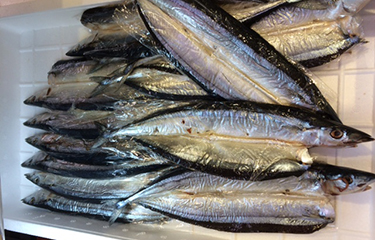
The Japan Fisheries Agency is forecasting a poor catch for the upcoming Pacific saury season, though it is expected to exceed that of 2021.
The 2022 Pacific saury season will run from August through December in east Hokkaido and Northeast Honshu Island. The forecast, compiled by the National Institute of Fisheries Resources, of the Japan Fisheries Research and Education Agency, reported fish will likely be on the small side this year – mainly averaging 100 grams, compared to the 100- to 110-gram fish caught in 2021. The prediction is based on a survey using trawl catch tests and a forecast of ocean currents, as saury are typically carried along the southward-flowing Oyashio Current, which varies from year to year.
For 2022, the agency is predicting that instead of saury being carried directly south by the current to the coast of Hokkaido, after October, the current will carry them southeast to the border of Japan's exclusive economic zone (EEZ) and the adjacent high seas. Schools of saury are then expected to migrate southwest by a branch of the current to waters off the Sanriku region of northeast Honshu Island around late October – a month later than usual, likely due to climactic and other factors.
When the saury spend a longer time on the high seas, they are more likely to be caught by Chinese and Taiwanese vessels that operate there. Japanese vessels can also fish the high seas, but as the Japanese saury fishery is shore-based, it would require long trips back and forth from the fishing grounds, with high fuel expenses cutting into profits. Tensions with Russia also make Japanese fishermen hesitant to pass through the Russian EEZ on the way to the high-seas fishing grounds – even though such “innocent passage” is allowed by the rules of EEZs.
As a result of the predicted low catch and low inventories of last year’s catch, current high prices for Pacific saury are expected to continue.
Japan’s Pacific saury catch volumes have been on a steady decline. From 1990 through 2009, catch volumes of 200,000 to 300,000 MT were common. This declined to around 100,000 MT for a few years from 2015 the 2018 and fell three years running from 2019 to 2021. The current forecast would break the streak of three consecutive years of record lows, though the level would still be historically low.
Photo by Chris Loew/SeafoodSource
